Showing posts with label 1940s. Show all posts

Friday, September 7, 2012

Orwellian syntax

he title of this post is a little iffy, but I think it works in a couple of ways. First, the content here is by George Orwell, therefore is by definition Orwellian, right? Secondly, his proposed overhaul of the English language (which we'll get to as soon as I'm done justifying and rationalising) is a bit on the totalitarian side, ergo, Orwellian. And uh, Thirdly... thirdly... oh yes, his criticism of the current state of prose essentially compares it to the sort of meaningless catchphrases found in 1984, where words cease to have any relation to their meaning and generally cause the downfall of civilisation as we know it.

That pretty much sums it up, actually, but a little context: I've just read George Orwell's essay on Politics and the English Language. The essay alternates between lambasting several samples of [truly lousy] writing and prescribing a few guidelines to avoid further transgressions. It was written in 1946, so we can only imagine how pained Orwell would be to see the current state of the written word (probably including my own. erk.). I bet he and Hemingway would've gotten along in some ways...

And now, for my own reference and for yours, George Orwell's basic rules for passable writing:

(i) Never use a metaphor, simile or other figure of speech which you are used to seeing in print.
(ii) Never use a long word where a short one will do.
(iii) If it is possible to cut a word out, always cut it out.
(iv) Never use the passive where you can use the active.
(v) Never use a foreign phrase, a scientific word or a jargon word if you can think of an everyday English equivalent.
(vi) Break any of these rules sooner than say anything outright barbarous.

Taken from the essay Politics and the English Language, 1946, page 156 of George Orwell, A Collection of Essays, Harcourt Brace, 1981. 

Friday, November 18, 2011

Books read in Chincoteague (1 of 7): Catch-22

s I finally wrapped up the last chapters of Catch-22 and went to enter this triumph in my book log, I discovered that I had begun this one not just months ago, but last November. Horrors, that I had left a book neglected for so very long, thinking that I wasn't in the mood for it, not giving it a chance. Well, to be fair, I probably wasn't in the mood for it, nor would I ever have been, but finally, on the porch swing overlooking the marsh, I at least felt comfortable enough to forge my way through the latter third of Catch-22 without going crazy myself.

Having been told by two reliable sources that this was a hilarious read, full of wit and whimsy, albeit dark whimsy, I figured I ought to at least give it a chance, read the whole damn thing and be able to reflect on it. Having done so, I'm glad I did, but the journey was one of the most depressing I've been on, stretching thin my last shreds of faith in a decent world.

Anyway, horrifyingly obtuse and, yes, hilariously conniving as Colonel Cathcart and Milo are, clearly this is a pretty good book because it did _get to me_. And I did understand Yossarian's plight, the desperation and the confusion, the fear that the world really is nuts, that this must be some deep level of punishing inferno, and the emotional grasping at what few friends could be found in the midst of war.

cavern, catacombs, McMillan, sand filtration, Washington, DC, underground, columns

What spun me for the greatest loop was the ending. I guess I shouldn't say here, (oh, heck: SPOILERS!) but it didn't seem in keeping with the rest of the book. In fact, I was so thrown by the ending that I felt certain I missed an important detail and Yossarian was deep into some fever dream, or was heading off for the promised land. The entire last two chapters or so took a sharp left and nearly tossed this passenger out around the curve. I suppose I'm glad it ended the way it did, with a hope for the future, an open ending and striking out for a new world. All is not lost, life goes on, "persevere."

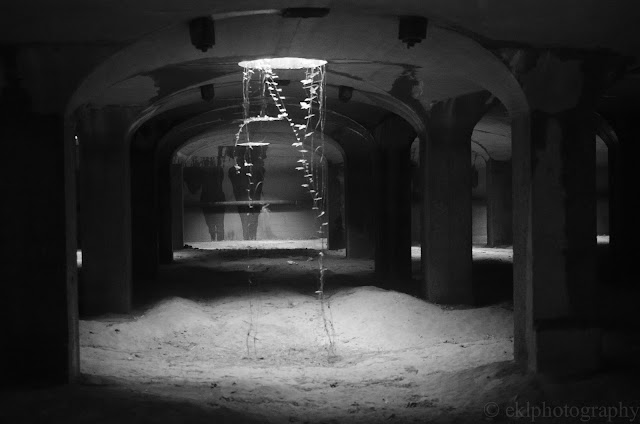
Not sure the photo is relevant, but since I didn't have anything that really is... this underground catacomb is from an exploration of the old McMillan sand filtration site in NE DC I did with DCUrban Explorers in late October.

This review also appears in part on LibraryThing.

Monday, April 18, 2011

Quotations, photos and ponderings, all. at. once.

    "You can live a lifetime and, at the end of it, know more about other people than you know about yourself. You learn to watch other people, but you never watch yourself because you strive against loneliness. If you read a book, or shuffle a deck of cards, or care for a dog, you are avoiding yourself. The abhorrence of loneliness is as natural as wanting to live at all. If it were otherwise, men would never have bothered to make an alphabet, nor to have fashioned words out of what were only animal sounds, nor to have crossed continents — each man to see what the other looked like. 
     Being alone in an aeroplane for even so short a time as a night and a day, irrevocably alone, with nothing to observe but your instruments and you own hands in semi-darkness, nothing to contemplate but the size of your small courage, nothing to wonder about but the beliefs, the faces and the hopes rooted in your mind — such an experience can be as startling as the first awareness of a stranger walking by your side at night. You are the stranger."
  Beryl Markham, West with the Night.


I already posted a passage from West with the Night, but since that was specifically relevant to the airplane post, here's a little more about the book itself: Generally, West with the Night is a ruminative, verbose, sweeping memoir that covers three notably distinct parts of Markham's life. After writing herself into the narrative, she takes the reader through her childhood, hunting lion with African locals, to leaving home and training race-horses, and finally to her career as a freelance pilot. 

So much of the book draws its strength from descriptions of people and places that the silence felt in the above passage is as startling to the reader as it is to Markham. The change from lengthy, illustrative passages about the African landscape and the characters who occupy it to the breathless and fleeting few paragraphs articulating her personal experience of flight parallels her assertion about loneliness. Most everything we do in our day-to-day lives is engineered to keep us from noticing that we are really very alone in the world, thus we keep self-awareness to a minimum in the interest of maintaining sanity. Even when physically alone, humans go to great lengths to avoid confronting themselves, whether by immersion in external stimuli, abuse of a substance, or simply by locking away their thoughts in a mental prison and living in denial of themselves. 

In conclusion, but not really to conclude this ongoing train of thought, West with the Night was an inspiring memoir not just in terms of tangible accomplishments and admirable writing, but in the additions Markham's personal philosophy made to my own modus operandi. Someday, I hope to meet myself.

Photo is of the Potomac River near Theodore Roosevelt Island, April 15, 2011.

Saturday, April 2, 2011

...I flew a plane?

Looks like I neglected to post anything for an entire month despite the pile of saved drafts I have going here. eh heh.

A few years back I made a quick list of Life Goals for myself. Being in college at the time, they were pretty basic things: live in one place for more than four months (e.g. not a dorm), learn basic car maintenance, learn to fly an airplane.

Last Friday I made a step the right direction and took the pilot's seat in a Cessna 172 for a 30 minute flight over Gaithersburg, MD. Ok, I didn't entirely fly the plane, but it was pretty gosh darn exciting (and a little terrifying) to be steering a dinky aircraft at 2500 feet. The best part was takeoff. My co-pilot/instructor handled the throttle and details, while I pulled back on the yoke and actually got the plane off the ground. Causing yourself to suddenly become airborne is distinctly thrilling.


Anyway, as exciting as that was, the experience made it very clear how much there is to learn (and how much it would cost to learn it). As accompaniment to this adventure I've also been reading Beryl Markham's memoir, West with the Night. While it is ostensibly and primarily a book about flight, Markham also covers encounters with lions, racing horses and much else about living in Africa in the early 20th century:

Tom taught me in a D.H. Gipsy Moth, at first, and her propeller beat the sunrise silence of the Athi Plains to shreds and scraps. We swung over the hills and over the town and back again, and I saw how a man can be master of a craft, and how a craft can be master of an element. I saw the alchemy of perspective reduce my world, and all my other life, to grains in a cup. I learned to watch, to put my trust in other hands than mine. And I learned to wander. I learned what every dreaming child needs to know — that no horizon is so far that you cannot get above it or beyond it. These I learned at once. But most things came harder.

For a couple more photos, visit my picasa collection.

Wednesday, February 2, 2011

Book Snark: Earth Abides

Perhaps, he felt in his mind, that was the difference! That was the difference between woman and man. She felt only in terms of the immediate, and was more interested in being able to spot her child's birthday than in all the future of civilization. Again, he felt superior. 
Earth Abides, by George R. Stewart (1949).

In fact, in reading this book about the fall of civilization, I am possessed by a great urge to preserve and protect the history of the world for posterity, just in case something should happen. If humanity vanishes for whatever reason, and/or if electricity eventually fails, what will be left? ebooks? I certainly think not. While electronic formats may be "the future," may be convenient, may be efficient, they will not last beyond the next wave of advancements. Neither will mp3 files, dvds, or all the information on the internet. In this fantastic future world, when perhaps everyone will be gone, those who are left, or those who make a galactic archaeological dig of the planet Earth may find files that are in no way compatible with their technology, or they might find vast libraries of knowledge on paper, which have only to be translated.

Earth Abides was a fantastic book, but in the end very frustrating. It became evident that it was not just the aforementioned woman who was uninterested in preserving civilization, but all of the "stolid" people who happened to survive the plague. Apparently it was beyond their capabilities or caring to teach their children how to read or write so much as basic numbers, much less entire books. Strange that in a novel about a post-apocalyptic world that was what I found most unbelievable.

The future may be defined by forward movement, but that movement should not assume complete abandonment of the past.