Showing posts with label memoir. Show all posts

Friday, May 17, 2013

Book review: Gaining Ground by Forrest Pritchard

B
efore I begin my review of Gaining Ground, allow to me to make a quick disclaimer: I am not an objective reader. In fact, I have worked for Forrest at farm markets every weekend for over a year now, in rain, snow, wind, thunder and tourist season. Before Smith Meadows came into my life I was largely vegetarian in order to avoid sponsoring the horror stories I read about the papers and books like Omnivore's Dilemma and Deep Economy. Then, through a boyfriend's friend's sister's best friend I found Smith Meadows, the perfect local farm with all the practices and principles an idealist could hope for.

Forrest Pritchard is Smith Meadows' farmer, its steward and practically a part of the soil he has worked so hard to nourish from the sad state it was in after years of overuse. As it turns out, lush pasture is easily achieved through a combination of patience and well planned herd rotation, switching between cattle, pigs, chickens and sheep, letting each fertilize and refresh the soil in turn. "Easily," of course, is a relative term when one is reading about it all from a comfy chair with a nice cup of tea.

In truth, it took not only years of hard work but decades of failure for the Pritchard family farm to turn around and produce a profit (as well as valuable land, animals and a sterling example of good farming practices). Gaining Ground recounts the journey Forrest took his entire family on when he realized that farming might be more of a calling for him than teaching (though writing is clearly still in his repertoire). As a bit of a book connoisseur, I did note that the book itself has a good looking, glossy cover, the text is printed clearly on nice feeling paper and the photos are incredibly helpful in placing the reader right there on the farm.

Gaining Ground has a good flow that kept me impatient to turn the page for the next adventure or roadblock, even though I knew exactly how it turned out. Forrest's anecdotes are sometimes touching, often hilarious, and range from rampant hogs to very confused market customers to a couple of completely baffling exchanges with a butcher. Pedro the goat, for instance, accompanied by Travis the humming farmhand, has a highly amusing adventure with some marigolds, in true goat-style.
Book cover, plaid-clad farm in field with cows. moooo.
As somewhat of an insider, I also know that there is a lot left out of this 317 page book. There were more adventures with goats, some ducks, more about Nancy's pasta business, a food truck and many more humorous stories from market and the farm. One hopes there will be a second book in the works... I, for one, would have enjoyed the inclusion of Forrest's other writing, perhaps the poetry he mentions sending off to literary magazines early on. The book stands at the right length and breadth to be a reasonable and fun read (One of Publishers Weekly's top 10 summer reads in nonfiction), though the prose could have dug a little deeper into the emotional underpinnings here and there.

The other members of the family receive occasional mentions, but the elder Mr. Pritchard has a fair share of the spotlight as he does his best to support his harebrained son through the snafus and disappointments of starting his free-range, grass-fed meat business. Mr. Pritchard's declining health provides a backdrop that Forrest puts to use in framing the problems with the commercial food industry and how we think about food in terms of cost, taste and enjoyment. On the whole, Gaining Ground is a good story, not an essay on farming practices, and it is this difference that will help readers to understand on a personal level what it means to buy local and why they too should work to save the family farm.

I did have one customer at market ask if Gaining Ground was a collection of recipes from Smith Meadows Kitchen, and when I passed this along to Forrest he said, "Sure, it's a recipe book. There's a real important recipe in there, they'll just have to read all the way to the end."

Gaining Ground is available on Amazon.com, in hardcopy and Kindle editions, and on IndieBound, as well as at your friendly local DC farm markets listed here. If you bring your copy to Smith Meadows farm day on June 1, Forrest will be happy to sign it for you. He may even sign copies brought to the Arlington and Takoma Park markets where he usually can be found on weekends. I will be putting my signed review copy in the Little Free Library for which I am co-steward. Pass it on!

Monday, March 18, 2013

Book review: Feynman's Rainbow

hen I started reading Feynman's Rainbow, all I knew about it was that it was on my to-read stack as a result of being a recent gift, and of course the title. I mean, heck, it includes "Feynman," what could go wrong? I had forgotten the other reference point that came with it: Leonard Mlodinow was also a writer for Star Trek. This finally occurred to me somewhere later in the book when he mentions his writing hobby and desire to become a screenwriter.

Most of the memoir/biography is about Mlodinow's time at Caltech in the 1980s, when he was unsure as to his worth as a physicist (and human being, since these things tend to devolve quickly into total failure of confidence). Supposedly, Rainbow is more about Feynman than Mlodinow, hence "biography," but I found it to be more focused on the author's soul-searching and interactions with many other characters at Caltech. Sure, there are big block quotes from his conversations with Feynman, but they're more anecdotal than anything else. That makes me think that the book rides on the famous physicist's name, but survives on the actual content.

Double rainbow over Marlboro College, 2006
And it was rather compelling content, too. Perhaps that's just because I feel like I'm in a similar, confusing, in-between place where I'm not terribly confident in my abilities. Still, Mlodinow's writing was engaging and he explained the related physics in straight-forward terms, just to fill the reader in on context.

While the book's title comes from a particular section on finding what is beautiful and amazing to you and then following that sense to your life's work, I particularly appreciated this quotation from Feynman:
I have to think I have a little bit better chance than the other guys, for some reason. I know in my heart that it is likely false, and likely the particular attitude I'm taking with it was thought of by others. I don't care; I fool myself into thinking I have an extra chance. That I have something to contribute. Otherwise I may as well wait for him to do it, whoever it is. 

Monday, November 28, 2011

Books read in Chincoteague (5 of 7): Rereadings

nother weakness: anything with Anne Fadiman's name attached to it. Rereadings is a collection of book reviews that Fadiman ran whilst at The American Scholar literary quarterly. Each review is a rereading of a book the reviewer (usually a writer themselves) had read long in their past. As Fadiman points out, each is more of a mini-memoir than a review of the book itself. Since I seem to currently be into memoirs and essays, this suited me just fine, plus the entire book is making recommendations for further reading! As if I needed more to read!

The eventual conclusion that each review comes to is: Everything Changes but the Past remains the same. The reviewers largely find themselves rereading with more perspective and experience, but remember their old selves, motivations and weaknesses (their ignorance and their bliss) vividly through association with the text. It makes me incredibly happy to hear others talking about their love of books, and how a life of reading has bolstered a life of writing. These aren't great literary accomplishments, these reviews, but they are familiar, as if hearing a friend tell you a long story after dinner in order to make the point: you might like the book, too.
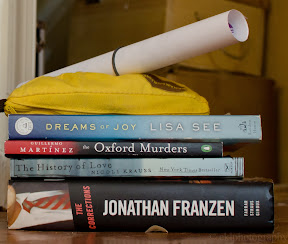
stack, books, bought, sundial, to-read
"It never occured to me that the need to catalog the stuff of everyday life might be a sign that the authors I loved were loners and misfits. Normal people, after all, don't stand around at garden parties or lie in bed with their loved ones trying to figure out what even the smallest ordinary gesture means."

-David Samuels, Marginal Notes on the Inner Lives of People with Cluttered Apartments in the East Seventies, a rereading of J.D. Salinger's Franny and Zooey.


Evidence of the superfluity of books in my life: this wee pile was acquired whilst in Sundial Books, currently the best little bookshop in Chincoteague.

Wednesday, November 23, 2011

Books read in Chincoteague (3 of 7): Not Becoming My Mother

eople of first world countries in the twenty-first century have a tendency to take an awful lot for granted. While many in democratic society worry that their freedoms are shrinking, it also seems as though they are expanding. Even a few decades ago a more conservative U.S. might not have put up with the diatribes of certain "grassroots" movements, more likely dismissing them outright as being incoherent and extremist. Today we still have the great benefit of an equal voice for all, even though some may be less deserving of serious consideration.

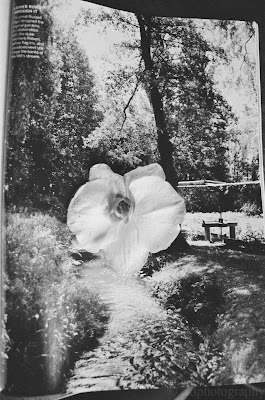
Orchid lying on a page from VogueAll of which is, for some reason, leading up to my notes on Not Becoming My Mother, this short memoir by Ruth Reichl about her mother's search (somewhat in vain) for a life as a non-homemaker in the middle of the 20th century. I have a certain weakness for reading about the lives of others, who, while not consequential or influential on any grand scale, have at least merited some well-written words and a bit of immortality on the bookshelf. No one is really inconsequential, in the big chaotic world of butterfly wingbeats, but some are significant only to a small circle of fortunate insiders.

Reichl's search for her mother's story focuses on the the fortunes of mid-century homemakers, facing proud and territorial husbands in a difficult job market after the Depression and World War II. Reichl had originally made the mistake of assuming that everything changed to roses for women after the 19th Amendment was passed. In truth, society took much longer to adjust to the change, and families behind closed doors longer still. Traditional patriarchal values (often maintained by the physically larger and stronger sex, and accepted by women who aren't sure how to do otherwise) still linger today. Reichl's mother did her best to instill deep seated independence and self-reliance in her daughter, such that she might never feel the need to ally herself with a husband in order to get by. Anyway, the thing was inspiring, comforting and entertaining, a quick read. Recommended.