Showing posts with label digital. Show all posts

Monday, February 21, 2011

Baking is exhausting

chocolate, cake, batter, flour, sifted, mix.Well. I'd been meaning to make a chocolate cake of some variety for a couple weeks, and today I finally got around to it. This recipe came out of the copy of Martha Stewart's Entertaining (also see this old blog post), which I received in the mail Friday (thanks to that B&N Groupon the other day). I'm saving the actual reading of Entertaining for a time when I can sit and peruse leisurely, but I nabbed this cake recipe for now.

meringue, egg whites, stiff peaks.
Chocolate almond cake comes from one of the wedding menus (for ~50 guests, as opposed to the 100 and 200 guest menus. Dear God.) at the back of the book. The original recipe actually involves making the full size, multi layer, stacked wedding style cake, and uses both this recipe and an orange almond cake alternately for the layers (with copious amounts of decorative frosting, of course). I just halved the recipe and made a basic two layer cake, instead. Some of the chocolate I'd been intending to use disappeared, and I ran out of eggs, so the chocolate glaze (which I nabbed from my Williams Sonoma book.. and quartered!) is a bit sparse. 

chocolate, cake, layers, assemble, cooling, rack.
Anyway, the recipe specifies that you shouldn't overcook the cake, because it should be extra moist in the middle. I may have overcooked a little bit, but it's so hard to tell how done the cake is before it cools... Still, it's quite tasty. The meringue gets folded in last and provides that nice fluffiness. I just stuffed some blackberry preserves that happened to be in the fridge between the layers, but I'd rather have used raspberry, and had a fluffier frosting on top. My resident critic tells me he doesn't like buttercream frosting, but I've never tried it at home. It's likely to be a lot better than the grocery store stuff, in any case.

chocolate, cake, slice, removed, preserves, jam, layer, filling.
Meanwhile, you may notice that my accompanying photos are a little nicer than usual. I've been getting back into my photography habit lately, and have been working with a DSLR for the last month. The internal debate over what camera I actually want and whether I can justify buying it has gotten quite raucous, but someday soon...

chocolate, cake, slice, jam, filling, preserves, plate.
After reading Photocritic's post about prime lenses I was eager to try one... and then I realised how silly that was. Of course, all cameras used to have "prime lenses." This zoom stuff is really quite recent (a prime is simply a lens that has a fixed focal length, eg, no zoom). So, these photos are indeedy sharper than the average bear, and more excitingly, were shot at f1.4 in my dark little kitchen at night. So HA.


And you may also notice the watermark on these images. I've actually gone and sprung for Adobe Lightroom, which has made my life a good deal easier with its editing, cataloging, web design, export... everything. I have a little project in the works...


Annnd recipe:

Wednesday, February 2, 2011

Book Snark: Earth Abides

Perhaps, he felt in his mind, that was the difference! That was the difference between woman and man. She felt only in terms of the immediate, and was more interested in being able to spot her child's birthday than in all the future of civilization. Again, he felt superior. 
Earth Abides, by George R. Stewart (1949).

In fact, in reading this book about the fall of civilization, I am possessed by a great urge to preserve and protect the history of the world for posterity, just in case something should happen. If humanity vanishes for whatever reason, and/or if electricity eventually fails, what will be left? ebooks? I certainly think not. While electronic formats may be "the future," may be convenient, may be efficient, they will not last beyond the next wave of advancements. Neither will mp3 files, dvds, or all the information on the internet. In this fantastic future world, when perhaps everyone will be gone, those who are left, or those who make a galactic archaeological dig of the planet Earth may find files that are in no way compatible with their technology, or they might find vast libraries of knowledge on paper, which have only to be translated.

Earth Abides was a fantastic book, but in the end very frustrating. It became evident that it was not just the aforementioned woman who was uninterested in preserving civilization, but all of the "stolid" people who happened to survive the plague. Apparently it was beyond their capabilities or caring to teach their children how to read or write so much as basic numbers, much less entire books. Strange that in a novel about a post-apocalyptic world that was what I found most unbelievable.

The future may be defined by forward movement, but that movement should not assume complete abandonment of the past.

Thursday, July 8, 2010

Tidbits

To say that I'm a little behind on my reading would be putting it mildly. To say that I'm a little behind on my blogging would be just plain true. So it is with great pleasure that I bring you [totally dated] noteworthy blurbs from the January 2010 issue of Wallpaper* magazine.

First off, this issue used a customized version of QR codes (example above right) to supplement the physical magazine content with online content. They called these "Augmented Reality" or "AR" graphics (below right). Unfortunately for those of us without the requisite cutting edge technology of a webcam, the idea fell a bit flat. In theory, one would find the AR graphics (little pixelated squares) throughout the magazine and hold them up to a webcam while on the appropriate Wallpaper* website and see some spiffy extras. As yours truly doesn't have a webcam to test this with, you'll just have to believe that it was awesomely augmented. QR codes are a pretty neat idea in general, but I haven't seen them catching on much in the States. I like the idea of being able to easily access information on the fly. Someday, someday we'll catch up to all these bits of the future. Someday I'll have a car that flies, dangit.

Anyway!
The interesting bits (which I summarily tore out of the issue, the better to blog about) were these:

Gapminder: From Sweden, a data toy that makes statistics about social, economic and environmental development do things like cartwheels. What makes me most happy about the service is that they neatly list where the data comes from. With 430 tidy data sets, it's a pretty handy tool for the general public. I'd be interested to hear what people who work in data services think about it.

Gapminder also offers that you can make your own visualization using Motion Chart in Google docs, and since their data is downloadable, you're free to use it. It's also the same gadget that does visualizations in Google Analytics, from the looks of it. I wanted to embed one of their graphs here, but I don't think "Trendanalyzer" will let me do it. Click through the sample image for the real thing:


And then there's Enhanced Editions: Again with the augmented, this time with plenty of peripherals added into an ebook to make the experience more, uhm, contemporary. It looks like you can alter (annotate and change the font size) your ebook on your iPhone (and only your iphone) to your desire the extent that they allow, as well as get video and audio content interspersed with the text. Personally, I don't think our short attention spans needed any encouragement. However, this is a much better use of ebooks than simply putting text on a digital screen and expecting a revolution to come through the front door carrying flags and blowing trumpets. Their premise is that everyone goes to video for their "information" these days (quotes because I don't think the greater part of youtube could be called a research repository), and this is certainly reflected in their features page. There isn't even an option to read, you have to watch the video.

Quite frankly I find that frustrating and I never watch video unless it tells a story itself (you know, movies, music videos...) because if it's informational, I can get that information much faster by scanning text. I suppose I'm old fashioned, but I just haven't got time to sit around watching video after video, no matter how short they are.

And now I can check "get that pile of stuff I've been meaning to blog about into the recycling" off my to-do list. Hoorah!

Friday, July 2, 2010

Photos, great and small

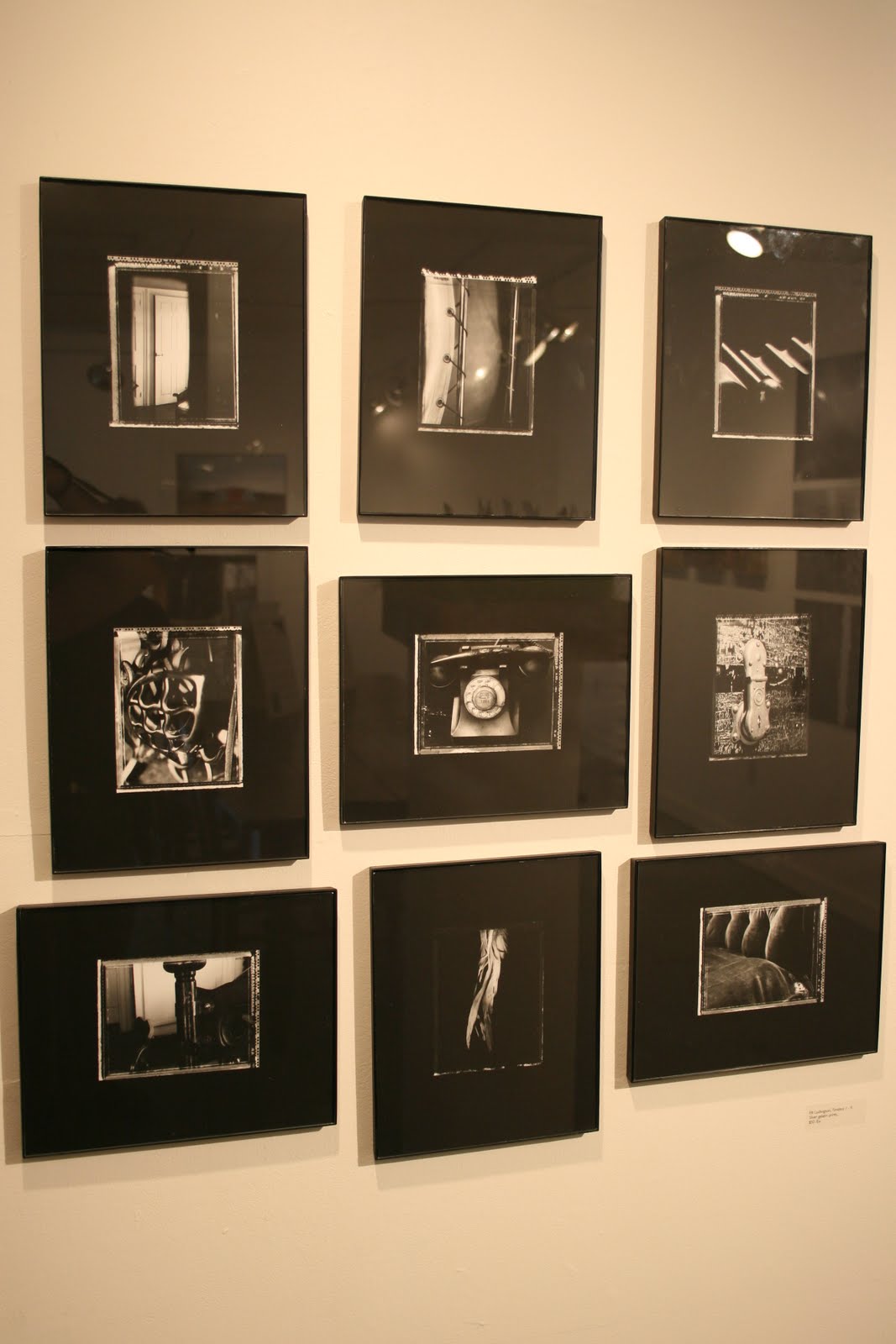
In my experience as a photographer, I have waffled between being a black and white darkroom purist and messing around with larger digital prints. The work I did in the darkroom focused on 4x5 contact prints, which felt precious and significant. Small photographs force the viewer to lean waaay in to see the details, practically putting their nose to the glass to get close enough. I like that because there's a certain amount of focus and concentration needed to view the work, and you can be more assured that your viewer will really look. I saw an exhibit a while back that really exemplified this, but of course I can't remember who or where. It was an early 20th century photographer who printed everything very small, usually 2x2 or smaller. Ideas?


This first photo is a series of prints I did mostly on location at the Whetstone Inn in VT. These nine prints hung in the Vermont Center for Photography for a month as part of a group show. It's tiny and hard to see the photos so you can't steal them, but trust me, they're really neat up close.
On the other hand, large panels of texture and colour can also pull a viewer in, but in a different way. A vast field of detail will make them feel as if they're floating away, swimming deeply in the content. The viewer is engaged in the print, but in a more meditative way, simply enjoying the patterns and colours. My interest in Rothko fits under this category.


Here's a quick example from my senior thesis show. I interspersed photos that represented memories with tight frames full of pattern or texture to explore how people observe and remember things. Unfortunately the Epson 7800 (I think) didn't print a lot bigger than this, as much as I would have loved a 5x6' print.

Anyone have good examples for either of these?

Friday, October 2, 2009

Wishful listing

Dear Santa,

This year for Christmas I would like to receive the following...

My computer has been acting up lately, fighting back against my overuse by occasionally turning itself off and complaining constantly, or just refusing to comply with my commands. Don't get me wrong, I love my little iBookG4, especially because it still runs OS9 applications (read: games, aka Power Pete, which technically came with OS7), but if I could relieve it of some of its burden we'd both be happier. I'm torn though. Since I also need my computer to be able to handle advanced graphics work, a desktop with a tower and wide-screen might be best, but I'd also like a more competent laptop... For now, the 15 inch solid state MacBook Pro (previous link) would fill in fine; I can always add the larger display later. And the Mac Pro Nehalem can just wait until I pick up the Epson 9900(with orange and green inks. whoa).

Meanwhile, my communications capabilities are suffering from another case of outdated technology. Three years of being in my left pocket have been hard on my Nokia. At the same time, my ipod classic did the thing ipods do and broke its headphone jack, and quite likely has a hard drive failure as well. My immediate thought was to get another ipod, but as it turns out I might as well get an iphone 3GS 32 GB and solve both problems at once. And again, the solid state drive will help a lot when it's bouncing around in pockets and bags. Next issue: bluetooth earbuds/headset and laser keyboard (although I'd prefer if it were a smaller device. If only someone would develop it further!).

If I'm going to be getting that Epson 9900, I should really also have a digital camera. I'm conceding the point of digitization in photography only because buying a few medium-large format film cameras (with lenses and different backs), learning colour processing and setting up a colour darkroom (or at least getting a film scanner and settling with the printer) all poses slightly more difficulty than spending a few grand on two pieces of equipment. A quick browse through some old Photocritic posts pointed me at the Nikon D90, but further research and recommendations are welcome.

On a less selfish note, a good way to connect with other artists/photographers in the area is to hunt down your local darkroom. The Washington School of Photography, for instance, has a camera club and workshops for community members.

...Anyway, Santa, I don't know how to prioritize my phone, computer and camera needs, but there you have it. My best to Mrs. Claus and all the elves. See you in two months!

Yours,
Elli