Showing posts with label baking. Show all posts

Wednesday, June 11, 2014

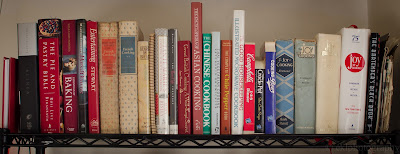
The Joy of "The Joy"


This article originally appeared in the Mountain Courier in March 2013, and I completely forgot to post it to my blog! My friend Suzanne, who edits and writes for the paper, suggested I write the article after seeing my collection of Joys in my kitchen pantry.

The sun slowly rises over a small sea of pop-up tents, my coffee and my breath adding to the quietly dissipating morning fog. A lone jogger pads by, the only traffic at this early hour. Piles of neatly stacked root vegetables, compulsively organized by a sleep-deprived farmer, wait patiently for the 10 am rush. My numbing fingers flick through the pages of a cookbook I’m perusing, looking for recipes to recommend with today’s cuts of grass-fed beef, pork, lamb and chicken that I’m here to peddle.

I was a vegetarian for the first 20 or so years of my life and have since been playing catch-up on how to cook things like pork belly and beef tongue. My customers and I, the adult novice, have found this particular cookbook quite handy for basic information and creative uses for a wide range of ingredients, both familiar and novel. The book is the Joy of Cooking, my ultimate guide on all things food.

Farm markets vary greatly across the region and the seasons, which translates into a certain amount of uncertainty as to what will be available at any given time. Seasonal produce is preferable for freshness, nutrition and the local economy, but sometimes one just doesn’t know what to do with a pile of kale and turnips, much less the wealth of parsnips or variety meats. It is here, in the unexpected and unexplored, that a good reference on cooking becomes invaluable.

It was not my intention to collect multiple editions of the Joy of Cooking. When my first copy came to me, I was more interested in it as a book—an antique livre to add to my library—than as a cookbook. A quick read-through, however, inspired me to assemble an unnecessarily complex cake using separate recipes for the batter, frosting, filling, and probably cake syrup as well, not to mention decoration. My notes on the subject are still tucked into the pages of this 1943 edition (1946 printing).

This first Joy was a gift from my mother, purchased in an antiquarian bookshop in Vermont on the advent of my first apartment, and thereby my first kitchen. Before this, my cooking skills had approximately encompassed rice, eggs, and—thanks to a summer in a friend’s well-appointed kitchen—homemade pizza and cinnamon rolls. As a vegetarian still working on my thesis, my most elaborate dish was stir-fried vegetables with tofu. The Joy was essential to me for basic instructions, factual lookups, information on the latest new ingredient from the food co-op and rules for baking. It was indeed the ideal first cookbook.

As things progressed I acquired two more editions: a brand new 75th anniversary revision bought as retail therapy, and my grandmother’s own 1952 edition complete with her notes and clippings. My three copies currently reside with a 1972 revision owned by a roommate; four Joys in total.

Irma Rombauer’s first edition came into being in 1931 as a collection of personal recipes from her “Victorian roots” to pass on to her children as they left the nest. It was also intended as a helpful guide to the newly minted housewife, alone and bewildered in her kitchen, written to be “so clear that a child can follow it.”

The early editions were a very personal affair for Irma and her daughter, Marion Rombauer Becker, who provided the first illustrations as well as helping her mother test recipes and organize the book. Irma’s wit and familiar tone lend themselves to a very friendly text in which the cook can feel as if she has a personal relationship with her cookbook and its writer. My 1943 Joy includes advice on war rationing, as well as bunches of recipes for aspics, gelatine salads, timbales and soufflés, all in the interest of disguising an array of leftovers. My recipe of choice, however, is for Crepes Suzette (essentially flaming French pancakes), which comes with an amusing anecdote about the dish’s origins with Chef Henri Charpentier and the Prince of Wales.

Both the 1943 and 1952 editions contain extensive advice on entertaining, how to execute full dinner service and from which direction the servants should serve the fish course. There is a handy chart on various fish and how to cook them, quite a lot on baking and confections, nutrition charts, wine charts, herb charts, leftovers charts and a glossary. Irma also took care to “give this book the impression of sobriety and stability it deserves [such that] the alcoholic cocktails have been relegated to the chapter on Beverages.” On the other hand, she also acknowledged that while smoking at the dinner table was très gauche (it destroys the palate), the hostess must provide cigarettes and an ash tray to make her guests as comfortable as possible.

My grandmother’s Joy, the 1952 revision, continues largely along the same track as the 1943 with general rules aimed at gaining an understanding and then a variety of applications. There are some exciting additions such as more pasta, which “takes a good deal of doctoring to make palatable,” a more organized list of household hints and with the new illustrator, Ginnie Hoffman, diagrams for everything. Irma and Marion can be seen slightly at odds in the introduction, where Irma insists that no cook will read anything but the recipe and information that he or she is looking for, while Marion believes that explaining how the book works is worth a page or two.

These earlier versions also include a fairly extensive section on game lumped in with poultry. Terrapin, of course, is now protected under the Endangered Species Act, and not many would consider squirrel a viable food source, never mind bear. While the inclusion of frog legs, aspics and the use of the singular “cooky” may give these editions a dated appearance, even the very earliest Joy in my collection emphasizes nutrition, taking note of Americans’ tendency toward overeating and not balancing caloric intake with nutritional needs.

As time and culture have progressed through the last 75 years, the target audience shifted away from the blushing bride and housewife toward an independent new cook. In the middle years, many sections bit the dust, including “Know Your Ingredients,” much of the entertaining instruction, and the gelatine concoctions. The 1970s were a time when horizons and palates were broadening, food was being shipped greater distances and people were eating tofu, of all things. Marion Rombauer Becker reorganized the book into sections on The Foods We Eat, Heat and Keep, which meant that absolutely everything was shuffled and, I found, rearranged in illogical order. The 1975 edition was the most popular Joy ever, so it must have made sense to most readers and cooks.

Which brings us to the 75th anniversary Joy, published in 2006, thanks to Ethan Becker, Marion’s son. As a Rombauer broodling and graduate of Le Cordon Bleu, Ethan brought respect for heritage and tradition while being open to change. The revision he put together organizes the recipes once again by their place in a meal, beginning with drinks, then hors d’oeuvres, vegetables, meats, desserts, and finishing with methods for preserving. The glory of this edition is the encyclopedic appendix that brings back “Know Your Ingredients,” a plethora of substitution, conversion and other charts, and information on every method you might need to know. Contrary to my assumption, this edition actually contains an expanded section on game, although the handy diagram on squirrel is omitted.

So here we are, back from market with an armload of food, ready to experiment, to learn a new way of preparing a favorite squash and what exactly to do with a bundle of fiddleheads. Any bride, bachelor, or impulse shopper will find his or her way with Joy, branching out into ethnic cuisines, more modern dishes and favorite personal recipes from Ethan, Marion and Irma herself.

Epilogue: I have since also acquired a mint condition, dust jacket-intact 1964 edition of Joy. It is happily nested with the others and gets regular attention from the chef.

The original version of this article in the print edition is here as a PDF. It includes tidibits from other contributors in a four page layout extravaganza.

Friday, August 23, 2013

Afternoon coffee (at 7 pm)

T
hese things always begin with the best of intentions, not to mention quite innocently. I had two objectives this afternoon (oh dear, and I see it's now 7pm. oops):
• Have a cup of coffee and plow through some documentation. And, I prefer having a small snack with my coffee, a croissant, a cookie, a slice of cake...
• Use up the heavy cream I accidentally bought to go in said coffee because I hadn't had coffee yet (the lack of a dilutionary dairy substance being the issue) and so instead of the milk I usually get I got a half litre of very thick, organic cream.

So what did I do? well I tweeted of course, asking for recipes. @HarlanH (data scientist extraordinaire) thoughtfully replied and reminded me of the existence of recipes that aren't for baked goods. Crazy, right? In retrospect, I ought to have just gone with his first thought and done a cream sauce for pasta. Instead, I followed his other recommendation to check out something called Eat Your Books.

As it turns out, Eat Your Books is a handy dandy, plug your cookbooks/magazines/blogs into it-search engine for physical collections. I faintly heard choirs of angels as I poked through the homepage: finally, I can search my cookbooks without pulling each one off the (rather precarious) shelf and flicking through the index, then a handful of recipes trying to find a use for my one stray ingredient! That method works ok for main ingredients, like zucchini, or pork chops, or even chocolate, but not for say, whole vanilla beans, cracked wheat, or, in this case, heavy cream.

I added my top cookbooks with haste. A free subscription only allows 5 resources on your e-shelf: Mastering the Art of French Cooking, The Art of French Baking, The Essentials of Baking, The Joy of Cooking and The Pie and Pastry Bible. That covers everything I usually look through, anyway. And lo, five hundred and forty four recipes appeared!

It being me, I didn't really have many other ingredients on hand apart from the standard baking arsenal, so I used the filters to narrow things down to "cakes." The filters are actually quite useful. Frankly, a paid subscription would be worth it, only $25 a year, I think. I would prefer some integration with other services, maybe add things I bought on Amazon, or pull in my "cookbooks" tag from LibraryThing. More so, I would like to be able to search all my physical books digitally. I can always use Google Books, but I don't think I've seen a service that will let me save my books and then search them. I'd love to be wrong about this, so please correct me if that's the case.

Right, so anyway, I wound up with a recipe from the 75th Anniversary Joy for Black Forest Cake. I made it a little easier, just two layers instead of three, and amusingly enough, I had half as much heavy cream as it called for (still plenty). I also had some sweet cherries I preserved in brandy back in cherry season, so that covered cherries and kirsch, and I had the cream, chocolate, just enough eggs (market tomorrow!). So here it is, the result of two hours, a lot of flipping back and forth in the Joy for base recipes, and some impatient refrigeration time.

The grand irony here, of course, is that I just used up all the cream in the cake, and now have nothing to put in my coffee.

Friday, May 17, 2013

The Art of French Baking: Strawberry Frangipane

he Art of French Baking, published by Phaidon, is a beautiful book. The covers are padded and sparkling white, the pages thick and smooth, the photographs well shot and printed, and any cookbook with bookmark ribbons gets a lot of points from me. However, the recipes seem to leave a little something to be desired.

I am an experienced baker. Not an expert, not experimental, and not a chemist, but my pie crusts are tender and flaky, my bread rises and my batters are light and fluffy. Therefore I was somewhat surprised when several recipes from this book did not come together or bake in the way I expected. The instructions are quite brief, which is fine if one already has some technique, but I repeatedly found myself with a dough that didn't hold together despite extra liquid, or choux puffs that simply wouldn't rise (I tried twice in one day), or worse, cookies that burned but didn't bake through.
strawberries, pie, cake, baking, frangipane

So now I've determined that I'll just need to reinterpret and double check the recipe for logic before I start anything. Make sure the oven temperature doesn't seem oddly high, that the wet and dry proportions make sense and that I can adjust here and there. Or at least I can make the recipes with frosting and cover up all the little problems!

Today I needed to use up the last of a flat of strawberries from market, and the Strawberry Frangipane looked pretty easy. It's just egg yolks, sugar, ground almonds and strawberries. Nothing can go wrong! Well, nothing except my being short an egg. Sigh. So I just eased back on the other ingredients. The batter was thicker than I was expected and didn't exactly pour between the strawberries, but it did melt around them once in the oven. Then it was just a matter of keeping an eye on it until the top was the perfect shade of done... except when I cut into it, the inside was not at all done. Not even a little. Back into the oven it goes.

I'm fairly fed up at this point, having never had so much trouble with recipes before. Perhaps it's partially my fault, but with every recipe coming from the same book it seems unlikely that this is entirely on me. I really want to love The Art of French Baking, but it's not living up to my expectations. You all know what the lesson is here, right?

strawberry, frangipane, pie, cake, eggs, simple
Here's a quick list of the things I've made from this book:
  • Sweet orange croquettes- excellent
  • Babas au rhum- pretty good, not as fluffy as I'd like.
  • Pate a choux puffs with pastry creme- total fail, no puff to be had, more like cookies. I have done these successfully in the past with a Martha Stewart recipe!
  • Petit fours with chocolate ganache and sprinkles- worked well in mini muffin tins
  • Duchesse petits fours- Dough didn't even slightly hold together and overcooked too quickly
  • Orange gateau, I think- I have a vague memory of using a pineapple, too. dunno.
  • Sweet slices- basically sugar cookies, oven temp was also too high
  • Strawberry Frangipane- Ha. Maybe once it's baked for three times the suggested time!

Saturday, July 14, 2012

Technical Testing Tribulations

ay back in November I finally staked my claim on a corner of the internet by registering and hosting a website under my name. I had stalled for almost a full year, thinking there was too much I would want to research before pinning down a registrar/host. Turns out that was the easy part (once I realised I didn't need a slew of dedicated servers in the former Soviet Bloc).

After choosing DreamHost at the recommendation of a friend and a popular website (Lifehacker, who recently re-affirmed DreamHost's dominance), all I had to do was learn how to code an entire website. And not just any website, one that would display a photographic portfolio dynamically and interactively and [buzzword] and [so on]. Ok, so I haven't quite gotten to that part yet, but the site exists and is a decent placeholder.

pie, blueberries, tart, lemon curd
The holdup is that I'm the sort of person who can't just throw up something pre-fabricated and call it a day, I have to learn how to code the entire thing myself, learn databases and cascading stylesheets, from scratch. Maybe once I've done that I could take an easier route, but without understanding the background it seems too much like cheating. Besides, most of the point was giving myself opportunity to learn, given that my photos probably aren't going to start flying off the shelves (there are some up, but they, too, are placeholders).
poached, apricots, tart, pie, cheescake
So in the meantime I've just been using the web export feature in Adobe Lightroom (a god-send for those of us who like cataloging, integration with other applications and services and powerful but simple tools). The problem I'm leading up to is that I'd like to stop hosting the photos I use in blog posts on Picasa and move them all over to a dedicated storage folder on my website. Heck, someday I should move this blog there, too.
orange, chiffon, chocolate, meringue, pie
The problem is that to use a photo in a post, I need to have a link to the .jpg file that will never change, or at least use a relative link to just "/kitten.jpg" rather than "http:// blah/folderA/section56/kitten.jpg" and so on. So that's one solution. But I also need the photo to link to a gallery view on my website, so that the clicker can browse through other photos from my blog, and also use spiffy navigation controls to browse by keyword or just mosey back through other parts of my portfolio.

I'm not going to list how much of that I have no idea how to accomplish, because it's too overwhelming. But, I've written an entire blogpost about it now, so that will hopefully motivate me.

Oh, and the reason there are random photos of pie here is because they're hosted on my website, just... not very sophisticatedly.

Tuesday, March 20, 2012

Photos of phood: Nougatine Pastry Crisps

ood lord.
I haven't posted since the holidays! The horror! Much didn't happen, then much did happen, and now I've got several drafted posts to get out and need to decide which go first. So instead, here's a couple photos of the most recent baking incident.

Earlier this month I had a request for palmiers as a birthday gift, so I [somewhat foolishly] bought a log of Amish butter from the local butcher. Foolish because 1) I neglected to notice that this was *salted* butter, something I never use and 2) it will always smell like butcher shop to me. Also probably 3) 2lbs of butter was more than I needed and more expensive than the perfectly good Cabot at home, but heck. Anyway, I had half left over and the fastest way to get rid of butter is in a 1lb butter package in pastry, SO:

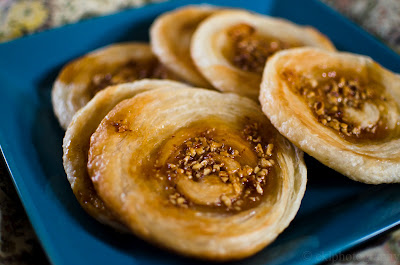
pastry, nougatine, almond, caramelMade puff pastry dough. ... only then did I go through a few recipes and realise that everything called for ingredients I didn't have (and I try to bake only with things on-hand, otherwise it would become a huge expense very quickly), fruit and cream and whatnot. Palmiers really only use butter, flour and sugar, which makes them very convenient. Eventually I found a recipe for an assembled dessert from the Ritz involving sort of a pastry sandwich around a cream/fruit filling from the Pie and Pastry Bible (I know, I know, big surprise, I'm using the book again).

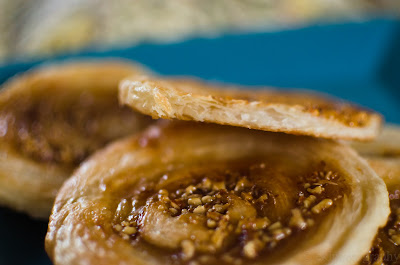
pastry, nougatine, almond, caramel The pastry discs are simply slabs of the dough rolled out thin and baked between cookie sheets to keep them flat. However, the secret (or not) addition is the nougatine crumble which tops them. I doubled the original recipe for this (figuring it can go on yogurt and stuff, too) and got a nice sheet of almond filled crunchy caramel. With a crumbled spoonful of this sprinkled on top, the pastry rounds become cookies with slightly chewy caramel and nutty almonds on top. Easy enough, attractive, and so flakey you can barely pick one up.

Saturday, December 24, 2011

Merry Christmoose!

Here's a selection of photos from things done in the days betwixt holidays this last month. Some crafty stuff, some baking stuff, some decorations... A decently festive month, indeed.

Monday, November 7, 2011

Palmiers

palmiers, pig's ears, elephant's ears, pastrypalmiers, pig's ears, elephant's ears, pastry

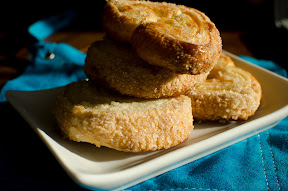
Last week I got one of the most ironic phone calls I can remember receiving. It was my dental hygienist, calling to remind me of my appointment... and to ask me if I might bring baked goods. So, last night, at a loss for what to make, I tried pastry for the first time. These are palmiers, and are made exclusively with flour, butter, water, salt and sugar. Even the dentist himself agreed that they were fantastic.

palmiers, pig's ears, elephant's ears, pastry

Monday, October 17, 2011

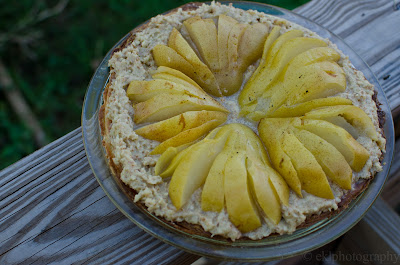
Pear, almond cream, tart. At length.

ometimes the route I take to a baking project is long and roundabout. In this case, I started well over a month ago thinking "oh hey, I should make pie crust with all this cream cheese that came out of my parents' fridge during the hurricane." Having subsequently moved, still with said cream cheese, it's now October, and the fruit available has changed completely. Fortunately, I moved to a location two blocks from a weekly, year-round farm market and despite the apple season fanatics, I found some lovely pears and bought 10.

Then I went looking for a recipe. I'd do it first, but that tends to result in a harried and expensive trip to several specialty stores looking for things like "espresso powder" and whatever. In this case, I got away with nothing more extravagant than a vanilla bean (albeit a bit of a ripoff at the local "My Organic Market").

Pear and almond cream tart pre-baking

So there I was with pears and cream cheese pie crust premade and waiting in the freezer (keeps for up to three months, yet I never pre-make enough for it to last more than one pie). A quick poke through my trusty bookshelf o' cookbooks, and I arrived at the inevitable conclusion: The Pie and Pastry Bible. Someday, I swear I'll use different books. Really. Having avoided apples especially because I'm tired of fruit-in-crust pies, I wanted something a little more interesting. The options were a gingery pear chiffon pie (which I had modified a couple years ago into a ginger and chocolate ganache pie for Thanksgiving) or pear almond cream tart.

Cookbook collection on the pantry shelf
Before I get into the things I'll do differently next time, let me just say that this is a very tasty, decent looking little open-faced pie/tart. However.

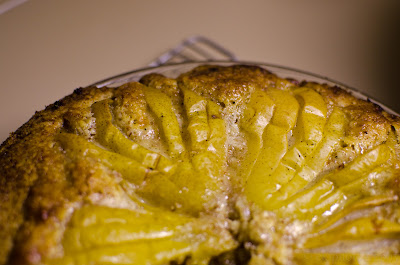
It started with the pre-baked crust. Ok, so the recipe called for the normal flakey pie crust, in a tart pan, and I was using cream cheese crust in a pie plate. It kinda shrunk a lot and got a bit too toasty on its own when it should have been a little underbaked in order to withstand the subsequent baking with filling. Still, super flakey, and actually incredibly tasty when dark brown and slightly caramelized with filling.

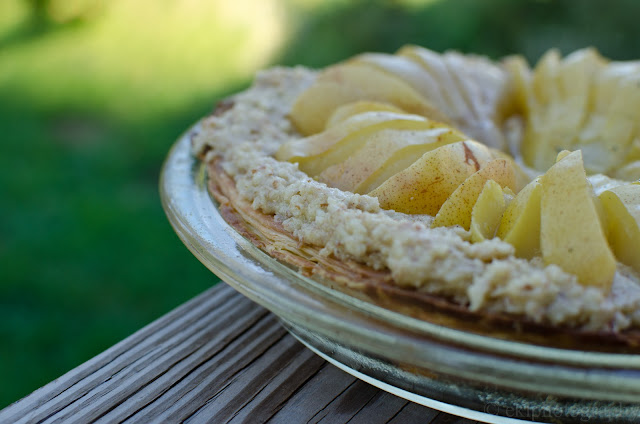
Pear almond cream pie, fanning of pears, cut
I also neglected to thoroughly process the almond flour/stuff. And to use blanched, sliced almonds. But that's just cause they come in "raw" in the bulk department. So, instead of what I assume was meant to be a smooth, creamy filling, I have a nutty, thick filling. It did manage to puff up (eventually) and has the texture of chewy meringue around the edges (also a little darker than necessary).

The poaching of the pears went well, though I recommend watching them a bit more carefully than I did and not getting distracted by other wildly exciting things like de-clogging the vacuum. yeah. I reserved some of the poaching liquid for my food and drink obsessed housemate to mix cocktails or something with. The vanilla bean was very worth it and can never, ever be substituted with vanilla extract, so don't even think about it.

Finished pear almond tart, meringue edges
In the video on Rose Levy Beranbaum's website (below), she has the pears sliced the short way across and fanned into little ridged mountains in the almond filling. It makes a kind of star pattern, but that didn't quite make sense to me visually, edibly or uh, logistically, so I fanned them lengthwise instead, with the intent that the almond filling could puff up between the slices. This mostly worked, but again I neglected to really thoroughly drain the pears, so the pie/tart took a lot longer to cook and was too wet in the center for most of the time.


This is kind of a long post for one little pie experiment, but I went searching the interweb for more info when the recipe didn't make sense and only easily found RLB's website. Hopefully this will help someone else. And also photos. It's blissful having a back porch to take things out on into natural light in order to photograph. The finished pie photo is from inside and at night (bleh!).

Tuesday, July 19, 2011

Wineberry pie

aving the recipe is only half the battle. It took several pies for me to get the pie crust to behave in such a way that I could roll it out, instead of trying to piece something together out of the fragments that never became a whole. Your only hope in this matter is to start with a good recipe and figure it out for yourself. The very best book ever is "The Pie and Pastry Bible" by Rose Levy Beranbaum. I've gotten so many recipes out of this book, if you know me, you've probably had one. In my mind, the best kind of cookbook isn't just recipes but philosophy and information, so that you actually have some clue why things need to be just so. Absolutely essential for the baker. Go get it. shoo.

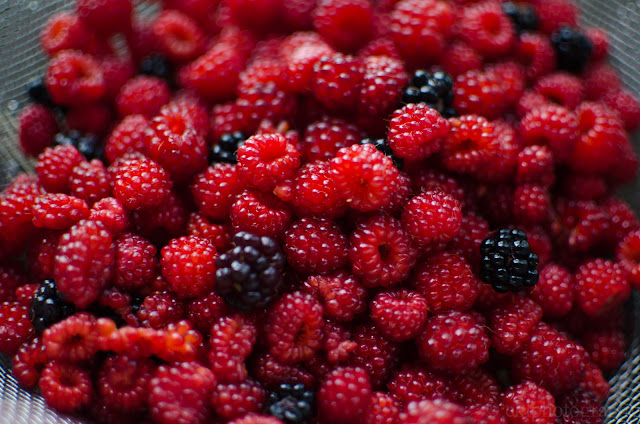
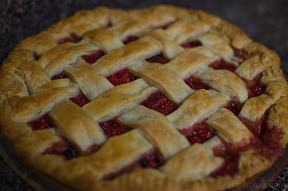
This past weekend I had the good fortune to spend a night atop a mountain in the Shenandoah region, and came back (thanks to Wortklauberlein) with a pound of fresh berries from the bazillions of vines lining the roads. The local population informed us that they are wineberries, a particularly sweet variety of raspberry. There's nothing so satisfying as baking or cooking with food you've picked yourself. er, or that someone has thoughtfully picked for you.
pie, berries, fresh, handpicked, appalachians, shenandoah, wineberries, blackberries

Ingredients
"Deluxe flaky pie crust" 21 oz
    14 tbl unsalted butter, cold.
    2.25 cups flour (pref. pastry)
    1/4 tsp salt
    1/4 tsp baking powder
    7.5 tbl ice water
    1 tbl cider vinegar
0.5 cup sugar (I only had brown)
2.5 tbl cornstarch
pinch salt
1 lb berries, washed and picked over for passengers.
  1. Pick a pound of wineberries and a few blackberries from Flattop Mountain. Or your backyard. Or somebody else's backyard. I don't think you can buy wineberries in the store, but this recipe will likely work with whatever berries you have handy.
  2. Make pie crust:
    • cut butter into small cubes, freeze for 30 min +
    • put flour, salt, baking powder in gallon size ziplock bag, shake to mix thoroughly.
    • add frozen butter, expel air and use rolling pin to (patiently) roll butter into flat flakes. Shake bag to redistribute when mix gets bunched up at one end. Freeze for 10 min.
    • sprinkle water and vinegar into bag, toss to mix.
    • keeping the bag open, knead from the outside of the bag until dough forms a single lump. To do this, you'll need to use the bag to fold the dough onto itself (don't touch it directly). About halfway through you'll get frustrated because it's not holding together yet. Put it in the fridge for a few minutes and come back to it. Once it's a lump, divide into two pieces, one for the top and one for the bottom crust. 
    • Refrigerate for at least an hour, preferably overnight. 
  3. Roll out bottom crust on lightly floured surface to 1/8 inch thickness. Lay in pie pan, cover and refrigerate at least 30 min, no more than 3 hours.
  4. Combine sugar, cornstarch and salt, whisk together. Toss berries gently in this mixture and let sit for 15 minutes. 
  5. Toss gently again and pour into bottom crust.
  6. Roll out top crust to 1/8 inch. I used a lattice pattern, but you could do a full top crust and cut a hole in the middle for steam to escape. Lay top crust over berries, use water to glue and fold edges under (or over) and crimp using a fork or your fingers.
  7. Refrigerate pie, covered loosely in plastic wrap, for about an hour.
  8. Preheat oven to 425 at least 20 minutes before baking. Use a baking stone if you have one and put it on the lower rack. Bake pie for 30 minutes or until juices are bubbling and crust is browned. Put a baking sheet or foil underneath the pie plate to catch drips.
  9. Let cool for at least 2 hours before serving, probably more like 4 if you have the patience.

Sunday, June 19, 2011

Father's Day Carrot Cake

It has come to my attention recently that for the most part people don't need more stuff, and so instead I bake them gifts for most of the assorted Hallmark holidays. It's actually more effort on my part, at least physically, and it's something we can share, instead of another [tie/bouquet] thoughtful but nonetheless impersonal gift. Books don't count, obviously, one can never have too many books.

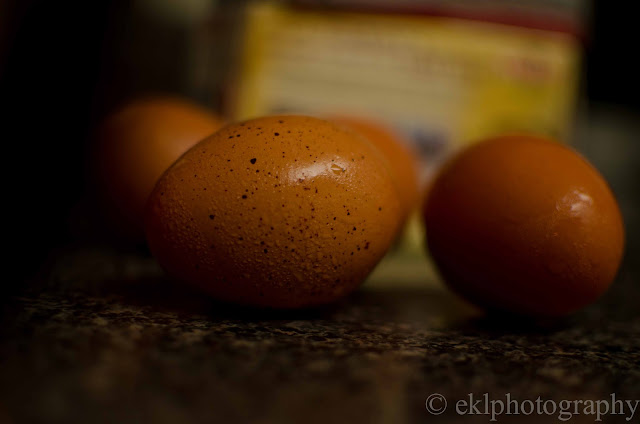
eggs, brown, spots, condensation, baking, cake

That being said, I made carrot cake for my dad for this Father's Day, which also meant the most cautious drive from NoVA into MD possible, so as not to lose the cake in a sudden stop or turn. I think I watched the cake more than the road. hm. Any minute now he'll cut a slice, and then I can post this! Unfortunately I don't have the recipe with me to include (and I don't mind keeping it a bit of a secret), but you can easily find it in the Williams Sonoma Essentials of Baking book I'm sure I've touted before.

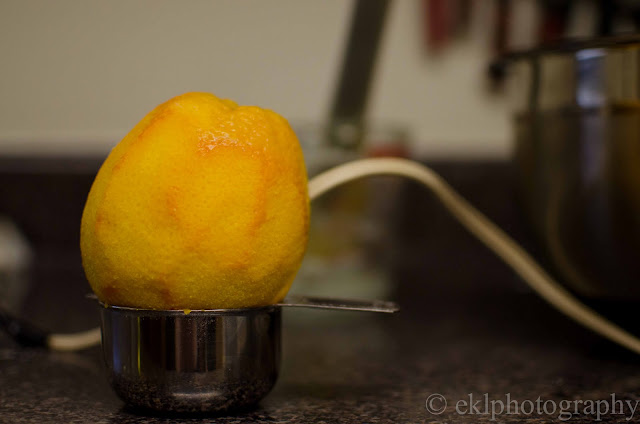
orange, navel, zest, juice, squeeze, baking, cake

I'm not sure whether it's harder to zest a squeezed citrus, or to squeeze a zested one. Either way, once it lacks some cohesion it's difficult to handle. Sometimes I forget things like: Orange juice comes from oranges, therefore "juice of one orange" could theoretically come from a carton, not the fresh fruit I just squeezed to death.


This is possibly my favourite frosting: cream cheese, white chocolate and orange juice (and butter). It's pretty sweet, thanks to the white chocolate, but has that cream cheese tang and then the orange flavor. I'm also a sucker for cream cheese pie crust, which gets used most frequently for the awesome cranberry apple pie I make in the Autumn and Winter.

Anywho, Happy Father's Day to all, but especially to mine.

Monday, February 21, 2011

Baking is exhausting

chocolate, cake, batter, flour, sifted, mix.Well. I'd been meaning to make a chocolate cake of some variety for a couple weeks, and today I finally got around to it. This recipe came out of the copy of Martha Stewart's Entertaining (also see this old blog post), which I received in the mail Friday (thanks to that B&N Groupon the other day). I'm saving the actual reading of Entertaining for a time when I can sit and peruse leisurely, but I nabbed this cake recipe for now.

meringue, egg whites, stiff peaks.
Chocolate almond cake comes from one of the wedding menus (for ~50 guests, as opposed to the 100 and 200 guest menus. Dear God.) at the back of the book. The original recipe actually involves making the full size, multi layer, stacked wedding style cake, and uses both this recipe and an orange almond cake alternately for the layers (with copious amounts of decorative frosting, of course). I just halved the recipe and made a basic two layer cake, instead. Some of the chocolate I'd been intending to use disappeared, and I ran out of eggs, so the chocolate glaze (which I nabbed from my Williams Sonoma book.. and quartered!) is a bit sparse. 

chocolate, cake, layers, assemble, cooling, rack.
Anyway, the recipe specifies that you shouldn't overcook the cake, because it should be extra moist in the middle. I may have overcooked a little bit, but it's so hard to tell how done the cake is before it cools... Still, it's quite tasty. The meringue gets folded in last and provides that nice fluffiness. I just stuffed some blackberry preserves that happened to be in the fridge between the layers, but I'd rather have used raspberry, and had a fluffier frosting on top. My resident critic tells me he doesn't like buttercream frosting, but I've never tried it at home. It's likely to be a lot better than the grocery store stuff, in any case.

chocolate, cake, slice, removed, preserves, jam, layer, filling.
Meanwhile, you may notice that my accompanying photos are a little nicer than usual. I've been getting back into my photography habit lately, and have been working with a DSLR for the last month. The internal debate over what camera I actually want and whether I can justify buying it has gotten quite raucous, but someday soon...

chocolate, cake, slice, jam, filling, preserves, plate.
After reading Photocritic's post about prime lenses I was eager to try one... and then I realised how silly that was. Of course, all cameras used to have "prime lenses." This zoom stuff is really quite recent (a prime is simply a lens that has a fixed focal length, eg, no zoom). So, these photos are indeedy sharper than the average bear, and more excitingly, were shot at f1.4 in my dark little kitchen at night. So HA.


And you may also notice the watermark on these images. I've actually gone and sprung for Adobe Lightroom, which has made my life a good deal easier with its editing, cataloging, web design, export... everything. I have a little project in the works...


Annnd recipe:

Friday, December 24, 2010

Obligatory, but festive!


As it turns out, borrowing someone's computer can be very frustrating when it's significantly different from your own. Apologies for poor formatting etc in this post, but wanted to get it up in time to say Merry Christmas!... in a somewhat timely fashion.

Eenywho, just some photos of the cookie-making marathon last weekend. I'm fairly pleased with the results: iced sugar cookes, braunekuchen (molasses/spice cookies), truffles, banana-chocolate-chip-mini-muffins (of hyphenage +1) and raspberry oatmeal ribbon bars.

Sunday, July 18, 2010

Tuesday Night Dinner, part IV

Somewhat delayed! Possibly by a month! whoops.

So after the pesto and whatnot I made scones as an afterthought. The recipe came from the Washington Post food section, but of course I didn't quite have everything required. I substituted whole wheat flour for the barley flour and used some chopped up and slightly macerated strawberries as the center layer. They make a fantastic not-too-sweet dessert or a snack with tea and are in fact ridiculously easy to make. Unfortunately I didn't take any pictures, but rest assured that they're very tasty and attractive scones.

Ingredients:

For the scones
  • 8 tablespoons (1 stick) cold unsalted butter, cut into 1/2-inch pieces, plus more for greasing the baking sheet
  • 1 cup plus 2 tablespoons barley flour, plus more for the work surface
  • 1 cup all-purpose flour
  • 1/4 cup packed light brown sugar
  • 2 teaspoons baking powder
  • 1/2 teaspoon baking soda
  • 1 1/4 teaspoons kosher salt
  • 1/2 cup regular or low-fat buttermilk
  • 1 large egg
For assembly
  • 1/2 cup strawberry jam or marmalade
  • 1 tablespoon unsalted butter, melted
  • 1 tablespoon granulated sugar

Find the rest of the recipe here.

Monday, July 12, 2010

Photos of Phood: Caramelized Onion Tart with Goat Cheese


Flaky pie crust, slow cooked onions with a bit of pepper and assorted herbs, a little custard and crumbled goat cheese. Wonderful hot and just as good at room temperature for lunch the next day.