Showing posts with label books. Show all posts

Wednesday, June 11, 2014

The Joy of "The Joy"


This article originally appeared in the Mountain Courier in March 2013, and I completely forgot to post it to my blog! My friend Suzanne, who edits and writes for the paper, suggested I write the article after seeing my collection of Joys in my kitchen pantry.

The sun slowly rises over a small sea of pop-up tents, my coffee and my breath adding to the quietly dissipating morning fog. A lone jogger pads by, the only traffic at this early hour. Piles of neatly stacked root vegetables, compulsively organized by a sleep-deprived farmer, wait patiently for the 10 am rush. My numbing fingers flick through the pages of a cookbook I’m perusing, looking for recipes to recommend with today’s cuts of grass-fed beef, pork, lamb and chicken that I’m here to peddle.

I was a vegetarian for the first 20 or so years of my life and have since been playing catch-up on how to cook things like pork belly and beef tongue. My customers and I, the adult novice, have found this particular cookbook quite handy for basic information and creative uses for a wide range of ingredients, both familiar and novel. The book is the Joy of Cooking, my ultimate guide on all things food.

Farm markets vary greatly across the region and the seasons, which translates into a certain amount of uncertainty as to what will be available at any given time. Seasonal produce is preferable for freshness, nutrition and the local economy, but sometimes one just doesn’t know what to do with a pile of kale and turnips, much less the wealth of parsnips or variety meats. It is here, in the unexpected and unexplored, that a good reference on cooking becomes invaluable.

It was not my intention to collect multiple editions of the Joy of Cooking. When my first copy came to me, I was more interested in it as a book—an antique livre to add to my library—than as a cookbook. A quick read-through, however, inspired me to assemble an unnecessarily complex cake using separate recipes for the batter, frosting, filling, and probably cake syrup as well, not to mention decoration. My notes on the subject are still tucked into the pages of this 1943 edition (1946 printing).

This first Joy was a gift from my mother, purchased in an antiquarian bookshop in Vermont on the advent of my first apartment, and thereby my first kitchen. Before this, my cooking skills had approximately encompassed rice, eggs, and—thanks to a summer in a friend’s well-appointed kitchen—homemade pizza and cinnamon rolls. As a vegetarian still working on my thesis, my most elaborate dish was stir-fried vegetables with tofu. The Joy was essential to me for basic instructions, factual lookups, information on the latest new ingredient from the food co-op and rules for baking. It was indeed the ideal first cookbook.

As things progressed I acquired two more editions: a brand new 75th anniversary revision bought as retail therapy, and my grandmother’s own 1952 edition complete with her notes and clippings. My three copies currently reside with a 1972 revision owned by a roommate; four Joys in total.

Irma Rombauer’s first edition came into being in 1931 as a collection of personal recipes from her “Victorian roots” to pass on to her children as they left the nest. It was also intended as a helpful guide to the newly minted housewife, alone and bewildered in her kitchen, written to be “so clear that a child can follow it.”

The early editions were a very personal affair for Irma and her daughter, Marion Rombauer Becker, who provided the first illustrations as well as helping her mother test recipes and organize the book. Irma’s wit and familiar tone lend themselves to a very friendly text in which the cook can feel as if she has a personal relationship with her cookbook and its writer. My 1943 Joy includes advice on war rationing, as well as bunches of recipes for aspics, gelatine salads, timbales and soufflés, all in the interest of disguising an array of leftovers. My recipe of choice, however, is for Crepes Suzette (essentially flaming French pancakes), which comes with an amusing anecdote about the dish’s origins with Chef Henri Charpentier and the Prince of Wales.

Both the 1943 and 1952 editions contain extensive advice on entertaining, how to execute full dinner service and from which direction the servants should serve the fish course. There is a handy chart on various fish and how to cook them, quite a lot on baking and confections, nutrition charts, wine charts, herb charts, leftovers charts and a glossary. Irma also took care to “give this book the impression of sobriety and stability it deserves [such that] the alcoholic cocktails have been relegated to the chapter on Beverages.” On the other hand, she also acknowledged that while smoking at the dinner table was très gauche (it destroys the palate), the hostess must provide cigarettes and an ash tray to make her guests as comfortable as possible.

My grandmother’s Joy, the 1952 revision, continues largely along the same track as the 1943 with general rules aimed at gaining an understanding and then a variety of applications. There are some exciting additions such as more pasta, which “takes a good deal of doctoring to make palatable,” a more organized list of household hints and with the new illustrator, Ginnie Hoffman, diagrams for everything. Irma and Marion can be seen slightly at odds in the introduction, where Irma insists that no cook will read anything but the recipe and information that he or she is looking for, while Marion believes that explaining how the book works is worth a page or two.

These earlier versions also include a fairly extensive section on game lumped in with poultry. Terrapin, of course, is now protected under the Endangered Species Act, and not many would consider squirrel a viable food source, never mind bear. While the inclusion of frog legs, aspics and the use of the singular “cooky” may give these editions a dated appearance, even the very earliest Joy in my collection emphasizes nutrition, taking note of Americans’ tendency toward overeating and not balancing caloric intake with nutritional needs.

As time and culture have progressed through the last 75 years, the target audience shifted away from the blushing bride and housewife toward an independent new cook. In the middle years, many sections bit the dust, including “Know Your Ingredients,” much of the entertaining instruction, and the gelatine concoctions. The 1970s were a time when horizons and palates were broadening, food was being shipped greater distances and people were eating tofu, of all things. Marion Rombauer Becker reorganized the book into sections on The Foods We Eat, Heat and Keep, which meant that absolutely everything was shuffled and, I found, rearranged in illogical order. The 1975 edition was the most popular Joy ever, so it must have made sense to most readers and cooks.

Which brings us to the 75th anniversary Joy, published in 2006, thanks to Ethan Becker, Marion’s son. As a Rombauer broodling and graduate of Le Cordon Bleu, Ethan brought respect for heritage and tradition while being open to change. The revision he put together organizes the recipes once again by their place in a meal, beginning with drinks, then hors d’oeuvres, vegetables, meats, desserts, and finishing with methods for preserving. The glory of this edition is the encyclopedic appendix that brings back “Know Your Ingredients,” a plethora of substitution, conversion and other charts, and information on every method you might need to know. Contrary to my assumption, this edition actually contains an expanded section on game, although the handy diagram on squirrel is omitted.

So here we are, back from market with an armload of food, ready to experiment, to learn a new way of preparing a favorite squash and what exactly to do with a bundle of fiddleheads. Any bride, bachelor, or impulse shopper will find his or her way with Joy, branching out into ethnic cuisines, more modern dishes and favorite personal recipes from Ethan, Marion and Irma herself.

Epilogue: I have since also acquired a mint condition, dust jacket-intact 1964 edition of Joy. It is happily nested with the others and gets regular attention from the chef.

The original version of this article in the print edition is here as a PDF. It includes tidibits from other contributors in a four page layout extravaganza.

Friday, August 23, 2013

Afternoon coffee (at 7 pm)

T
hese things always begin with the best of intentions, not to mention quite innocently. I had two objectives this afternoon (oh dear, and I see it's now 7pm. oops):
• Have a cup of coffee and plow through some documentation. And, I prefer having a small snack with my coffee, a croissant, a cookie, a slice of cake...
• Use up the heavy cream I accidentally bought to go in said coffee because I hadn't had coffee yet (the lack of a dilutionary dairy substance being the issue) and so instead of the milk I usually get I got a half litre of very thick, organic cream.

So what did I do? well I tweeted of course, asking for recipes. @HarlanH (data scientist extraordinaire) thoughtfully replied and reminded me of the existence of recipes that aren't for baked goods. Crazy, right? In retrospect, I ought to have just gone with his first thought and done a cream sauce for pasta. Instead, I followed his other recommendation to check out something called Eat Your Books.

As it turns out, Eat Your Books is a handy dandy, plug your cookbooks/magazines/blogs into it-search engine for physical collections. I faintly heard choirs of angels as I poked through the homepage: finally, I can search my cookbooks without pulling each one off the (rather precarious) shelf and flicking through the index, then a handful of recipes trying to find a use for my one stray ingredient! That method works ok for main ingredients, like zucchini, or pork chops, or even chocolate, but not for say, whole vanilla beans, cracked wheat, or, in this case, heavy cream.

I added my top cookbooks with haste. A free subscription only allows 5 resources on your e-shelf: Mastering the Art of French Cooking, The Art of French Baking, The Essentials of Baking, The Joy of Cooking and The Pie and Pastry Bible. That covers everything I usually look through, anyway. And lo, five hundred and forty four recipes appeared!

It being me, I didn't really have many other ingredients on hand apart from the standard baking arsenal, so I used the filters to narrow things down to "cakes." The filters are actually quite useful. Frankly, a paid subscription would be worth it, only $25 a year, I think. I would prefer some integration with other services, maybe add things I bought on Amazon, or pull in my "cookbooks" tag from LibraryThing. More so, I would like to be able to search all my physical books digitally. I can always use Google Books, but I don't think I've seen a service that will let me save my books and then search them. I'd love to be wrong about this, so please correct me if that's the case.

Right, so anyway, I wound up with a recipe from the 75th Anniversary Joy for Black Forest Cake. I made it a little easier, just two layers instead of three, and amusingly enough, I had half as much heavy cream as it called for (still plenty). I also had some sweet cherries I preserved in brandy back in cherry season, so that covered cherries and kirsch, and I had the cream, chocolate, just enough eggs (market tomorrow!). So here it is, the result of two hours, a lot of flipping back and forth in the Joy for base recipes, and some impatient refrigeration time.

The grand irony here, of course, is that I just used up all the cream in the cake, and now have nothing to put in my coffee.

Friday, May 17, 2013

The Art of French Baking: Strawberry Frangipane

he Art of French Baking, published by Phaidon, is a beautiful book. The covers are padded and sparkling white, the pages thick and smooth, the photographs well shot and printed, and any cookbook with bookmark ribbons gets a lot of points from me. However, the recipes seem to leave a little something to be desired.

I am an experienced baker. Not an expert, not experimental, and not a chemist, but my pie crusts are tender and flaky, my bread rises and my batters are light and fluffy. Therefore I was somewhat surprised when several recipes from this book did not come together or bake in the way I expected. The instructions are quite brief, which is fine if one already has some technique, but I repeatedly found myself with a dough that didn't hold together despite extra liquid, or choux puffs that simply wouldn't rise (I tried twice in one day), or worse, cookies that burned but didn't bake through.
strawberries, pie, cake, baking, frangipane

So now I've determined that I'll just need to reinterpret and double check the recipe for logic before I start anything. Make sure the oven temperature doesn't seem oddly high, that the wet and dry proportions make sense and that I can adjust here and there. Or at least I can make the recipes with frosting and cover up all the little problems!

Today I needed to use up the last of a flat of strawberries from market, and the Strawberry Frangipane looked pretty easy. It's just egg yolks, sugar, ground almonds and strawberries. Nothing can go wrong! Well, nothing except my being short an egg. Sigh. So I just eased back on the other ingredients. The batter was thicker than I was expected and didn't exactly pour between the strawberries, but it did melt around them once in the oven. Then it was just a matter of keeping an eye on it until the top was the perfect shade of done... except when I cut into it, the inside was not at all done. Not even a little. Back into the oven it goes.

I'm fairly fed up at this point, having never had so much trouble with recipes before. Perhaps it's partially my fault, but with every recipe coming from the same book it seems unlikely that this is entirely on me. I really want to love The Art of French Baking, but it's not living up to my expectations. You all know what the lesson is here, right?

strawberry, frangipane, pie, cake, eggs, simple
Here's a quick list of the things I've made from this book:
  • Sweet orange croquettes- excellent
  • Babas au rhum- pretty good, not as fluffy as I'd like.
  • Pate a choux puffs with pastry creme- total fail, no puff to be had, more like cookies. I have done these successfully in the past with a Martha Stewart recipe!
  • Petit fours with chocolate ganache and sprinkles- worked well in mini muffin tins
  • Duchesse petits fours- Dough didn't even slightly hold together and overcooked too quickly
  • Orange gateau, I think- I have a vague memory of using a pineapple, too. dunno.
  • Sweet slices- basically sugar cookies, oven temp was also too high
  • Strawberry Frangipane- Ha. Maybe once it's baked for three times the suggested time!

Book review: Gaining Ground by Forrest Pritchard

B
efore I begin my review of Gaining Ground, allow to me to make a quick disclaimer: I am not an objective reader. In fact, I have worked for Forrest at farm markets every weekend for over a year now, in rain, snow, wind, thunder and tourist season. Before Smith Meadows came into my life I was largely vegetarian in order to avoid sponsoring the horror stories I read about the papers and books like Omnivore's Dilemma and Deep Economy. Then, through a boyfriend's friend's sister's best friend I found Smith Meadows, the perfect local farm with all the practices and principles an idealist could hope for.

Forrest Pritchard is Smith Meadows' farmer, its steward and practically a part of the soil he has worked so hard to nourish from the sad state it was in after years of overuse. As it turns out, lush pasture is easily achieved through a combination of patience and well planned herd rotation, switching between cattle, pigs, chickens and sheep, letting each fertilize and refresh the soil in turn. "Easily," of course, is a relative term when one is reading about it all from a comfy chair with a nice cup of tea.

In truth, it took not only years of hard work but decades of failure for the Pritchard family farm to turn around and produce a profit (as well as valuable land, animals and a sterling example of good farming practices). Gaining Ground recounts the journey Forrest took his entire family on when he realized that farming might be more of a calling for him than teaching (though writing is clearly still in his repertoire). As a bit of a book connoisseur, I did note that the book itself has a good looking, glossy cover, the text is printed clearly on nice feeling paper and the photos are incredibly helpful in placing the reader right there on the farm.

Gaining Ground has a good flow that kept me impatient to turn the page for the next adventure or roadblock, even though I knew exactly how it turned out. Forrest's anecdotes are sometimes touching, often hilarious, and range from rampant hogs to very confused market customers to a couple of completely baffling exchanges with a butcher. Pedro the goat, for instance, accompanied by Travis the humming farmhand, has a highly amusing adventure with some marigolds, in true goat-style.
Book cover, plaid-clad farm in field with cows. moooo.
As somewhat of an insider, I also know that there is a lot left out of this 317 page book. There were more adventures with goats, some ducks, more about Nancy's pasta business, a food truck and many more humorous stories from market and the farm. One hopes there will be a second book in the works... I, for one, would have enjoyed the inclusion of Forrest's other writing, perhaps the poetry he mentions sending off to literary magazines early on. The book stands at the right length and breadth to be a reasonable and fun read (One of Publishers Weekly's top 10 summer reads in nonfiction), though the prose could have dug a little deeper into the emotional underpinnings here and there.

The other members of the family receive occasional mentions, but the elder Mr. Pritchard has a fair share of the spotlight as he does his best to support his harebrained son through the snafus and disappointments of starting his free-range, grass-fed meat business. Mr. Pritchard's declining health provides a backdrop that Forrest puts to use in framing the problems with the commercial food industry and how we think about food in terms of cost, taste and enjoyment. On the whole, Gaining Ground is a good story, not an essay on farming practices, and it is this difference that will help readers to understand on a personal level what it means to buy local and why they too should work to save the family farm.

I did have one customer at market ask if Gaining Ground was a collection of recipes from Smith Meadows Kitchen, and when I passed this along to Forrest he said, "Sure, it's a recipe book. There's a real important recipe in there, they'll just have to read all the way to the end."

Gaining Ground is available on Amazon.com, in hardcopy and Kindle editions, and on IndieBound, as well as at your friendly local DC farm markets listed here. If you bring your copy to Smith Meadows farm day on June 1, Forrest will be happy to sign it for you. He may even sign copies brought to the Arlington and Takoma Park markets where he usually can be found on weekends. I will be putting my signed review copy in the Little Free Library for which I am co-steward. Pass it on!

Friday, March 29, 2013

Memory catalog

S
ometimes, months or years later, things come back to me that I once read in some book, some article, somewhere in the wide world. If I'm very lucky, I can track the fragmented memory to the source. Maybe I remember hearing the ocean wind whistling in my ears alongside the words that have pushed to the surface of my thoughts, or perhaps the context of surrounding material has remained, a preceding essay in a collection or the experience of an online newspaper. If I'm so lucky, I can usually find the original piece and catalog it more thoroughly for the next time (thereby guaranteeing that there will be no next time).
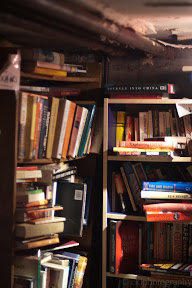
books, pile, stack, mess, bookstore, window, light, backlit, cozy

In this case, I had a thought bubble up about explaining the size of one's library to guests when they ask "So, you've read all of these?" What a silly question. It's usually posed by someone who has no library of their own, no understanding of the value of such a collection as insurance against dullness and the possibility of suddenly finding oneself with nothing to read. Sure, I have read a large number of the books on my shelves, and I keep them around as reminders of good times, comforting me with the knowledge that I absorbed something from each of them, and can easily open them up again as I please.

It's this last point that is relevant here. The book in question turned out to be A Passion for Books, appropriately enough. I brought this somewhat large paperback along on a solo bike trip last summer under the assumption that I would have time and energy left for reading after biking 60 miles a day. I did not. Nonetheless, I got through a couple of the essays and whatnot while in various B&Bs and the memory link stuck. The book, my friend, had traveled with me and formed that particular synaptical [sic!] connection while in the middle of strange lands (Western Maryland, you know) and unfamiliar furnishings.

Here now are the three passages by assorted authors from the Passion for Books collection which each mention (independently!) the arduous task of explaining one's library to unsuspecting visitors:

In the gradual growth of every student's library, he may – or may not – continue to admit literary friends and advisers; but he will be sure, sooner or later, to send for a man with a tool-chest. Sooner or later, every nook and corner will be filled with books, every window will be more or less darkened, and added shelves must be devised. He may find it hard to achieve just the arrangement he wants, but he will find it hardest of all to meet squarely that inevitable inquiry of the puzzled carpenter as he looks about him. "Have you really read all these books?" The expected answer is, "To be sure, how can you doubt it?" Yet if you asked him in turn, "Have you actually used every tool in your tool-chest?" you would very likely be told, "Not one half as yet, at least this season; I have the others by me, to use as I need them." Now if this reply can be fairly made in a simple, well-defined, distinctly limited occupation like that of a joiner, how much more inevitable it is in a pursuit which covers the whole range of thought and all the facts in the universe. The library is the author's tool-chest. He must at least learn, as he grows older, to take what he wants and to leave the rest. 
Books Unread by Thomas Wentworth Higginson (what a name)

In the two years I had been coming there, maybe two or three hundred days spent in that apartment from morning till night, I never saw anyone else there – no visitor, no delivery person, no handyman – no one. I asked Chaim about this on one of our walks (I later understood that great Yiddish writers simply do not have or permit visitors; then again, maybe it was the threat of coffee that kept everyone away), and he said something about not wanting people to think him strange for having too many books. I thought he was talking about the annoying line all book collectors endure: Have you read all of these books? I told him about Dr. Johnson's stock response: Yes, and some of them twice! Chaim stopped walking and looked at me disdainfully. "If anyone asks you if you've read all those books," he said, "it means you don't have enough books."
They Don't Call It a Mania for Nothing by Harold Rabinowitz (also the editor of Passion)

About the time of the discovery of America a book came out called The Ship of Fools, by one Sebastian Brant. In it was an attack on the book fool: a satire on the passion of collecting, in which the author said that the possession of books was but a poor substitute for learning. That phrase which the layman reader asks the book collector so often with a smirk of condescension, "So you really read them?" undoubtedly originated then. The real book collector, with suppressed murder in his heart, smiles acquiescence, assuming an apologetic air for his peculiar little hobby. His invisible armor is his knowledge, and he has been called a fool so often he glories in it. He can afford to have his little joke. So much for this threadbare gibe.
Talking of Old Books by A.S.W. Rosenbach (perhaps the most successful modern book collector of them all)

Monday, March 25, 2013

Encouraging growth (aka, pruning)

D
istinctly not my most exciting post ever: Last week, mid-March, I went about the process of pruning some of the more unruly shrubs around the yard. Today, it's snowing and there's an inch of frozen precipitation covering the buds and new shoots. Oh well? I've put together a second sheet in my spreadsheet of garden info using my favorite pruning book, the American Horticultural Society's Pruning and Training.

For the most part, pruning is about removing dead or diseased parts of the plant and encouraging growth. It's important to understand how a plant reacts to pruning in order to stimulate the growth you want. When a cut is made, the plant will react by putting energy into growing side buds on that same branch, or if you've cut back hard, by sprouting a bunch of new shoots from around the base of that cut. So, you'll want to cut back to just above a bud, so that the branch can then create a couple new branches and nice bushy growth. The book really explains this better.

The result of my tidying was a large trash bin of very prickly rose branches, yet to picked up by our wonderful local rubbish collection service. My rose bushes are tidier without dead branches cluttering up their undersides and centers (preventing light from reaching the lower branches and providing a home for mildew, bugs and other troubles), and a few of the other shrubs around the yard are less leggy and ready to fluff out with spring growth. Anyway, here's the new pruning sheet:


Next up on my list is fixing the boxwood disaster in front. I've debated between just trimming it back up into formal hedge shape and trying out some cloud pruning, but I think the former will win out. It's just so dull looking in front of the house with nothing but green hedge. If I trim up the underside enough I may be able to get some wandering jew under there, or at least a couple pots of trailing vines.

Monday, March 18, 2013

Book review: Feynman's Rainbow

hen I started reading Feynman's Rainbow, all I knew about it was that it was on my to-read stack as a result of being a recent gift, and of course the title. I mean, heck, it includes "Feynman," what could go wrong? I had forgotten the other reference point that came with it: Leonard Mlodinow was also a writer for Star Trek. This finally occurred to me somewhere later in the book when he mentions his writing hobby and desire to become a screenwriter.

Most of the memoir/biography is about Mlodinow's time at Caltech in the 1980s, when he was unsure as to his worth as a physicist (and human being, since these things tend to devolve quickly into total failure of confidence). Supposedly, Rainbow is more about Feynman than Mlodinow, hence "biography," but I found it to be more focused on the author's soul-searching and interactions with many other characters at Caltech. Sure, there are big block quotes from his conversations with Feynman, but they're more anecdotal than anything else. That makes me think that the book rides on the famous physicist's name, but survives on the actual content.

Double rainbow over Marlboro College, 2006
And it was rather compelling content, too. Perhaps that's just because I feel like I'm in a similar, confusing, in-between place where I'm not terribly confident in my abilities. Still, Mlodinow's writing was engaging and he explained the related physics in straight-forward terms, just to fill the reader in on context.

While the book's title comes from a particular section on finding what is beautiful and amazing to you and then following that sense to your life's work, I particularly appreciated this quotation from Feynman:
I have to think I have a little bit better chance than the other guys, for some reason. I know in my heart that it is likely false, and likely the particular attitude I'm taking with it was thought of by others. I don't care; I fool myself into thinking I have an extra chance. That I have something to contribute. Otherwise I may as well wait for him to do it, whoever it is. 

Thursday, February 21, 2013

What color is your flower?

few weeks ago a friend suggested that I fill out the "Flower exercise" from What Color Is Your Parachute? The exercise is designed to help you figure out what you're looking for in a career, and from what I can tell, it's also the core of Parachute (My copy is from something like 1980, and I haven't quite managed to read it). The book actually goes into quite a lot of detail on how to fill out the flower, but you can also just wing it based on the petal titles.

I know, it sounds a little hokey. I thought so too, especially since I thought I had a pretty good idea what I was looking for already, but I went with it. Turns out it's always helpful to get thoughts outside your head, whether to see all the facts in one place, leave reminders for yourself or generate new thoughts in the process. I don't want to make mine entirely public, but here are a few things I'm looking to do in my career:
  • Make information widely available and easy to access. That could be something straightforward like library work, or structuring webpages so that users can find what they're looking for plus several things they weren't. It could even be backend support for projects with this as a goal, e.g. part of a multidisciplinary team.
  • Help people become inspired to be self-motivated, informed learners who never just say "I don't know," but rather "Let's look it up."
  • Provide information services through products that are viable, upgradeable, scaleable and generally future friendly. So, no silos, relative links, transferable data, that sort of thing. 
As for skills, I have profiles on Coursera and Codecademy that will give a bit of an idea what MOOCs I've been fiddling with, and this project should also make it pretty clear what I'm capable of (anything! mwahaha*ahem). Generally: HTML, CSS, JS, some SQL and PHP, WordPress, Photoshop, Lightroom, baking, gardening... 

The other petals include things like: I'd like to work in a sunny, friendly office, with bikeability, sensible benefits, and most importantly lots of opportunity for learning and inspiration from colleagues, classes, workshops, conferences. 

And continuing with the embedding problem, here are some snippets of Parachute from Google Books in an iframe:

Wednesday, April 18, 2012

How inner conflict makes dullards of us all

r something like that. Having never read Chekov previously and also having no historical context for his writing, what follows is an entirely off-the-cuff stream of thoughts relating to the short novel, The Duel (translated by Constance Garnett, as recommended by Hemingway).

On the surface, this seems to be a story about a bunch of locals with nothing better to do than squabble and moralise at each other. Since all they have are their own experiences and opinions and lack much depth, they are not terribly interesting or sustainable characters, but their observations of each other carry some weight to the reader.

Instead of just taking the situation at face value, it's also possible to see the conflict as a metaphor for the conflict within an individual. In particular, the two gentlemen who wind up dueling, Laevsky and Von Koren, might be representative of the conflicting aspects of a personality, two ways in which to react to the surrounding world. Both consider society to be broken and useless. Laevksy chooses to spend his life full of apathy and regret, avoiding engagement, while Von Koren displays aggression towards others in a misconstrued attempt to bring them around to his philosophy, and also toward himself in order to maintain his prescription of action.

By the time the characters reach the grounds of the duel, they have both lost their motivation and aggression and decide not to follow through. They are the dueling aspects of a personality: at great odds with each other right up until the critical point, when nothing comes of the whole business (and the deacon steps in! Don't get me started on spirituality). They continue on their paths and gradually make some changes in their lives, but the grand, driving force of pure dogmatism has disappeared.

So I suppose the lesson I took from this was that holding your ground and acting on/being true to your character is important to maintaining an identity and strong progression through life. Don't stand still or get lost in internal debate, but use conflict to come to new places in thought and in life. Or something like that.

Saturday, March 31, 2012

Etymology, or, Seeing the trees for the forest

eautiful.         Pronunciation:  /ˈbjuːtɪfʊl/
Forms: beautefull, beutifull, beutyfull, bewtifull, bewtyfull, beuty-, butyful, beautifull, beautyfull, beautiful, beautifull.
Etymology:  < beauty n. + -ful suffix. Occas. compared with -er, -est, usually with more, most.

A.2.a.  Affording keen pleasure to the senses generally.
A.3. Impressing with charm the intellectual or moral sense, through inherent fitness or grace, or exact adaptation to a purpose. 1
Là, tout n’est qu’ordre et beauté,
Luxe, calme et volupté.2
beauty, n.   Pronunciation: /ˈbjuːtɪ/
Etymology:  Middle English bealte,  beute, < Old French bealte, beaute,  biaute,  earlier beltet, modern beauté, (cognate with Provencal beltat,  beutat, Spanish beldad, Italian beltà ) < late Latin *bellitātem, < bellus beautiful: see -ty suffix1.

I. abstractly: 2. That quality or combination of qualities which affords keen pleasure to other senses, or which charms the intellectual or moral faculties, through inherent grace, or fitness to a desired end; cf. beautiful adj. 3.

   A girl came in the café and sat by herself at a table near the window. She was very pretty with a face fresh as a newly minted coin if they minted coins in smooth flesh with rain-freshened skin, and her hair was black as a crow's wing and cut sharply and diagonally across her cheek.
   I looked at her and she disturbed me and made me very excited. I wished I could put her in the story, or anywhere, but she had placed herself so she could watch the street and the entry and I knew she was waiting for someone. So I went on writing.
   The story was writing itself and I was having a hard time keeping up with it. I ordered another run St. James and I watched the girl whenever I looked up, or when I sharpened the pencil with a pencil sharpener with the shavings curling into the saucer under my drink.
   I've seen you, beauty, and you belong to me now, whoever you are waiting for and if I never see you again, I thought. You belong to me and all Paris belongs to me and I belong to this notebook and this pencil. 3
1. "Beautiful, adj. and n." Second edition, 1989; online version December 2011. <http://0-www.oed.com.libsys.arlingtonva.us/view/Entry/16680>; accessed 26 February 2012. Earlier version first published in New English Dictionary, 1887.
2. Baudelaire, Charles. "L’Invitation au Voyage." Online version 21 mars 2012 à 15:42 <http://fr.wikipedia.org/wiki/L%27Invitation_au_voyage_(poéme)>; accessed 30 March 2012.
3. Hemingway, Ernest. A Moveable Feast. New York: Scribner, 1964. Print.

Monday, December 19, 2011

Quotations: Calvino

n the shop window you have promptly identified the cover with the title you were looking for. Following this visual trail, you have forced your way through the shop past the thick barricade of Books You Haven't Read, which were frowning at you from the tables and shelves, trying to cow you. But you know you must never allow yourself to be awed, that among them there extend for acres and acres the Books You Needn't Read, the Books Made For Purposes Other Than Reading, Books Read Even Before You Open Them Since They Belong To The Category Of Books Read Before Being Written. And thus you pass the outer girdle of ramparts, but then you are attacked by the infantry of the Books That If You Had More Than One Life You Would Certainly Also Read But Unfortunately Your Days Are Numbered, with a rapid maneuver you bypass them and move into the phalanxes of the Books You Mean To Read But There Are Others You Must Read First, the Books Too Expensive Now And You'll Wait Till They're Remaindered, the Books ditto When They Come Out In Paperback, Books You Can Borrow From Somebody, Books That Everybody's Read So It's As If You Had Read Them, Too. Eluding these assaults, you come up beneath the towers of the fortress where other troops are holding out:
     the Books You've Been Planning To Read For Ages,
     the Books You've Been Hunting For Years Without Success,
     the Books Dealing With Something You're Working On At The Moment,
     the Books You Want To Own So They'll Be Handy Just In Case,
     the Books You Could Put Aside Maybe To Read This Summer,
     the Books You Need To Go With Other Books On Your Shelves,
     the Books That Fill You With Sudden, Inexplicable Curiosity, Not Easily Justified.
Now you have been able to reduce the countless embattled troops to an array that is, to be sure, very large, but still calculable in a finite number; but this relative relief is then undermined by the ambush of the Books Read Long Ago Which It's Now Time To Reread and the Books You've Always Pretended To Have Read And Now It's Time To Sit Down And Really Read Them...

 From If on a Winter's Night a Traveller, by Italo Calvino. Wonderful book, you should go read it.

Saturday, December 10, 2011

Books read in Chincoteague (7 of 7): The Cabinet of Curiosities

ast but certainly not least we have a book acquired from one Jeff VanderMeer, signed by said editor and his accomplice, Ann VanderMeer, and kindly shipped to me for review purposes an embarrassingly long time ago. As is appropriate to such an anthology of bits and pieces, I read The Thackery T. Lambshead Cabinet of Curiosities in fits and starts, probably beginning by the pool last summer, the majority read at Chincoteague, and finished post-move in the new house. On the other hand, it's a rich and complex enough world to sink into, if one tends towards more efficient, focused reading.

bookstore, books, basement, capitol hill books, dusty, creepyThis level of complexity largely stems from the wide array of contributors to this steampunk confluence, including Garth Nix, Tad Williams, Cherie Priest (of Boneshaker) and Alan Moore. While there were amusing oddities described in brief at various points in the book, the short stories have continued to stand out in my mind. The Relic, a story of a sand-bound church and its odd holy item, has stuck with me most. Some of the content felt mildly forced from the authors' pens, as if they had a story to tell, but had to include that one pesky element (the curiosity). The best written works used the items from Lambshead's cabinet, or snippets about the Doctor himself (because, of course, he was a doctor) to explore into a corner or two of the world set before them. This difference lies between the authors who tried to make the curiosities fit into a world of their own and those who used the curiosity to explore Lambshead's world.

The art is also a wide sweep of varietals, ranging from detailed penwork to signature styles to collaged photographs used to illustrate the [wholly imaginary] cabinet. This is a most impressive anthology, which I will be pleased to keep on my shelf and sometimes flip through to reread a passage or two.

The accidental harmony of the trenches during the war produced, sometimes, odd acquaintances... "Well, that's a proper cup," Russell said softly, as the smell climbed out of the teapot, fragrant and fragile. The brew, when he poured it, was clear amber-gold, and made Edward think of peaches hanging in a garden of shining, fruit-heavy trees, a great sighing breath of wind stirring all the branches to a shake. 
"It'll be all right, you know," Russell said. He rubbed a hand over the teapot. "I don't like to say, because the fellows don't understand, but you see him, too; or at least as much of him as I do... I don't know his name," Russell said thoughtfully. "I've never managed to find out; I don't know that he hears us at all, or thinks of us. I suppose if he ever woke up, he might be right annoyed with us, sitting here drinking up his dreams. But he never has."
Lord Dunsany's Teapot, by Naomi Novik, from The Cabinet of Curiosities. 

Wednesday, November 30, 2011

Books read in Chincoteague (6 of 7): The Shipping News

arlier in this week of reading I very quickly judged a book to be not-my-type. The same could have happened with The Shipping News, but for the fact that Annie Proulx's writing style (unique, fragmented thought-blows of sentences) drew me in, the hope that things would improve for Quoyle, our protagonist, and the knowledge that the book did pick up in mood after the first few chapters. It was well worth it, and that very same point winds up being the heart of the book.

The early descriptions of Quoyle make him out to be a lumbering clod, barely capable of speech, unattractive in every way, making the reader feel the self-loathing of a young man lost in a highly critical world. As he begins to let his voice be heard, more of his own character comes out, slowly and painfully, and the story moves forward as we get to know him and he gets to know himself. While the beginning of the book is one calamity after another, Quoyle sticks with it and keeps plodding along, going where the winds take him until his fortunes right themselves.

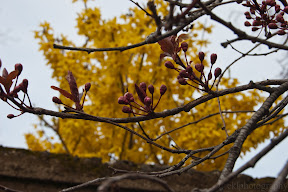
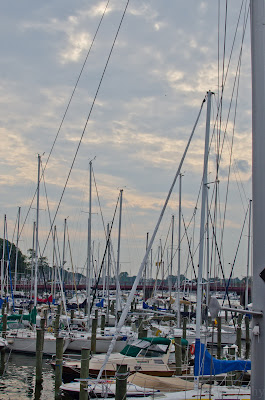
spring, flowers, blossoms, tree, DC, Frederickboats, masts, harbor, marina, Eastport, Annapolis, cloudsshed, collection, yard, oddities, weird, carebears, barney


Once I was inside this world, I stopped wanting to leave. One of my favourite quirks in the book is Quoyle's habit of creating impromptu newspaper headlines about the world around him ("Man with Hangover Listens to Boat Builder Project Variables"). There was also the warmth of the closeknit community in the Northern reaches, the intriguing history and mystery of each character and the town, even an abandoned village on a desolate island. I made a point of never checking the publication date on Shipping News, because it sits fairly happily in the near-present, comfortably familiar and nonspecific. Come to think of it, this was probably my favourite book of the week.
"There are four women in every man's heart. The Maid in the Meadow, the Demon Lover, the Stouthearted Woman, the Tall and Quiet Woman."

Monday, November 28, 2011

Books read in Chincoteague (5 of 7): Rereadings

nother weakness: anything with Anne Fadiman's name attached to it. Rereadings is a collection of book reviews that Fadiman ran whilst at The American Scholar literary quarterly. Each review is a rereading of a book the reviewer (usually a writer themselves) had read long in their past. As Fadiman points out, each is more of a mini-memoir than a review of the book itself. Since I seem to currently be into memoirs and essays, this suited me just fine, plus the entire book is making recommendations for further reading! As if I needed more to read!

The eventual conclusion that each review comes to is: Everything Changes but the Past remains the same. The reviewers largely find themselves rereading with more perspective and experience, but remember their old selves, motivations and weaknesses (their ignorance and their bliss) vividly through association with the text. It makes me incredibly happy to hear others talking about their love of books, and how a life of reading has bolstered a life of writing. These aren't great literary accomplishments, these reviews, but they are familiar, as if hearing a friend tell you a long story after dinner in order to make the point: you might like the book, too.
stack, books, bought, sundial, to-read
"It never occured to me that the need to catalog the stuff of everyday life might be a sign that the authors I loved were loners and misfits. Normal people, after all, don't stand around at garden parties or lie in bed with their loved ones trying to figure out what even the smallest ordinary gesture means."

-David Samuels, Marginal Notes on the Inner Lives of People with Cluttered Apartments in the East Seventies, a rereading of J.D. Salinger's Franny and Zooey.


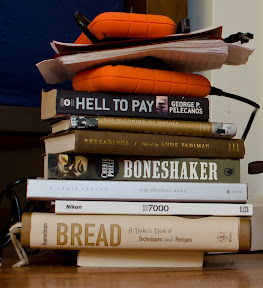
Evidence of the superfluity of books in my life: this wee pile was acquired whilst in Sundial Books, currently the best little bookshop in Chincoteague.

Friday, November 25, 2011

Books read in Chincoteague (4 of 7): Boneshaker

or once, the cover blurb is entirely accurate: "A steampunk-zombie-airship adventure[!]" Really, what more do you need to know? And yet, the characters in Cherie Priest's Boneshaker do go a bit deeper than that. They have emotional needs, frailities, a search for a father and role model, a last hope for lost love, an avoidance of kinship at the same time as a frantic search for the same. Not to mention attempts to understand another culture, come to terms with a violent history and guilt (over the same), and yes, the book contains a map.

In the desolate wastes of an alternate Seattle it's every man for himself, except when he feels the need to assuage his guilty soul by coming to a comrade's aid, but it's also all men against the undead, the darkness, without and within. Things can be simple and full of comaraderie in a society with a common enemy. And yet, men and women turn against each other in order to save themselves, to avoid or fight their inner demons, always always putting the self first, for there is very little true altruism in the world.

The book was pretty good, a fascinating and light frolic through a fledgling universe with some mystery thrown in along the way. The steampunk aspects are not obnoxiously overwhelming, but the "blight" victims (the zombie hordes) seem a little gratuitous (I think this is pretty much always the case with the undead). At four hundred fourteen reasonably dense pages, I could have gone for a lot more detail of the world and development of some of the characters' relationships. I'm told there are further developments to be had in subsequent novels.

Monday, November 21, 2011

Books read in Chincoteague (2 of 7): Hell to Pay

his was a bit of a disaster for me. I think I encountered George Pelecanos mentioned among a list of the best DC based authors (including Marie Arana). When I heard he wrote crime novels set in DC, I had to read one. Unfortunately, the first chapter I attempted was not to my liking (I believe that was The Big Blowdown), and I dropped that attempt back at the library in favor of a different set of a characters and plot. Come some booksale, I picked up two more, and brought Hell to Pay along to the beach in hopes that it would be a good fluffy crime/thriller to keep me going.

Nooo such luck. If I could've gotten behind the writing the story might have been decent, but it seemed bogged down in vernacular (like the books written in a Scottish "accent"), not just in the characters' voices but in the narrator's as well. The overwhelming number of scenes drenched in sexual innuendo and indiscriminate flirtations were nauseating and unappealing and I didn't care in the least whether the crime was solved or not (although at the point I got to, a quarter of the way in, there had yet to _be_ a crime commited). So perhaps this is simply not the book, nor even the author for me. Oh well.


Washington, DC, New York Avenue, downtown, snow, traffic

Friday, November 18, 2011

Books read in Chincoteague (1 of 7): Catch-22

s I finally wrapped up the last chapters of Catch-22 and went to enter this triumph in my book log, I discovered that I had begun this one not just months ago, but last November. Horrors, that I had left a book neglected for so very long, thinking that I wasn't in the mood for it, not giving it a chance. Well, to be fair, I probably wasn't in the mood for it, nor would I ever have been, but finally, on the porch swing overlooking the marsh, I at least felt comfortable enough to forge my way through the latter third of Catch-22 without going crazy myself.

Having been told by two reliable sources that this was a hilarious read, full of wit and whimsy, albeit dark whimsy, I figured I ought to at least give it a chance, read the whole damn thing and be able to reflect on it. Having done so, I'm glad I did, but the journey was one of the most depressing I've been on, stretching thin my last shreds of faith in a decent world.

Anyway, horrifyingly obtuse and, yes, hilariously conniving as Colonel Cathcart and Milo are, clearly this is a pretty good book because it did _get to me_. And I did understand Yossarian's plight, the desperation and the confusion, the fear that the world really is nuts, that this must be some deep level of punishing inferno, and the emotional grasping at what few friends could be found in the midst of war.

cavern, catacombs, McMillan, sand filtration, Washington, DC, underground, columns

What spun me for the greatest loop was the ending. I guess I shouldn't say here, (oh, heck: SPOILERS!) but it didn't seem in keeping with the rest of the book. In fact, I was so thrown by the ending that I felt certain I missed an important detail and Yossarian was deep into some fever dream, or was heading off for the promised land. The entire last two chapters or so took a sharp left and nearly tossed this passenger out around the curve. I suppose I'm glad it ended the way it did, with a hope for the future, an open ending and striking out for a new world. All is not lost, life goes on, "persevere."

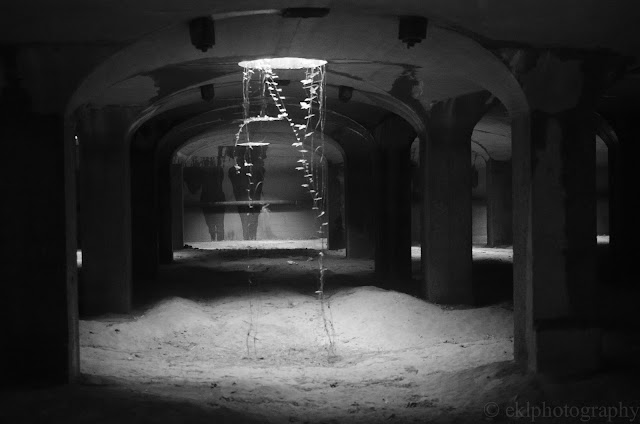
Not sure the photo is relevant, but since I didn't have anything that really is... this underground catacomb is from an exploration of the old McMillan sand filtration site in NE DC I did with DCUrban Explorers in late October.

This review also appears in part on LibraryThing.

Thursday, November 17, 2011

Books Read in Chincoteague (0 of 7): Introduction

am a reader. If I could be The Reader I would be, but in this day and age it seems that all of the archetypes have all been claimed, and all one can do is occupy an indefinite article.

In order to avoid a[nother] rant about [the sad state of] contemporary society, I will simply describe the situation, the setting for the seven posts I will make in the forthcoming fortnight. Once a year, every year for the last [20+] my family has vacationed in a small cottage on Chincoteague Island for a week. When I was smaller and/or younger, the purpose included daily trips to the ocean for sandcastle making and mole-crab catching, mom-made sandwiches and hours spent sitting in the porch swing listening to books on tape. 

books, boneshaker, not becoming my mother, shipping news, hell to pay, rereadings, vacation, readingNow the entire purpose seems to be to bike around the [nice, flat] island a bit, go for a long walk or two on [what's left of] Assateague Island and spend as much time as possible reading book after [quality] book. In my teens, I blazed through every book Anne McCaffrey had written in the space of approximately 48 hours (Slight exaggeration. May have been 72.). While I'm still not reading Joyce and James and Dostoevsky in the space of hours, I did manage a few decently mature books in the space of a week; a book a day for soothing a soul. 

And, somehow, the books I brought along matched my mental state and future-goals with aplomb. Each stood up and made its point across time and space, reaching me through excellent authors, stories and words. 

The overarching themes in a nutshell: From The Shipping News to Catch-22, a frabjous sense of optimism or hopeless-hope in the face of disaster, despair and delirium (Endless tie-in!), lessons on the paths we take through life to the place Ruth Reichl's mom teaches us to be: unshakably within our selves.

Then, from Boneshaker back to Shipping News, a sense of community and grand purpose pervading humanity in times of challenge and need. Reichl's mother proselytizes steadfast self-confidence, but the citizens of Proulx's Newfoundland will tell you: in the end, only the wind and the sea will have their way.

Stay tuned for seven (7!) upcoming (short) book reviews...

Monday, October 17, 2011

Pear, almond cream, tart. At length.

ometimes the route I take to a baking project is long and roundabout. In this case, I started well over a month ago thinking "oh hey, I should make pie crust with all this cream cheese that came out of my parents' fridge during the hurricane." Having subsequently moved, still with said cream cheese, it's now October, and the fruit available has changed completely. Fortunately, I moved to a location two blocks from a weekly, year-round farm market and despite the apple season fanatics, I found some lovely pears and bought 10.

Then I went looking for a recipe. I'd do it first, but that tends to result in a harried and expensive trip to several specialty stores looking for things like "espresso powder" and whatever. In this case, I got away with nothing more extravagant than a vanilla bean (albeit a bit of a ripoff at the local "My Organic Market").

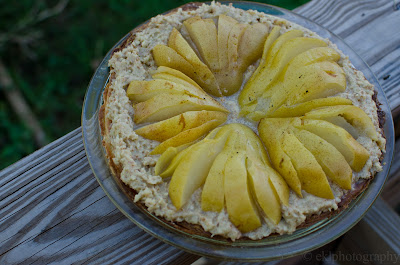
Pear and almond cream tart pre-baking

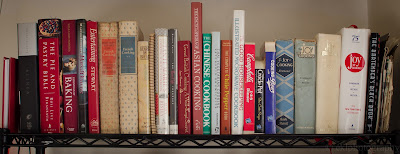
So there I was with pears and cream cheese pie crust premade and waiting in the freezer (keeps for up to three months, yet I never pre-make enough for it to last more than one pie). A quick poke through my trusty bookshelf o' cookbooks, and I arrived at the inevitable conclusion: The Pie and Pastry Bible. Someday, I swear I'll use different books. Really. Having avoided apples especially because I'm tired of fruit-in-crust pies, I wanted something a little more interesting. The options were a gingery pear chiffon pie (which I had modified a couple years ago into a ginger and chocolate ganache pie for Thanksgiving) or pear almond cream tart.

Cookbook collection on the pantry shelf
Before I get into the things I'll do differently next time, let me just say that this is a very tasty, decent looking little open-faced pie/tart. However.

It started with the pre-baked crust. Ok, so the recipe called for the normal flakey pie crust, in a tart pan, and I was using cream cheese crust in a pie plate. It kinda shrunk a lot and got a bit too toasty on its own when it should have been a little underbaked in order to withstand the subsequent baking with filling. Still, super flakey, and actually incredibly tasty when dark brown and slightly caramelized with filling.

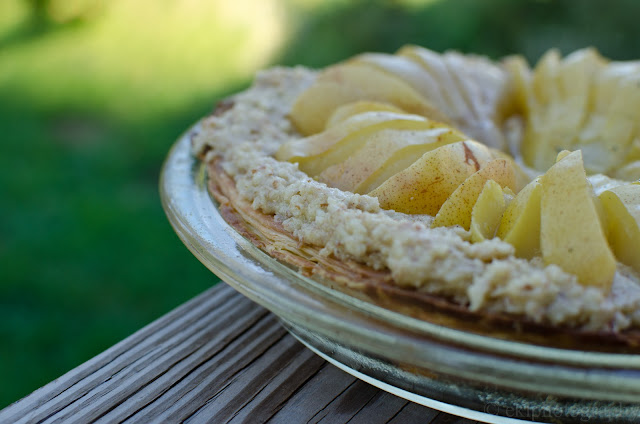
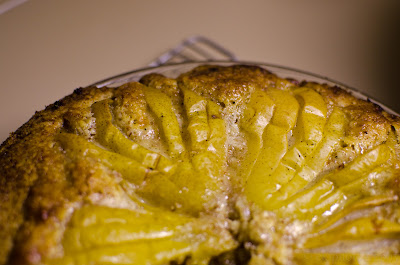
Pear almond cream pie, fanning of pears, cut
I also neglected to thoroughly process the almond flour/stuff. And to use blanched, sliced almonds. But that's just cause they come in "raw" in the bulk department. So, instead of what I assume was meant to be a smooth, creamy filling, I have a nutty, thick filling. It did manage to puff up (eventually) and has the texture of chewy meringue around the edges (also a little darker than necessary).

The poaching of the pears went well, though I recommend watching them a bit more carefully than I did and not getting distracted by other wildly exciting things like de-clogging the vacuum. yeah. I reserved some of the poaching liquid for my food and drink obsessed housemate to mix cocktails or something with. The vanilla bean was very worth it and can never, ever be substituted with vanilla extract, so don't even think about it.

Finished pear almond tart, meringue edges
In the video on Rose Levy Beranbaum's website (below), she has the pears sliced the short way across and fanned into little ridged mountains in the almond filling. It makes a kind of star pattern, but that didn't quite make sense to me visually, edibly or uh, logistically, so I fanned them lengthwise instead, with the intent that the almond filling could puff up between the slices. This mostly worked, but again I neglected to really thoroughly drain the pears, so the pie/tart took a lot longer to cook and was too wet in the center for most of the time.


This is kind of a long post for one little pie experiment, but I went searching the interweb for more info when the recipe didn't make sense and only easily found RLB's website. Hopefully this will help someone else. And also photos. It's blissful having a back porch to take things out on into natural light in order to photograph. The finished pie photo is from inside and at night (bleh!).

Tuesday, July 19, 2011

Wineberry pie

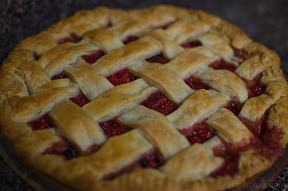
aving the recipe is only half the battle. It took several pies for me to get the pie crust to behave in such a way that I could roll it out, instead of trying to piece something together out of the fragments that never became a whole. Your only hope in this matter is to start with a good recipe and figure it out for yourself. The very best book ever is "The Pie and Pastry Bible" by Rose Levy Beranbaum. I've gotten so many recipes out of this book, if you know me, you've probably had one. In my mind, the best kind of cookbook isn't just recipes but philosophy and information, so that you actually have some clue why things need to be just so. Absolutely essential for the baker. Go get it. shoo.

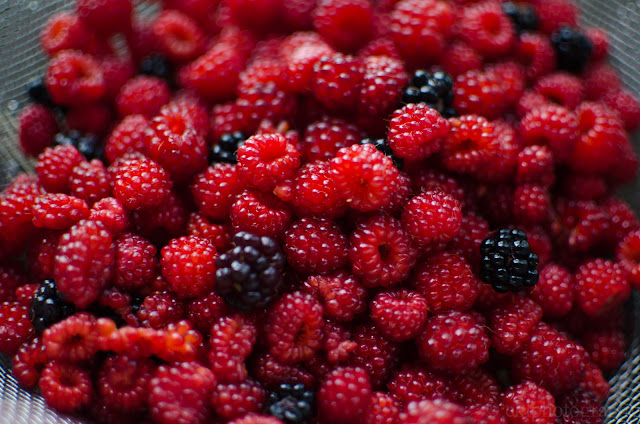
This past weekend I had the good fortune to spend a night atop a mountain in the Shenandoah region, and came back (thanks to Wortklauberlein) with a pound of fresh berries from the bazillions of vines lining the roads. The local population informed us that they are wineberries, a particularly sweet variety of raspberry. There's nothing so satisfying as baking or cooking with food you've picked yourself. er, or that someone has thoughtfully picked for you.
pie, berries, fresh, handpicked, appalachians, shenandoah, wineberries, blackberries

Ingredients
"Deluxe flaky pie crust" 21 oz
    14 tbl unsalted butter, cold.
    2.25 cups flour (pref. pastry)
    1/4 tsp salt
    1/4 tsp baking powder
    7.5 tbl ice water
    1 tbl cider vinegar
0.5 cup sugar (I only had brown)
2.5 tbl cornstarch
pinch salt
1 lb berries, washed and picked over for passengers.
  1. Pick a pound of wineberries and a few blackberries from Flattop Mountain. Or your backyard. Or somebody else's backyard. I don't think you can buy wineberries in the store, but this recipe will likely work with whatever berries you have handy.
  2. Make pie crust:
    • cut butter into small cubes, freeze for 30 min +
    • put flour, salt, baking powder in gallon size ziplock bag, shake to mix thoroughly.
    • add frozen butter, expel air and use rolling pin to (patiently) roll butter into flat flakes. Shake bag to redistribute when mix gets bunched up at one end. Freeze for 10 min.
    • sprinkle water and vinegar into bag, toss to mix.
    • keeping the bag open, knead from the outside of the bag until dough forms a single lump. To do this, you'll need to use the bag to fold the dough onto itself (don't touch it directly). About halfway through you'll get frustrated because it's not holding together yet. Put it in the fridge for a few minutes and come back to it. Once it's a lump, divide into two pieces, one for the top and one for the bottom crust. 
    • Refrigerate for at least an hour, preferably overnight. 
  3. Roll out bottom crust on lightly floured surface to 1/8 inch thickness. Lay in pie pan, cover and refrigerate at least 30 min, no more than 3 hours.
  4. Combine sugar, cornstarch and salt, whisk together. Toss berries gently in this mixture and let sit for 15 minutes. 
  5. Toss gently again and pour into bottom crust.
  6. Roll out top crust to 1/8 inch. I used a lattice pattern, but you could do a full top crust and cut a hole in the middle for steam to escape. Lay top crust over berries, use water to glue and fold edges under (or over) and crimp using a fork or your fingers.
  7. Refrigerate pie, covered loosely in plastic wrap, for about an hour.
  8. Preheat oven to 425 at least 20 minutes before baking. Use a baking stone if you have one and put it on the lower rack. Bake pie for 30 minutes or until juices are bubbling and crust is browned. Put a baking sheet or foil underneath the pie plate to catch drips.
  9. Let cool for at least 2 hours before serving, probably more like 4 if you have the patience.