Showing posts with label writing. Show all posts

Wednesday, June 11, 2014

The Joy of "The Joy"


This article originally appeared in the Mountain Courier in March 2013, and I completely forgot to post it to my blog! My friend Suzanne, who edits and writes for the paper, suggested I write the article after seeing my collection of Joys in my kitchen pantry.

The sun slowly rises over a small sea of pop-up tents, my coffee and my breath adding to the quietly dissipating morning fog. A lone jogger pads by, the only traffic at this early hour. Piles of neatly stacked root vegetables, compulsively organized by a sleep-deprived farmer, wait patiently for the 10 am rush. My numbing fingers flick through the pages of a cookbook I’m perusing, looking for recipes to recommend with today’s cuts of grass-fed beef, pork, lamb and chicken that I’m here to peddle.

I was a vegetarian for the first 20 or so years of my life and have since been playing catch-up on how to cook things like pork belly and beef tongue. My customers and I, the adult novice, have found this particular cookbook quite handy for basic information and creative uses for a wide range of ingredients, both familiar and novel. The book is the Joy of Cooking, my ultimate guide on all things food.

Farm markets vary greatly across the region and the seasons, which translates into a certain amount of uncertainty as to what will be available at any given time. Seasonal produce is preferable for freshness, nutrition and the local economy, but sometimes one just doesn’t know what to do with a pile of kale and turnips, much less the wealth of parsnips or variety meats. It is here, in the unexpected and unexplored, that a good reference on cooking becomes invaluable.

It was not my intention to collect multiple editions of the Joy of Cooking. When my first copy came to me, I was more interested in it as a book—an antique livre to add to my library—than as a cookbook. A quick read-through, however, inspired me to assemble an unnecessarily complex cake using separate recipes for the batter, frosting, filling, and probably cake syrup as well, not to mention decoration. My notes on the subject are still tucked into the pages of this 1943 edition (1946 printing).

This first Joy was a gift from my mother, purchased in an antiquarian bookshop in Vermont on the advent of my first apartment, and thereby my first kitchen. Before this, my cooking skills had approximately encompassed rice, eggs, and—thanks to a summer in a friend’s well-appointed kitchen—homemade pizza and cinnamon rolls. As a vegetarian still working on my thesis, my most elaborate dish was stir-fried vegetables with tofu. The Joy was essential to me for basic instructions, factual lookups, information on the latest new ingredient from the food co-op and rules for baking. It was indeed the ideal first cookbook.

As things progressed I acquired two more editions: a brand new 75th anniversary revision bought as retail therapy, and my grandmother’s own 1952 edition complete with her notes and clippings. My three copies currently reside with a 1972 revision owned by a roommate; four Joys in total.

Irma Rombauer’s first edition came into being in 1931 as a collection of personal recipes from her “Victorian roots” to pass on to her children as they left the nest. It was also intended as a helpful guide to the newly minted housewife, alone and bewildered in her kitchen, written to be “so clear that a child can follow it.”

The early editions were a very personal affair for Irma and her daughter, Marion Rombauer Becker, who provided the first illustrations as well as helping her mother test recipes and organize the book. Irma’s wit and familiar tone lend themselves to a very friendly text in which the cook can feel as if she has a personal relationship with her cookbook and its writer. My 1943 Joy includes advice on war rationing, as well as bunches of recipes for aspics, gelatine salads, timbales and soufflés, all in the interest of disguising an array of leftovers. My recipe of choice, however, is for Crepes Suzette (essentially flaming French pancakes), which comes with an amusing anecdote about the dish’s origins with Chef Henri Charpentier and the Prince of Wales.

Both the 1943 and 1952 editions contain extensive advice on entertaining, how to execute full dinner service and from which direction the servants should serve the fish course. There is a handy chart on various fish and how to cook them, quite a lot on baking and confections, nutrition charts, wine charts, herb charts, leftovers charts and a glossary. Irma also took care to “give this book the impression of sobriety and stability it deserves [such that] the alcoholic cocktails have been relegated to the chapter on Beverages.” On the other hand, she also acknowledged that while smoking at the dinner table was très gauche (it destroys the palate), the hostess must provide cigarettes and an ash tray to make her guests as comfortable as possible.

My grandmother’s Joy, the 1952 revision, continues largely along the same track as the 1943 with general rules aimed at gaining an understanding and then a variety of applications. There are some exciting additions such as more pasta, which “takes a good deal of doctoring to make palatable,” a more organized list of household hints and with the new illustrator, Ginnie Hoffman, diagrams for everything. Irma and Marion can be seen slightly at odds in the introduction, where Irma insists that no cook will read anything but the recipe and information that he or she is looking for, while Marion believes that explaining how the book works is worth a page or two.

These earlier versions also include a fairly extensive section on game lumped in with poultry. Terrapin, of course, is now protected under the Endangered Species Act, and not many would consider squirrel a viable food source, never mind bear. While the inclusion of frog legs, aspics and the use of the singular “cooky” may give these editions a dated appearance, even the very earliest Joy in my collection emphasizes nutrition, taking note of Americans’ tendency toward overeating and not balancing caloric intake with nutritional needs.

As time and culture have progressed through the last 75 years, the target audience shifted away from the blushing bride and housewife toward an independent new cook. In the middle years, many sections bit the dust, including “Know Your Ingredients,” much of the entertaining instruction, and the gelatine concoctions. The 1970s were a time when horizons and palates were broadening, food was being shipped greater distances and people were eating tofu, of all things. Marion Rombauer Becker reorganized the book into sections on The Foods We Eat, Heat and Keep, which meant that absolutely everything was shuffled and, I found, rearranged in illogical order. The 1975 edition was the most popular Joy ever, so it must have made sense to most readers and cooks.

Which brings us to the 75th anniversary Joy, published in 2006, thanks to Ethan Becker, Marion’s son. As a Rombauer broodling and graduate of Le Cordon Bleu, Ethan brought respect for heritage and tradition while being open to change. The revision he put together organizes the recipes once again by their place in a meal, beginning with drinks, then hors d’oeuvres, vegetables, meats, desserts, and finishing with methods for preserving. The glory of this edition is the encyclopedic appendix that brings back “Know Your Ingredients,” a plethora of substitution, conversion and other charts, and information on every method you might need to know. Contrary to my assumption, this edition actually contains an expanded section on game, although the handy diagram on squirrel is omitted.

So here we are, back from market with an armload of food, ready to experiment, to learn a new way of preparing a favorite squash and what exactly to do with a bundle of fiddleheads. Any bride, bachelor, or impulse shopper will find his or her way with Joy, branching out into ethnic cuisines, more modern dishes and favorite personal recipes from Ethan, Marion and Irma herself.

Epilogue: I have since also acquired a mint condition, dust jacket-intact 1964 edition of Joy. It is happily nested with the others and gets regular attention from the chef.

The original version of this article in the print edition is here as a PDF. It includes tidibits from other contributors in a four page layout extravaganza.

Wednesday, February 6, 2013

From the archives: Moose!

pulled onto Jenne road at 8:15, a left turn. As I advanced down the narrow dirt path at perhaps 10 or 15 mph, something moved in my left peripheral. I slammed on the brakes, stopping Gemma (my car) in her tracks. At the same moment, the poor moose I had startled walked out of the bushes to the side of the car, just a foot from my front bumper. I sat very still, being slightly worried that the moose would get the idea that I was trouble and should be trompled.  
The moose had other plans. He (I’m assuming it’s a he. It was a moose of moderate size without antlers) started ambling down the center of the road in front of me, completely blocking passage by any way.
So I waited. And I waited. The moose butt in front of me continued to mosey and generally take its time getting down the road ahead. When it was a moose butt in the distance, I started scootching up, revving my engine a little to let him know I was there. 
Two big moose eyes and ears turned to look at me in a vague, moose-like approximation of indignation. I stopped and went back to staring at moose-butt. Finally he decided, of his own accord, mind you, to get off the road, and stepped delicately into some shrubs. 
As I pulled past the spot where he had disappeared I muttered under my breath in mild frustration: Meese.

Originally posted to a previous (now defunct) blog on August 28th, 2006. One of two moose-sightings I had while living in Vermont!

Friday, September 7, 2012

Orwellian syntax

he title of this post is a little iffy, but I think it works in a couple of ways. First, the content here is by George Orwell, therefore is by definition Orwellian, right? Secondly, his proposed overhaul of the English language (which we'll get to as soon as I'm done justifying and rationalising) is a bit on the totalitarian side, ergo, Orwellian. And uh, Thirdly... thirdly... oh yes, his criticism of the current state of prose essentially compares it to the sort of meaningless catchphrases found in 1984, where words cease to have any relation to their meaning and generally cause the downfall of civilisation as we know it.

That pretty much sums it up, actually, but a little context: I've just read George Orwell's essay on Politics and the English Language. The essay alternates between lambasting several samples of [truly lousy] writing and prescribing a few guidelines to avoid further transgressions. It was written in 1946, so we can only imagine how pained Orwell would be to see the current state of the written word (probably including my own. erk.). I bet he and Hemingway would've gotten along in some ways...

And now, for my own reference and for yours, George Orwell's basic rules for passable writing:

(i) Never use a metaphor, simile or other figure of speech which you are used to seeing in print.
(ii) Never use a long word where a short one will do.
(iii) If it is possible to cut a word out, always cut it out.
(iv) Never use the passive where you can use the active.
(v) Never use a foreign phrase, a scientific word or a jargon word if you can think of an everyday English equivalent.
(vi) Break any of these rules sooner than say anything outright barbarous.

Taken from the essay Politics and the English Language, 1946, page 156 of George Orwell, A Collection of Essays, Harcourt Brace, 1981. 

Saturday, March 31, 2012

Etymology, or, Seeing the trees for the forest

eautiful.         Pronunciation:  /ˈbjuːtɪfʊl/
Forms: beautefull, beutifull, beutyfull, bewtifull, bewtyfull, beuty-, butyful, beautifull, beautyfull, beautiful, beautifull.
Etymology:  < beauty n. + -ful suffix. Occas. compared with -er, -est, usually with more, most.

A.2.a.  Affording keen pleasure to the senses generally.
A.3. Impressing with charm the intellectual or moral sense, through inherent fitness or grace, or exact adaptation to a purpose. 1
Là, tout n’est qu’ordre et beauté,
Luxe, calme et volupté.2
beauty, n.   Pronunciation: /ˈbjuːtɪ/
Etymology:  Middle English bealte,  beute, < Old French bealte, beaute,  biaute,  earlier beltet, modern beauté, (cognate with Provencal beltat,  beutat, Spanish beldad, Italian beltà ) < late Latin *bellitātem, < bellus beautiful: see -ty suffix1.

I. abstractly: 2. That quality or combination of qualities which affords keen pleasure to other senses, or which charms the intellectual or moral faculties, through inherent grace, or fitness to a desired end; cf. beautiful adj. 3.

   A girl came in the café and sat by herself at a table near the window. She was very pretty with a face fresh as a newly minted coin if they minted coins in smooth flesh with rain-freshened skin, and her hair was black as a crow's wing and cut sharply and diagonally across her cheek.
   I looked at her and she disturbed me and made me very excited. I wished I could put her in the story, or anywhere, but she had placed herself so she could watch the street and the entry and I knew she was waiting for someone. So I went on writing.
   The story was writing itself and I was having a hard time keeping up with it. I ordered another run St. James and I watched the girl whenever I looked up, or when I sharpened the pencil with a pencil sharpener with the shavings curling into the saucer under my drink.
   I've seen you, beauty, and you belong to me now, whoever you are waiting for and if I never see you again, I thought. You belong to me and all Paris belongs to me and I belong to this notebook and this pencil. 3
1. "Beautiful, adj. and n." Second edition, 1989; online version December 2011. <http://0-www.oed.com.libsys.arlingtonva.us/view/Entry/16680>; accessed 26 February 2012. Earlier version first published in New English Dictionary, 1887.
2. Baudelaire, Charles. "L’Invitation au Voyage." Online version 21 mars 2012 à 15:42 <http://fr.wikipedia.org/wiki/L%27Invitation_au_voyage_(poéme)>; accessed 30 March 2012.
3. Hemingway, Ernest. A Moveable Feast. New York: Scribner, 1964. Print.

Monday, November 28, 2011

Books read in Chincoteague (5 of 7): Rereadings

nother weakness: anything with Anne Fadiman's name attached to it. Rereadings is a collection of book reviews that Fadiman ran whilst at The American Scholar literary quarterly. Each review is a rereading of a book the reviewer (usually a writer themselves) had read long in their past. As Fadiman points out, each is more of a mini-memoir than a review of the book itself. Since I seem to currently be into memoirs and essays, this suited me just fine, plus the entire book is making recommendations for further reading! As if I needed more to read!

The eventual conclusion that each review comes to is: Everything Changes but the Past remains the same. The reviewers largely find themselves rereading with more perspective and experience, but remember their old selves, motivations and weaknesses (their ignorance and their bliss) vividly through association with the text. It makes me incredibly happy to hear others talking about their love of books, and how a life of reading has bolstered a life of writing. These aren't great literary accomplishments, these reviews, but they are familiar, as if hearing a friend tell you a long story after dinner in order to make the point: you might like the book, too.
stack, books, bought, sundial, to-read
"It never occured to me that the need to catalog the stuff of everyday life might be a sign that the authors I loved were loners and misfits. Normal people, after all, don't stand around at garden parties or lie in bed with their loved ones trying to figure out what even the smallest ordinary gesture means."

-David Samuels, Marginal Notes on the Inner Lives of People with Cluttered Apartments in the East Seventies, a rereading of J.D. Salinger's Franny and Zooey.


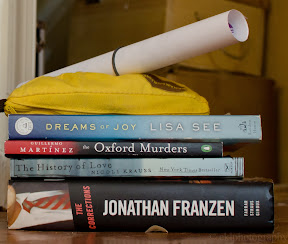
Evidence of the superfluity of books in my life: this wee pile was acquired whilst in Sundial Books, currently the best little bookshop in Chincoteague.

Monday, November 21, 2011

Books read in Chincoteague (2 of 7): Hell to Pay

his was a bit of a disaster for me. I think I encountered George Pelecanos mentioned among a list of the best DC based authors (including Marie Arana). When I heard he wrote crime novels set in DC, I had to read one. Unfortunately, the first chapter I attempted was not to my liking (I believe that was The Big Blowdown), and I dropped that attempt back at the library in favor of a different set of a characters and plot. Come some booksale, I picked up two more, and brought Hell to Pay along to the beach in hopes that it would be a good fluffy crime/thriller to keep me going.

Nooo such luck. If I could've gotten behind the writing the story might have been decent, but it seemed bogged down in vernacular (like the books written in a Scottish "accent"), not just in the characters' voices but in the narrator's as well. The overwhelming number of scenes drenched in sexual innuendo and indiscriminate flirtations were nauseating and unappealing and I didn't care in the least whether the crime was solved or not (although at the point I got to, a quarter of the way in, there had yet to _be_ a crime commited). So perhaps this is simply not the book, nor even the author for me. Oh well.


Washington, DC, New York Avenue, downtown, snow, traffic

Monday, September 12, 2011

Another ode to bicycling

here must be a storm out at sea, on the bay, over bigger water. The field at Gravelly Point is speckled with seagulls, round white spots on the lush green (it's already been raining)(like golf balls). A single gull hovers in the wind over the trail, bored with picking through the grass. Every once in a while one of them cries out, that sound that puts me on the beach, on sand, in salt breeze. The roaring silence of wind in my ears is harshly broken by the roaring noise of jet engines overhead, a larger bird taking off, banking against the wind. Some of the gulls startle and scatter into the air en masse to land a few feet away. False start. A lone jogger jogs by, similarly startled to find this place so differently populated. Il n'y a pas des gens aujourd'hui, seulement les mouettes et le vent.

water, raindrops, Hirshhorn, WashingtonDC, Hurricane Irene, fountain, rain

Monday, April 18, 2011

Quotations, photos and ponderings, all. at. once.

    "You can live a lifetime and, at the end of it, know more about other people than you know about yourself. You learn to watch other people, but you never watch yourself because you strive against loneliness. If you read a book, or shuffle a deck of cards, or care for a dog, you are avoiding yourself. The abhorrence of loneliness is as natural as wanting to live at all. If it were otherwise, men would never have bothered to make an alphabet, nor to have fashioned words out of what were only animal sounds, nor to have crossed continents — each man to see what the other looked like. 
     Being alone in an aeroplane for even so short a time as a night and a day, irrevocably alone, with nothing to observe but your instruments and you own hands in semi-darkness, nothing to contemplate but the size of your small courage, nothing to wonder about but the beliefs, the faces and the hopes rooted in your mind — such an experience can be as startling as the first awareness of a stranger walking by your side at night. You are the stranger."
  Beryl Markham, West with the Night.


I already posted a passage from West with the Night, but since that was specifically relevant to the airplane post, here's a little more about the book itself: Generally, West with the Night is a ruminative, verbose, sweeping memoir that covers three notably distinct parts of Markham's life. After writing herself into the narrative, she takes the reader through her childhood, hunting lion with African locals, to leaving home and training race-horses, and finally to her career as a freelance pilot. 

So much of the book draws its strength from descriptions of people and places that the silence felt in the above passage is as startling to the reader as it is to Markham. The change from lengthy, illustrative passages about the African landscape and the characters who occupy it to the breathless and fleeting few paragraphs articulating her personal experience of flight parallels her assertion about loneliness. Most everything we do in our day-to-day lives is engineered to keep us from noticing that we are really very alone in the world, thus we keep self-awareness to a minimum in the interest of maintaining sanity. Even when physically alone, humans go to great lengths to avoid confronting themselves, whether by immersion in external stimuli, abuse of a substance, or simply by locking away their thoughts in a mental prison and living in denial of themselves. 

In conclusion, but not really to conclude this ongoing train of thought, West with the Night was an inspiring memoir not just in terms of tangible accomplishments and admirable writing, but in the additions Markham's personal philosophy made to my own modus operandi. Someday, I hope to meet myself.

Photo is of the Potomac River near Theodore Roosevelt Island, April 15, 2011.

Thursday, April 14, 2011

Into forever

There are two categories within the spectrum of the noises of man: primary and secondary. The primary are mostly found during the day, when the sun is out, and children are running and yelling, couples are talking idly over lunch, businessmen are debating over cell phones and conference tables.

The secondary are found at night, in the darkness and calm of the empty air. These are the sounds of what man has made, the hum of cars on the highway, the clatter of a train over the tracks, the hum of the metro cars, lit from within, boxes of light passing through the wastes of the night, the purr of jet engines idling on the runway, the roar of planes braking as they touch their tiny wheels to the ground (their true purpose is obvious in the disproportionality of these wheels).

One can feel part of the world when invisible and flying through the darkness, outside the machines and jets and buildings, the well-lit havens of humanity, isolated from the boundless darkness. The warm spring air is heady, and no matter how deeply each breath is drawn the lungs hunger for more.

The bicycle wheels turn frenetically under me as I soar over roads and paths, through the darkness, dodging cars and dips in the road, the gentle whir of gears the only indication of human presence. My muscles know no bounds in this darkness and in this air, thick with dreams from the somnolent crowds of the Earth, if I close my eyes and lift my arms, I might just become one with the clouds, the few pinpricks of light and the three-quarter moon casting shadows between streetlights. My soul grows in this night, spreading a disproportionate wingspan, fueled by all that I have yet to know, and growing beyond reasonable measure.

airplane, water, washington dc, sunset, lights

EDIT 4/16: I'm leaving this post up as an example of the writing process, but it needs some serious editing and revising before I'd be anything like happy with it. As it stands, it's simply representative of some thoughts from the other night, quickly scribbled and thrown to the masses (who have, thank goodness, largely ignored me). Also, those light blips across the airport sky in the photo are a plane taking off, not a random aberration. 

Wednesday, December 15, 2010

Sometimes, I post poetry: Barter, by Sara Teasdale


Barter

by Sara Teasdale

Life has loveliness to sell,
All beautiful and splendid things,
Blue waves whitened on a cliff,
Soaring fire that sways and sings,
And childrens's faces looking up
Holding wonder in a cup.

Life has loveliness to sell,
Music like a curve of gold,
Scent of pine trees in the rain,
Eyes that love you, arms that hold,
And for your spirit's still delight,
Holy thoughts that star the night.

Spend all you have for loveliness,
Buy it and never count the cost;
For one white singing hour of peace
Count many a year of strife well lost,
And for a breath of ecstacy
Give all you have been, or could be.

Sunday, May 2, 2010

To think, to write...


Four years ago, I packed up my life and moved it all 500 miles to one small town on the top of a hill in Southern Vermont, without a damn clue what it would turn into for me. I may wax poetic about it all for years, in hindsight, in retrospect, whatever shades that might tint the memories. Everything wasn't always perfect, but the town of Marlboro felt like *home*. But before Marlboro, there was another me. A me who filled journal after journal with tiny cramped writing, drawings, designs, and lord-knows-what workings of teenage consciousness (the first image in this post is a quick view of some pages from an old journal of mine, and two books I hand-bound on the edges of the frame). Most of the writing probably isn't worth reading, but the way I lay out the text and sketches, sometimes weaving strands of text into images makes the journals visually appealing, a flip-book of nostalgia. Once I got to Marlboro I stopped writing and sketching after one journal of nothing but text. My question is, why did I stop? While I'm not prepared to completely answer that yet, here are some thoughts on the subject:

First, why did the content shift to text-only? Was it because I felt I didn't have the time to commit to more sincere creations on the pages? Because I felt my sketches and layout concepts were piddly, and not worth putting on paper? How could I be more self-conscious in college than in High School? My intent in keeping the journals was always that someday, someone would read them. Whether that would be a progeny or a historian, an alien anthropologist... Or maybe I thought they would fall into someone's hands sooner than that, and prove how awesome I was. With that in mind, I suppose the shift was because I started sharing more with people face to face at college, and didn't feel the need to record everything on paper for future transmission.

And then why did I stop writing entirely? Even at times when I could have used some introspection, I didn't write... at least not in paper journals. I began emailing, using Facebook and Twitter, recording my movements and thoughts in communications and snippets. Microblogging. This, so far as I'm concerned, is a significant step down. Maybe even a slide. Then again, I'm not sure all that introspection helped me develop much at the time, either.

I don't know if trying to restart my journaling is a mistake or not (my own version of NaNoWriMo... whatever month it may be). But if I think "nothing I do is worth recording, not the entire day, certainly" then I'm only discouraging myself. Maybe I became more private, in an odd, long-term way.

... and here I am blogging about it. Hopefully posting this will make me more inclined to journal at least once a week...

Thursday, August 6, 2009

Wherein I wish I had better colour correction capabilities

A couple of weeks ago Marlboro VT had its annual town rummage sale. The first day, everything is for sale by donation. The second day, everything is free. There are two parts to the sale: the clothing and accessories, and housewares, which covers pretty much any random piece of junk you want to get rid of. So there I was, walking into the housewares section, located in the Town House (where Town Meetings are held each year), and lying plaintively on a table near the door was an open case with an old typewriter sitting in it.

Hello, the typewriter seemed to say. I'm old, and beat up, I could use some help, maybe a little love and a new ribbon. Just take me home, please? Don't leave me here...


Well. I browsed the rest of housewares for a while, and was leaving again when I felt its lonely little self reach out to me. Oh, all right, I said to myself, and bundled the thing up and brought it home with me. A girl and her Remington Rem-riter, a Remington Rem-riter and its girl. hm. I felt hugely guilty stripping the paint off of its casings, but I'm pretty pleased with the results. It also took a while.


The process included: dismantling the casing, unscrewing the carriage/ruler assembly, stripping the paint using a green stripper and a lot of patience, doing a coat of rustoleum primer, then a coat of copper spray paint, then some acrylic topcoat, dusting, wiping and oiling the insides, figuring out which pieces went where in what order (my notes were uniquely unhelpful), and finally, the test run. It still needs new ribbon, but it's damn shiny and happy looking now.


Somewhat ironically, or anachronistically, I don't have a printer, which leaves me without blank sheets of paper for my typewriter...

Friday, July 17, 2009

Sources

If I was a skilled blog writer, I would have a clever title that wraps up the various subjects in my posts and ties them all in a neat bundle. For example, "Sources" should have the bits I'm going to write, but also something about, I don't know, primary sources, research, reference, wells, genealogy... But it doesn't, so here we are anyway:

I take distinct pleasure in knowing where things come from. Not just that, but having a story of some sort attached to things. It gives them meaning beyond "thing," making me feel a little less guilty about all my material possessions. I tend to buy more when I'm on vacations, because it allows me to come back and say, oh, this skirt/pair of shoes/earrings/etc came from London/Avignon/Greece/etc. Far better than *another* shirt from the Gap. Who doesn't have one of those? It occurred to me as I was making toast this evening that this applies not just to material things, but food as well. My dinner tonight:

Toast: Oatmeal molasses bread I made yesterday from organic ingredients. The recipe came from a baking book I first met while house-sitting my first summer in Marlboro. That was my first time with a kitchen all to myself, and I went a little nuts cooking.. at least when there were people to feed. On the toast is soft goat cheese I bought from a friend in Marlboro the other day, and cinnamon pear jam from Sidehill farm in the Cotton Mill complex in Brattleboro. I discovered them while gallery sitting during the Cotton Mill open house three years ago. They also make a very tasty mango-habenero jam.

Salad: Less of a story here. Some goat feta from the same source in Marlboro, and fresh avocado, pepper, romaine, cucumber from Dutton's farm stand in Brattleboro. I had bicycled to Dutton's earlier this week from a friends house in West Bratt as a trial run for biking in town. I'd say it went fairly well. I just like being able to get somewhere on the bike instead of going for the heck of it all the time. Ah, but the reason I started in on salads at home in the first place goes back... five or six years now, to when I had my first goat cheese salad at the Riverview. Which reminds me, I forgot the cranberries.

*runs off to perform salad modifications*