Showing posts with label mysogony. Show all posts

Wednesday, November 23, 2011

Books read in Chincoteague (3 of 7): Not Becoming My Mother

eople of first world countries in the twenty-first century have a tendency to take an awful lot for granted. While many in democratic society worry that their freedoms are shrinking, it also seems as though they are expanding. Even a few decades ago a more conservative U.S. might not have put up with the diatribes of certain "grassroots" movements, more likely dismissing them outright as being incoherent and extremist. Today we still have the great benefit of an equal voice for all, even though some may be less deserving of serious consideration.
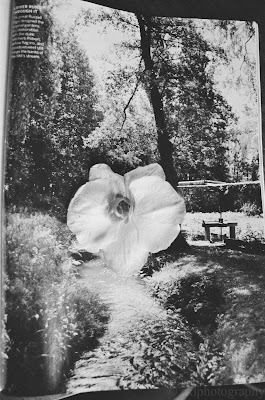
Orchid lying on a page from VogueAll of which is, for some reason, leading up to my notes on Not Becoming My Mother, this short memoir by Ruth Reichl about her mother's search (somewhat in vain) for a life as a non-homemaker in the middle of the 20th century. I have a certain weakness for reading about the lives of others, who, while not consequential or influential on any grand scale, have at least merited some well-written words and a bit of immortality on the bookshelf. No one is really inconsequential, in the big chaotic world of butterfly wingbeats, but some are significant only to a small circle of fortunate insiders.

Reichl's search for her mother's story focuses on the the fortunes of mid-century homemakers, facing proud and territorial husbands in a difficult job market after the Depression and World War II. Reichl had originally made the mistake of assuming that everything changed to roses for women after the 19th Amendment was passed. In truth, society took much longer to adjust to the change, and families behind closed doors longer still. Traditional patriarchal values (often maintained by the physically larger and stronger sex, and accepted by women who aren't sure how to do otherwise) still linger today. Reichl's mother did her best to instill deep seated independence and self-reliance in her daughter, such that she might never feel the need to ally herself with a husband in order to get by. Anyway, the thing was inspiring, comforting and entertaining, a quick read. Recommended.

Monday, November 21, 2011

Books read in Chincoteague (2 of 7): Hell to Pay

his was a bit of a disaster for me. I think I encountered George Pelecanos mentioned among a list of the best DC based authors (including Marie Arana). When I heard he wrote crime novels set in DC, I had to read one. Unfortunately, the first chapter I attempted was not to my liking (I believe that was The Big Blowdown), and I dropped that attempt back at the library in favor of a different set of a characters and plot. Come some booksale, I picked up two more, and brought Hell to Pay along to the beach in hopes that it would be a good fluffy crime/thriller to keep me going.

Nooo such luck. If I could've gotten behind the writing the story might have been decent, but it seemed bogged down in vernacular (like the books written in a Scottish "accent"), not just in the characters' voices but in the narrator's as well. The overwhelming number of scenes drenched in sexual innuendo and indiscriminate flirtations were nauseating and unappealing and I didn't care in the least whether the crime was solved or not (although at the point I got to, a quarter of the way in, there had yet to _be_ a crime commited). So perhaps this is simply not the book, nor even the author for me. Oh well.


Washington, DC, New York Avenue, downtown, snow, traffic

Wednesday, February 2, 2011

Book Snark: Earth Abides

Perhaps, he felt in his mind, that was the difference! That was the difference between woman and man. She felt only in terms of the immediate, and was more interested in being able to spot her child's birthday than in all the future of civilization. Again, he felt superior. 
Earth Abides, by George R. Stewart (1949).

In fact, in reading this book about the fall of civilization, I am possessed by a great urge to preserve and protect the history of the world for posterity, just in case something should happen. If humanity vanishes for whatever reason, and/or if electricity eventually fails, what will be left? ebooks? I certainly think not. While electronic formats may be "the future," may be convenient, may be efficient, they will not last beyond the next wave of advancements. Neither will mp3 files, dvds, or all the information on the internet. In this fantastic future world, when perhaps everyone will be gone, those who are left, or those who make a galactic archaeological dig of the planet Earth may find files that are in no way compatible with their technology, or they might find vast libraries of knowledge on paper, which have only to be translated.

Earth Abides was a fantastic book, but in the end very frustrating. It became evident that it was not just the aforementioned woman who was uninterested in preserving civilization, but all of the "stolid" people who happened to survive the plague. Apparently it was beyond their capabilities or caring to teach their children how to read or write so much as basic numbers, much less entire books. Strange that in a novel about a post-apocalyptic world that was what I found most unbelievable.

The future may be defined by forward movement, but that movement should not assume complete abandonment of the past.

Sunday, August 22, 2010

Dear Mr. Freud...

...Thank you for reminding me that you were quite a misogynistic twit.

I just went back into my copy of Introductory Lectures on Psycho-Analysis from college to look up symbolism in dreams. I'd had one about quelques tours en l'air (a ballet jump where one leaps and turns one- to several times in the air) in which I could jump and then, Mary Poppins style, continue rotating casually much longer than gravity should have permitted. So I went to look up dreams about flying, only remembering something about their having to do with sex:

Dreams can symbolize erection in yet another, far more expressive manner. They can treat the sexual organ as the essence of the dreamer's whole person and make him himself fly. ...And do not make an objection out of the fact that women can have the same flying dreams as men. Remember, rather, that our dreams aim at being the fulfillments of wishes and that the wish to be a man is found so frequently, consciously or unconsciously, in women.


Right. That's it. My flying dreams are not, in fact, anything to do with a desire to escape the bounds of gravity (daily life) and to ascend to something more spectacular, to leave the humdrum behind, break free of seemingly unstoppable forces (gravity, society, money etc), they're really only about my wanting to be a man. Who would want to be a woman, anyway? bah.