Showing posts with label food. Show all posts

Saturday, June 14, 2014

That avocado-quinoa thing

Last week in Austin I had the pleasure of dining at Lambert's BBQ with a couple of fellow Drupalists. We ordered a fleet of tasty dishes, but made particular note of an avocado/quinoa confabulation that lay beneath a trout: Cold Smoked Rainbow Trout, Avocado Quinoa, Bella Verde Cilantro, Tomato & Serrano Vinaigrette. The quinoa adhered to the little blocks of avocado and added subtle crunch to each bite, while also imparting significant flavor for two typically understated ingredients. Must've been _some_ vinaigrette. So, I decided to try to create something similar. And got a little distracted, so it's completely different, but not bad.

Avocado and Quinoa salad-thing

1 cup quinoa, any variety (the restaurant used plain, I used tricolor)
1 tbl olive oil, salt
~2 cups water

Toast the quinoa in the olive oil and salt until it begins to smell nutty. Add the water, bring to a boil, then simmer until the water is absorbed and the quinoa is the desired texture. Let cool.

1 small cucumber
1 small onion (red)

Meanwhile, dice cucumber and onion (I had a spring onion, but red would probably be better). Toss together in a bowl.

2 limes
2 avocados

Squeeze a couple of limes and reserve the juice (debatably, lemon might've been better). Dice two avocados (peel then slice) and toss with lime juice.

handful of cilantro
couple sprigs dill
salt and pepper

Chop herbs, add to cucumber and onion along with avocado and lime juice. Salt and pepper to taste and careful fold everything together with the quinoa. Let sit in the fridge for a bit for the flavors to relax, then serve at room temperature or chilled.

Suggestions welcome!

Wednesday, June 11, 2014

The Joy of "The Joy"


This article originally appeared in the Mountain Courier in March 2013, and I completely forgot to post it to my blog! My friend Suzanne, who edits and writes for the paper, suggested I write the article after seeing my collection of Joys in my kitchen pantry.

The sun slowly rises over a small sea of pop-up tents, my coffee and my breath adding to the quietly dissipating morning fog. A lone jogger pads by, the only traffic at this early hour. Piles of neatly stacked root vegetables, compulsively organized by a sleep-deprived farmer, wait patiently for the 10 am rush. My numbing fingers flick through the pages of a cookbook I’m perusing, looking for recipes to recommend with today’s cuts of grass-fed beef, pork, lamb and chicken that I’m here to peddle.

I was a vegetarian for the first 20 or so years of my life and have since been playing catch-up on how to cook things like pork belly and beef tongue. My customers and I, the adult novice, have found this particular cookbook quite handy for basic information and creative uses for a wide range of ingredients, both familiar and novel. The book is the Joy of Cooking, my ultimate guide on all things food.

Farm markets vary greatly across the region and the seasons, which translates into a certain amount of uncertainty as to what will be available at any given time. Seasonal produce is preferable for freshness, nutrition and the local economy, but sometimes one just doesn’t know what to do with a pile of kale and turnips, much less the wealth of parsnips or variety meats. It is here, in the unexpected and unexplored, that a good reference on cooking becomes invaluable.

It was not my intention to collect multiple editions of the Joy of Cooking. When my first copy came to me, I was more interested in it as a book—an antique livre to add to my library—than as a cookbook. A quick read-through, however, inspired me to assemble an unnecessarily complex cake using separate recipes for the batter, frosting, filling, and probably cake syrup as well, not to mention decoration. My notes on the subject are still tucked into the pages of this 1943 edition (1946 printing).

This first Joy was a gift from my mother, purchased in an antiquarian bookshop in Vermont on the advent of my first apartment, and thereby my first kitchen. Before this, my cooking skills had approximately encompassed rice, eggs, and—thanks to a summer in a friend’s well-appointed kitchen—homemade pizza and cinnamon rolls. As a vegetarian still working on my thesis, my most elaborate dish was stir-fried vegetables with tofu. The Joy was essential to me for basic instructions, factual lookups, information on the latest new ingredient from the food co-op and rules for baking. It was indeed the ideal first cookbook.

As things progressed I acquired two more editions: a brand new 75th anniversary revision bought as retail therapy, and my grandmother’s own 1952 edition complete with her notes and clippings. My three copies currently reside with a 1972 revision owned by a roommate; four Joys in total.

Irma Rombauer’s first edition came into being in 1931 as a collection of personal recipes from her “Victorian roots” to pass on to her children as they left the nest. It was also intended as a helpful guide to the newly minted housewife, alone and bewildered in her kitchen, written to be “so clear that a child can follow it.”

The early editions were a very personal affair for Irma and her daughter, Marion Rombauer Becker, who provided the first illustrations as well as helping her mother test recipes and organize the book. Irma’s wit and familiar tone lend themselves to a very friendly text in which the cook can feel as if she has a personal relationship with her cookbook and its writer. My 1943 Joy includes advice on war rationing, as well as bunches of recipes for aspics, gelatine salads, timbales and soufflés, all in the interest of disguising an array of leftovers. My recipe of choice, however, is for Crepes Suzette (essentially flaming French pancakes), which comes with an amusing anecdote about the dish’s origins with Chef Henri Charpentier and the Prince of Wales.

Both the 1943 and 1952 editions contain extensive advice on entertaining, how to execute full dinner service and from which direction the servants should serve the fish course. There is a handy chart on various fish and how to cook them, quite a lot on baking and confections, nutrition charts, wine charts, herb charts, leftovers charts and a glossary. Irma also took care to “give this book the impression of sobriety and stability it deserves [such that] the alcoholic cocktails have been relegated to the chapter on Beverages.” On the other hand, she also acknowledged that while smoking at the dinner table was très gauche (it destroys the palate), the hostess must provide cigarettes and an ash tray to make her guests as comfortable as possible.

My grandmother’s Joy, the 1952 revision, continues largely along the same track as the 1943 with general rules aimed at gaining an understanding and then a variety of applications. There are some exciting additions such as more pasta, which “takes a good deal of doctoring to make palatable,” a more organized list of household hints and with the new illustrator, Ginnie Hoffman, diagrams for everything. Irma and Marion can be seen slightly at odds in the introduction, where Irma insists that no cook will read anything but the recipe and information that he or she is looking for, while Marion believes that explaining how the book works is worth a page or two.

These earlier versions also include a fairly extensive section on game lumped in with poultry. Terrapin, of course, is now protected under the Endangered Species Act, and not many would consider squirrel a viable food source, never mind bear. While the inclusion of frog legs, aspics and the use of the singular “cooky” may give these editions a dated appearance, even the very earliest Joy in my collection emphasizes nutrition, taking note of Americans’ tendency toward overeating and not balancing caloric intake with nutritional needs.

As time and culture have progressed through the last 75 years, the target audience shifted away from the blushing bride and housewife toward an independent new cook. In the middle years, many sections bit the dust, including “Know Your Ingredients,” much of the entertaining instruction, and the gelatine concoctions. The 1970s were a time when horizons and palates were broadening, food was being shipped greater distances and people were eating tofu, of all things. Marion Rombauer Becker reorganized the book into sections on The Foods We Eat, Heat and Keep, which meant that absolutely everything was shuffled and, I found, rearranged in illogical order. The 1975 edition was the most popular Joy ever, so it must have made sense to most readers and cooks.

Which brings us to the 75th anniversary Joy, published in 2006, thanks to Ethan Becker, Marion’s son. As a Rombauer broodling and graduate of Le Cordon Bleu, Ethan brought respect for heritage and tradition while being open to change. The revision he put together organizes the recipes once again by their place in a meal, beginning with drinks, then hors d’oeuvres, vegetables, meats, desserts, and finishing with methods for preserving. The glory of this edition is the encyclopedic appendix that brings back “Know Your Ingredients,” a plethora of substitution, conversion and other charts, and information on every method you might need to know. Contrary to my assumption, this edition actually contains an expanded section on game, although the handy diagram on squirrel is omitted.

So here we are, back from market with an armload of food, ready to experiment, to learn a new way of preparing a favorite squash and what exactly to do with a bundle of fiddleheads. Any bride, bachelor, or impulse shopper will find his or her way with Joy, branching out into ethnic cuisines, more modern dishes and favorite personal recipes from Ethan, Marion and Irma herself.

Epilogue: I have since also acquired a mint condition, dust jacket-intact 1964 edition of Joy. It is happily nested with the others and gets regular attention from the chef.

The original version of this article in the print edition is here as a PDF. It includes tidibits from other contributors in a four page layout extravaganza.

Friday, May 17, 2013

Book review: Gaining Ground by Forrest Pritchard

B
efore I begin my review of Gaining Ground, allow to me to make a quick disclaimer: I am not an objective reader. In fact, I have worked for Forrest at farm markets every weekend for over a year now, in rain, snow, wind, thunder and tourist season. Before Smith Meadows came into my life I was largely vegetarian in order to avoid sponsoring the horror stories I read about the papers and books like Omnivore's Dilemma and Deep Economy. Then, through a boyfriend's friend's sister's best friend I found Smith Meadows, the perfect local farm with all the practices and principles an idealist could hope for.

Forrest Pritchard is Smith Meadows' farmer, its steward and practically a part of the soil he has worked so hard to nourish from the sad state it was in after years of overuse. As it turns out, lush pasture is easily achieved through a combination of patience and well planned herd rotation, switching between cattle, pigs, chickens and sheep, letting each fertilize and refresh the soil in turn. "Easily," of course, is a relative term when one is reading about it all from a comfy chair with a nice cup of tea.

In truth, it took not only years of hard work but decades of failure for the Pritchard family farm to turn around and produce a profit (as well as valuable land, animals and a sterling example of good farming practices). Gaining Ground recounts the journey Forrest took his entire family on when he realized that farming might be more of a calling for him than teaching (though writing is clearly still in his repertoire). As a bit of a book connoisseur, I did note that the book itself has a good looking, glossy cover, the text is printed clearly on nice feeling paper and the photos are incredibly helpful in placing the reader right there on the farm.

Gaining Ground has a good flow that kept me impatient to turn the page for the next adventure or roadblock, even though I knew exactly how it turned out. Forrest's anecdotes are sometimes touching, often hilarious, and range from rampant hogs to very confused market customers to a couple of completely baffling exchanges with a butcher. Pedro the goat, for instance, accompanied by Travis the humming farmhand, has a highly amusing adventure with some marigolds, in true goat-style.
Book cover, plaid-clad farm in field with cows. moooo.
As somewhat of an insider, I also know that there is a lot left out of this 317 page book. There were more adventures with goats, some ducks, more about Nancy's pasta business, a food truck and many more humorous stories from market and the farm. One hopes there will be a second book in the works... I, for one, would have enjoyed the inclusion of Forrest's other writing, perhaps the poetry he mentions sending off to literary magazines early on. The book stands at the right length and breadth to be a reasonable and fun read (One of Publishers Weekly's top 10 summer reads in nonfiction), though the prose could have dug a little deeper into the emotional underpinnings here and there.

The other members of the family receive occasional mentions, but the elder Mr. Pritchard has a fair share of the spotlight as he does his best to support his harebrained son through the snafus and disappointments of starting his free-range, grass-fed meat business. Mr. Pritchard's declining health provides a backdrop that Forrest puts to use in framing the problems with the commercial food industry and how we think about food in terms of cost, taste and enjoyment. On the whole, Gaining Ground is a good story, not an essay on farming practices, and it is this difference that will help readers to understand on a personal level what it means to buy local and why they too should work to save the family farm.

I did have one customer at market ask if Gaining Ground was a collection of recipes from Smith Meadows Kitchen, and when I passed this along to Forrest he said, "Sure, it's a recipe book. There's a real important recipe in there, they'll just have to read all the way to the end."

Gaining Ground is available on Amazon.com, in hardcopy and Kindle editions, and on IndieBound, as well as at your friendly local DC farm markets listed here. If you bring your copy to Smith Meadows farm day on June 1, Forrest will be happy to sign it for you. He may even sign copies brought to the Arlington and Takoma Park markets where he usually can be found on weekends. I will be putting my signed review copy in the Little Free Library for which I am co-steward. Pass it on!

Monday, January 21, 2013

New Year, New Garden

fter a relatively successful summer of vegetables last year, this year I think I'll take a more studied approach. Well, somewhat more studied, really just building slowly on the last go-round and adding a few things. Mostly, I now have a large enough crop of compost to use for a bed or two, and I know how big those dang zucchini will get.

Unfortunately, this means I do need to dig a few new beds, possibly three or four. I already have a satellite view of the house to transform into a (to scale) chart of the yard in order to keep track of what was where which year. As most gardeners these days know, it's best to rotate which crop goes in what bed each year, so any pests don't get too cozy and the soil isn't depleted (can't find a good reference right now). I've heard lots of advice on keeping a garden journal of notes about each step of the process, how different plants fared, etc. Frankly, I didn't, it seemed like one more thing to do and for the first year, fine-tuning was not a big concern.

So, mapping aside, that leaves us with planning what plants and when. I'm still looking for a source for hops, sage and tarragon, seed or seedling, if anyone in the DC area wants to trade (I get most of my seeds from Johnny's Selected Seeds).

As you'll see below, quite a few things need to germinate indoors as long as eight weeks before the last frost (early April in Alexandria). My google calendar is now laden with "PLANT CANTALOUPE" and such. I'm going to try out a grow light this time as my seedlings got a little too sperky* last year, even on a South-facing windowsill. This does mean that I'll also need some sort of heat source underneath my seedling trays. Although the basement is a pretty regular temperature, it's only around 65F and seeds prefer something more like 68 or 70.

Anywho, I've put together this little chart for my own benefit, but thought it might be of use to some other backyard gardener. Feel free to copy the format or just get inspiration. Click the chart to see it full-size in google drive and to copy or peruse further.

seeds, spreadsheet, alexandria, va, garden, planning schedule


*I grew up using this word and only recently encountered several people who said "What?! 'Sperky'??" It means what it sounds like. Don't suppose anyone else uses it?

Tuesday, March 20, 2012

Photos of phood: Nougatine Pastry Crisps

ood lord.
I haven't posted since the holidays! The horror! Much didn't happen, then much did happen, and now I've got several drafted posts to get out and need to decide which go first. So instead, here's a couple photos of the most recent baking incident.

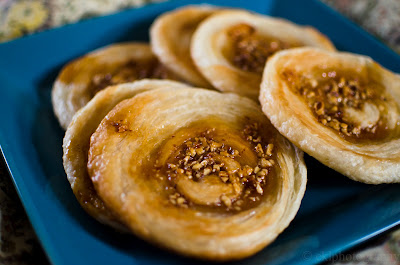
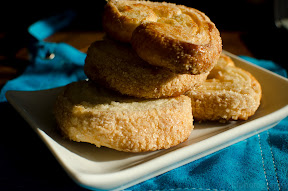
Earlier this month I had a request for palmiers as a birthday gift, so I [somewhat foolishly] bought a log of Amish butter from the local butcher. Foolish because 1) I neglected to notice that this was *salted* butter, something I never use and 2) it will always smell like butcher shop to me. Also probably 3) 2lbs of butter was more than I needed and more expensive than the perfectly good Cabot at home, but heck. Anyway, I had half left over and the fastest way to get rid of butter is in a 1lb butter package in pastry, SO:

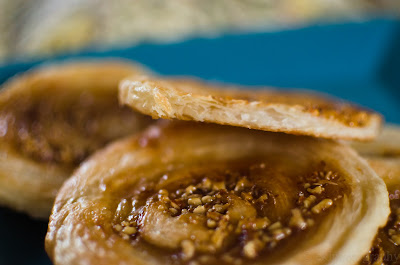
pastry, nougatine, almond, caramelMade puff pastry dough. ... only then did I go through a few recipes and realise that everything called for ingredients I didn't have (and I try to bake only with things on-hand, otherwise it would become a huge expense very quickly), fruit and cream and whatnot. Palmiers really only use butter, flour and sugar, which makes them very convenient. Eventually I found a recipe for an assembled dessert from the Ritz involving sort of a pastry sandwich around a cream/fruit filling from the Pie and Pastry Bible (I know, I know, big surprise, I'm using the book again).

pastry, nougatine, almond, caramel The pastry discs are simply slabs of the dough rolled out thin and baked between cookie sheets to keep them flat. However, the secret (or not) addition is the nougatine crumble which tops them. I doubled the original recipe for this (figuring it can go on yogurt and stuff, too) and got a nice sheet of almond filled crunchy caramel. With a crumbled spoonful of this sprinkled on top, the pastry rounds become cookies with slightly chewy caramel and nutty almonds on top. Easy enough, attractive, and so flakey you can barely pick one up.

Tuesday, November 15, 2011

Photos of phood (now with vastly improved imaging capabilities)

tortellini, fresh, pasta, homemade, butternut, squash, stuffed, local

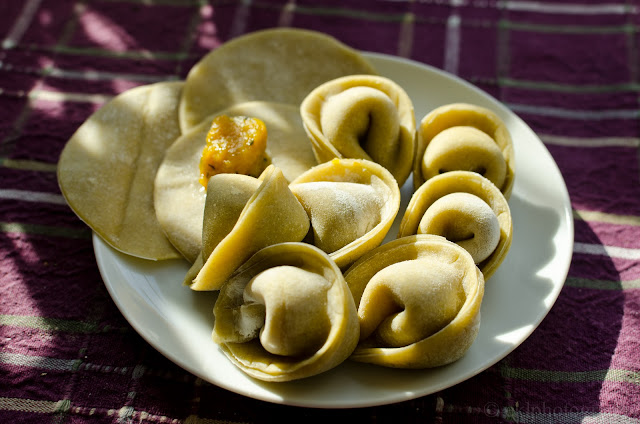
Apparently Mondays are good for making something different. The last time I did tortellini was at least a year ago, but this week I had nabbed a butternut squash at market and have enough eggs to burn on pasta. The squash wasn't terribly flavorful, so wrapping it in pasta seemed like a good plan. The photo shows some unrolled pasta circles, a bit of filling (squash + whatever herbs were lying around) and a few of the finished tortellinis. Cheese is really fantastic in these, but squash is a heckuva lot cheaper. They come out pretty big because I can only roll the pasta so thin with a rolling pin, and any less filling isn't sufficient.

I wont write out the entire process, but the pasta recipe is basically: for each egg, use a bit less than 100g of flour. I used 5 eggs and maybe 450g flour to start, a bit more for rolling, which makes for a very soft pasta dough, but is so much easier to work with.

The method: make a pile of flour with a well, put eggs in the middle, slowly stir flour in from edges until everything is integrated enough to knead (and not run off the counter). Knead. Let rest, covered. Divide, roll out to 1/4" thick slabs. Rest covered. Roll out as thin as you like, dry on a rack to slightly leathery feel. Cut. Dry some more if just doing noodles or stuff with stuff and let dry a bit. Freeze if not using right away, drop (fresh or frozen) in boiling water for ~5 min (mine, as I said, are very thick). Tada.

chocolates, sugar cube, designer, painted, truffles, Alexandria, VAchocolates, sugar cube, designer, painted, Alexandria, VA
chocolates, sugar cube, designer, painted, Alexandria, VA

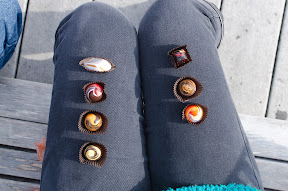
And because I had these photos of pretty chocolates from the Sugar Cube in Oldtown lying around, here are some pretty chocolates. They also tasted good, of course, very smooth, nice Autumn flavors.

Monday, November 7, 2011

Palmiers

palmiers, pig's ears, elephant's ears, pastrypalmiers, pig's ears, elephant's ears, pastry

Last week I got one of the most ironic phone calls I can remember receiving. It was my dental hygienist, calling to remind me of my appointment... and to ask me if I might bring baked goods. So, last night, at a loss for what to make, I tried pastry for the first time. These are palmiers, and are made exclusively with flour, butter, water, salt and sugar. Even the dentist himself agreed that they were fantastic.

palmiers, pig's ears, elephant's ears, pastry

Monday, October 17, 2011

Pear, almond cream, tart. At length.

ometimes the route I take to a baking project is long and roundabout. In this case, I started well over a month ago thinking "oh hey, I should make pie crust with all this cream cheese that came out of my parents' fridge during the hurricane." Having subsequently moved, still with said cream cheese, it's now October, and the fruit available has changed completely. Fortunately, I moved to a location two blocks from a weekly, year-round farm market and despite the apple season fanatics, I found some lovely pears and bought 10.

Then I went looking for a recipe. I'd do it first, but that tends to result in a harried and expensive trip to several specialty stores looking for things like "espresso powder" and whatever. In this case, I got away with nothing more extravagant than a vanilla bean (albeit a bit of a ripoff at the local "My Organic Market").

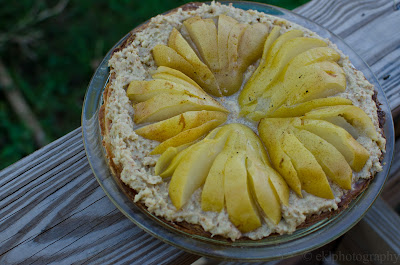
Pear and almond cream tart pre-baking

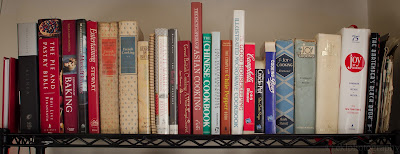
So there I was with pears and cream cheese pie crust premade and waiting in the freezer (keeps for up to three months, yet I never pre-make enough for it to last more than one pie). A quick poke through my trusty bookshelf o' cookbooks, and I arrived at the inevitable conclusion: The Pie and Pastry Bible. Someday, I swear I'll use different books. Really. Having avoided apples especially because I'm tired of fruit-in-crust pies, I wanted something a little more interesting. The options were a gingery pear chiffon pie (which I had modified a couple years ago into a ginger and chocolate ganache pie for Thanksgiving) or pear almond cream tart.

Cookbook collection on the pantry shelf
Before I get into the things I'll do differently next time, let me just say that this is a very tasty, decent looking little open-faced pie/tart. However.

It started with the pre-baked crust. Ok, so the recipe called for the normal flakey pie crust, in a tart pan, and I was using cream cheese crust in a pie plate. It kinda shrunk a lot and got a bit too toasty on its own when it should have been a little underbaked in order to withstand the subsequent baking with filling. Still, super flakey, and actually incredibly tasty when dark brown and slightly caramelized with filling.

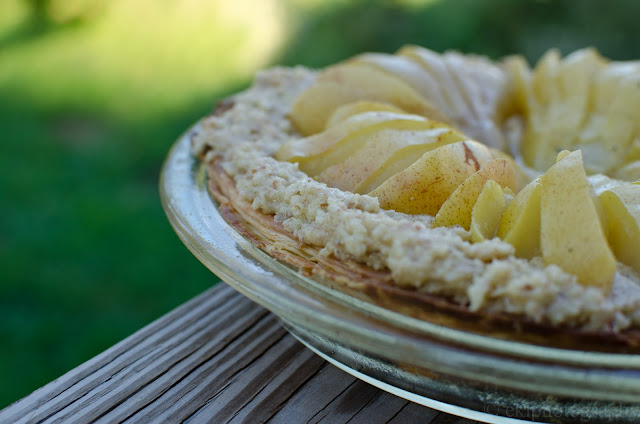
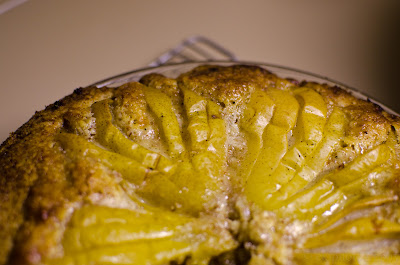
Pear almond cream pie, fanning of pears, cut
I also neglected to thoroughly process the almond flour/stuff. And to use blanched, sliced almonds. But that's just cause they come in "raw" in the bulk department. So, instead of what I assume was meant to be a smooth, creamy filling, I have a nutty, thick filling. It did manage to puff up (eventually) and has the texture of chewy meringue around the edges (also a little darker than necessary).

The poaching of the pears went well, though I recommend watching them a bit more carefully than I did and not getting distracted by other wildly exciting things like de-clogging the vacuum. yeah. I reserved some of the poaching liquid for my food and drink obsessed housemate to mix cocktails or something with. The vanilla bean was very worth it and can never, ever be substituted with vanilla extract, so don't even think about it.

Finished pear almond tart, meringue edges
In the video on Rose Levy Beranbaum's website (below), she has the pears sliced the short way across and fanned into little ridged mountains in the almond filling. It makes a kind of star pattern, but that didn't quite make sense to me visually, edibly or uh, logistically, so I fanned them lengthwise instead, with the intent that the almond filling could puff up between the slices. This mostly worked, but again I neglected to really thoroughly drain the pears, so the pie/tart took a lot longer to cook and was too wet in the center for most of the time.


This is kind of a long post for one little pie experiment, but I went searching the interweb for more info when the recipe didn't make sense and only easily found RLB's website. Hopefully this will help someone else. And also photos. It's blissful having a back porch to take things out on into natural light in order to photograph. The finished pie photo is from inside and at night (bleh!).

Tuesday, July 19, 2011

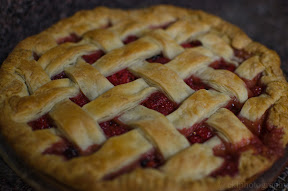
Wineberry pie

aving the recipe is only half the battle. It took several pies for me to get the pie crust to behave in such a way that I could roll it out, instead of trying to piece something together out of the fragments that never became a whole. Your only hope in this matter is to start with a good recipe and figure it out for yourself. The very best book ever is "The Pie and Pastry Bible" by Rose Levy Beranbaum. I've gotten so many recipes out of this book, if you know me, you've probably had one. In my mind, the best kind of cookbook isn't just recipes but philosophy and information, so that you actually have some clue why things need to be just so. Absolutely essential for the baker. Go get it. shoo.

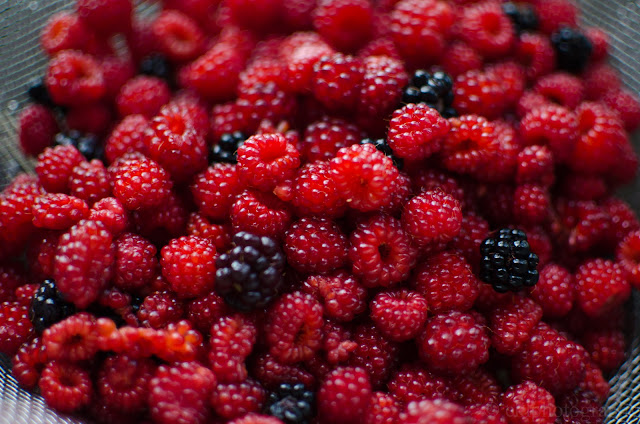
This past weekend I had the good fortune to spend a night atop a mountain in the Shenandoah region, and came back (thanks to Wortklauberlein) with a pound of fresh berries from the bazillions of vines lining the roads. The local population informed us that they are wineberries, a particularly sweet variety of raspberry. There's nothing so satisfying as baking or cooking with food you've picked yourself. er, or that someone has thoughtfully picked for you.
pie, berries, fresh, handpicked, appalachians, shenandoah, wineberries, blackberries

Ingredients
"Deluxe flaky pie crust" 21 oz
    14 tbl unsalted butter, cold.
    2.25 cups flour (pref. pastry)
    1/4 tsp salt
    1/4 tsp baking powder
    7.5 tbl ice water
    1 tbl cider vinegar
0.5 cup sugar (I only had brown)
2.5 tbl cornstarch
pinch salt
1 lb berries, washed and picked over for passengers.

  1. Pick a pound of wineberries and a few blackberries from Flattop Mountain. Or your backyard. Or somebody else's backyard. I don't think you can buy wineberries in the store, but this recipe will likely work with whatever berries you have handy.
  2. Make pie crust:
    • cut butter into small cubes, freeze for 30 min +
    • put flour, salt, baking powder in gallon size ziplock bag, shake to mix thoroughly.
    • add frozen butter, expel air and use rolling pin to (patiently) roll butter into flat flakes. Shake bag to redistribute when mix gets bunched up at one end. Freeze for 10 min.
    • sprinkle water and vinegar into bag, toss to mix.
    • keeping the bag open, knead from the outside of the bag until dough forms a single lump. To do this, you'll need to use the bag to fold the dough onto itself (don't touch it directly). About halfway through you'll get frustrated because it's not holding together yet. Put it in the fridge for a few minutes and come back to it. Once it's a lump, divide into two pieces, one for the top and one for the bottom crust. 
    • Refrigerate for at least an hour, preferably overnight. 
  3. Roll out bottom crust on lightly floured surface to 1/8 inch thickness. Lay in pie pan, cover and refrigerate at least 30 min, no more than 3 hours.
  4. Combine sugar, cornstarch and salt, whisk together. Toss berries gently in this mixture and let sit for 15 minutes. 
  5. Toss gently again and pour into bottom crust.
  6. Roll out top crust to 1/8 inch. I used a lattice pattern, but you could do a full top crust and cut a hole in the middle for steam to escape. Lay top crust over berries, use water to glue and fold edges under (or over) and crimp using a fork or your fingers.
  7. Refrigerate pie, covered loosely in plastic wrap, for about an hour.
  8. Preheat oven to 425 at least 20 minutes before baking. Use a baking stone if you have one and put it on the lower rack. Bake pie for 30 minutes or until juices are bubbling and crust is browned. Put a baking sheet or foil underneath the pie plate to catch drips.
  9. Let cool for at least 2 hours before serving, probably more like 4 if you have the patience.

Monday, February 21, 2011

Baking is exhausting

chocolate, cake, batter, flour, sifted, mix.Well. I'd been meaning to make a chocolate cake of some variety for a couple weeks, and today I finally got around to it. This recipe came out of the copy of Martha Stewart's Entertaining (also see this old blog post), which I received in the mail Friday (thanks to that B&N Groupon the other day). I'm saving the actual reading of Entertaining for a time when I can sit and peruse leisurely, but I nabbed this cake recipe for now.

meringue, egg whites, stiff peaks.
Chocolate almond cake comes from one of the wedding menus (for ~50 guests, as opposed to the 100 and 200 guest menus. Dear God.) at the back of the book. The original recipe actually involves making the full size, multi layer, stacked wedding style cake, and uses both this recipe and an orange almond cake alternately for the layers (with copious amounts of decorative frosting, of course). I just halved the recipe and made a basic two layer cake, instead. Some of the chocolate I'd been intending to use disappeared, and I ran out of eggs, so the chocolate glaze (which I nabbed from my Williams Sonoma book.. and quartered!) is a bit sparse. 

chocolate, cake, layers, assemble, cooling, rack.
Anyway, the recipe specifies that you shouldn't overcook the cake, because it should be extra moist in the middle. I may have overcooked a little bit, but it's so hard to tell how done the cake is before it cools... Still, it's quite tasty. The meringue gets folded in last and provides that nice fluffiness. I just stuffed some blackberry preserves that happened to be in the fridge between the layers, but I'd rather have used raspberry, and had a fluffier frosting on top. My resident critic tells me he doesn't like buttercream frosting, but I've never tried it at home. It's likely to be a lot better than the grocery store stuff, in any case.

chocolate, cake, slice, removed, preserves, jam, layer, filling.
Meanwhile, you may notice that my accompanying photos are a little nicer than usual. I've been getting back into my photography habit lately, and have been working with a DSLR for the last month. The internal debate over what camera I actually want and whether I can justify buying it has gotten quite raucous, but someday soon...

chocolate, cake, slice, jam, filling, preserves, plate.
After reading Photocritic's post about prime lenses I was eager to try one... and then I realised how silly that was. Of course, all cameras used to have "prime lenses." This zoom stuff is really quite recent (a prime is simply a lens that has a fixed focal length, eg, no zoom). So, these photos are indeedy sharper than the average bear, and more excitingly, were shot at f1.4 in my dark little kitchen at night. So HA.


And you may also notice the watermark on these images. I've actually gone and sprung for Adobe Lightroom, which has made my life a good deal easier with its editing, cataloging, web design, export... everything. I have a little project in the works...


Annnd recipe:

Friday, December 24, 2010

Obligatory, but festive!


As it turns out, borrowing someone's computer can be very frustrating when it's significantly different from your own. Apologies for poor formatting etc in this post, but wanted to get it up in time to say Merry Christmas!... in a somewhat timely fashion.

Eenywho, just some photos of the cookie-making marathon last weekend. I'm fairly pleased with the results: iced sugar cookes, braunekuchen (molasses/spice cookies), truffles, banana-chocolate-chip-mini-muffins (of hyphenage +1) and raspberry oatmeal ribbon bars.

Monday, November 8, 2010

Toothsome quotations: WASPs vs. YSL

The linguistic philosophers of France, especially the late Roland Barthes, understood how French cuisine and French culture are related, and how both fit with structuralist philosophy. A Parisian dinner is mean to be a single elegant statement, like a well-turned sentence or an outfit from Yves Saint-Laurent. The Anglo-Saxon view of a banquet can be expressed in terms of the history of the world. You begin with soup – water with things swimming in it – then move on to the aqueous kingdom, then to flying creatures, then to mammals. Finally you celebrate man in cheeses and desserts, both products of sophisticated culture. This is the diachronic view, which the French reject. They prefer to see the various courses as syntagms, or sentence components – soup adjective, fish noun, chicken adverb.

-Anthony Burgess, "The Language of Food" in Homage to Qwert Yuiop, found in The Ravenous Muse, Karen E. Gordon, ed.

Monday, November 1, 2010

Toothsome quotations: 'In herbis'

In an age when just the composition of a salad required a great knowledge of herbs, their flavours and combined tastes, it was commonly said that "In herbis, et in verbis et in lapidibus sunt virtues" ("There are powers in herbs, words, and stones"). The syncretic character of late medieval cuisine... finds a mirror-like reflection in the taste for farce and linguistic blending, and in the interweaving and overlapping of words. Farce, whether "stuffed" or "mixed," makes up the combination of seasoned ingredients which conspire to please the palate; it is the dietary archetype at the origin of linguistic structuring and presides over the stuffing of vocabulary and locutions.


-Piero Camporesi, Bread of Dreams, from the collection The Ravenous Muse, Karen E. Gordon, ed.

Monday, July 26, 2010

Photos of Phood: Cucumber Salad


This is, in fact, the best use I've found for my mandoline so far. It's vastly easier than trying to cut all those cucumbers into perfectly thin slices. We accidentally got a lot of very cheap if not free cucumbers from the Farm Market and well, had to do *something* with them...

Friday, July 23, 2010

Photos of Phood: Caramel Corn


So darn easy, and so tasty.

Wednesday, July 21, 2010

Photos of Phood: Enrobed in Chocolate


Ah, here is one of the ganache balls finished! In the foreground are my attempts to do the same thing with caramel. Semi-success, mostly turned into puddles. Next time they'll be in cup form instead.

Monday, July 19, 2010

Photos of Phood: Chocolate Ganache

I think I need lights so I can shoot my food stuffs properly. The lack of focus and the flash bother me. Nonetheless: Chocolate. I believe this became centers for little chocolate covered ganache balls.

Sunday, July 18, 2010

Tuesday Night Dinner, part IV

Somewhat delayed! Possibly by a month! whoops.

So after the pesto and whatnot I made scones as an afterthought. The recipe came from the Washington Post food section, but of course I didn't quite have everything required. I substituted whole wheat flour for the barley flour and used some chopped up and slightly macerated strawberries as the center layer. They make a fantastic not-too-sweet dessert or a snack with tea and are in fact ridiculously easy to make. Unfortunately I didn't take any pictures, but rest assured that they're very tasty and attractive scones.

Ingredients:

For the scones
  • 8 tablespoons (1 stick) cold unsalted butter, cut into 1/2-inch pieces, plus more for greasing the baking sheet
  • 1 cup plus 2 tablespoons barley flour, plus more for the work surface
  • 1 cup all-purpose flour
  • 1/4 cup packed light brown sugar
  • 2 teaspoons baking powder
  • 1/2 teaspoon baking soda
  • 1 1/4 teaspoons kosher salt
  • 1/2 cup regular or low-fat buttermilk
  • 1 large egg
For assembly
  • 1/2 cup strawberry jam or marmalade
  • 1 tablespoon unsalted butter, melted
  • 1 tablespoon granulated sugar

Find the rest of the recipe here.

Friday, July 16, 2010

Photos of Phood: Cucumber Sushi


I have a terrible weakness for sushi rice. Sometimes I'll just make a bowl of it for dinner. This cucumber roll is probably the most perfect piece of sushi I've ever made. I think I sharpened my knife immediately beforehand to make the cuts neat.

Wednesday, July 14, 2010

Photos of Phood: Stir Fry with Almonds


I love how the edge of the wok looks a little like vignetting. Almonds, broccoli, rice, a little soy sauce. Nuts are awesome to cook with, like chestnuts in stuffing.