Showing posts with label consciousness. Show all posts

Friday, March 29, 2013

Memory catalog

S
ometimes, months or years later, things come back to me that I once read in some book, some article, somewhere in the wide world. If I'm very lucky, I can track the fragmented memory to the source. Maybe I remember hearing the ocean wind whistling in my ears alongside the words that have pushed to the surface of my thoughts, or perhaps the context of surrounding material has remained, a preceding essay in a collection or the experience of an online newspaper. If I'm so lucky, I can usually find the original piece and catalog it more thoroughly for the next time (thereby guaranteeing that there will be no next time).
books, pile, stack, mess, bookstore, window, light, backlit, cozy

In this case, I had a thought bubble up about explaining the size of one's library to guests when they ask "So, you've read all of these?" What a silly question. It's usually posed by someone who has no library of their own, no understanding of the value of such a collection as insurance against dullness and the possibility of suddenly finding oneself with nothing to read. Sure, I have read a large number of the books on my shelves, and I keep them around as reminders of good times, comforting me with the knowledge that I absorbed something from each of them, and can easily open them up again as I please.

It's this last point that is relevant here. The book in question turned out to be A Passion for Books, appropriately enough. I brought this somewhat large paperback along on a solo bike trip last summer under the assumption that I would have time and energy left for reading after biking 60 miles a day. I did not. Nonetheless, I got through a couple of the essays and whatnot while in various B&Bs and the memory link stuck. The book, my friend, had traveled with me and formed that particular synaptical [sic!] connection while in the middle of strange lands (Western Maryland, you know) and unfamiliar furnishings.

Here now are the three passages by assorted authors from the Passion for Books collection which each mention (independently!) the arduous task of explaining one's library to unsuspecting visitors:

In the gradual growth of every student's library, he may – or may not – continue to admit literary friends and advisers; but he will be sure, sooner or later, to send for a man with a tool-chest. Sooner or later, every nook and corner will be filled with books, every window will be more or less darkened, and added shelves must be devised. He may find it hard to achieve just the arrangement he wants, but he will find it hardest of all to meet squarely that inevitable inquiry of the puzzled carpenter as he looks about him. "Have you really read all these books?" The expected answer is, "To be sure, how can you doubt it?" Yet if you asked him in turn, "Have you actually used every tool in your tool-chest?" you would very likely be told, "Not one half as yet, at least this season; I have the others by me, to use as I need them." Now if this reply can be fairly made in a simple, well-defined, distinctly limited occupation like that of a joiner, how much more inevitable it is in a pursuit which covers the whole range of thought and all the facts in the universe. The library is the author's tool-chest. He must at least learn, as he grows older, to take what he wants and to leave the rest. 
Books Unread by Thomas Wentworth Higginson (what a name)

In the two years I had been coming there, maybe two or three hundred days spent in that apartment from morning till night, I never saw anyone else there – no visitor, no delivery person, no handyman – no one. I asked Chaim about this on one of our walks (I later understood that great Yiddish writers simply do not have or permit visitors; then again, maybe it was the threat of coffee that kept everyone away), and he said something about not wanting people to think him strange for having too many books. I thought he was talking about the annoying line all book collectors endure: Have you read all of these books? I told him about Dr. Johnson's stock response: Yes, and some of them twice! Chaim stopped walking and looked at me disdainfully. "If anyone asks you if you've read all those books," he said, "it means you don't have enough books."
They Don't Call It a Mania for Nothing by Harold Rabinowitz (also the editor of Passion)

About the time of the discovery of America a book came out called The Ship of Fools, by one Sebastian Brant. In it was an attack on the book fool: a satire on the passion of collecting, in which the author said that the possession of books was but a poor substitute for learning. That phrase which the layman reader asks the book collector so often with a smirk of condescension, "So you really read them?" undoubtedly originated then. The real book collector, with suppressed murder in his heart, smiles acquiescence, assuming an apologetic air for his peculiar little hobby. His invisible armor is his knowledge, and he has been called a fool so often he glories in it. He can afford to have his little joke. So much for this threadbare gibe.
Talking of Old Books by A.S.W. Rosenbach (perhaps the most successful modern book collector of them all)

Friday, November 18, 2011

Books read in Chincoteague (1 of 7): Catch-22

s I finally wrapped up the last chapters of Catch-22 and went to enter this triumph in my book log, I discovered that I had begun this one not just months ago, but last November. Horrors, that I had left a book neglected for so very long, thinking that I wasn't in the mood for it, not giving it a chance. Well, to be fair, I probably wasn't in the mood for it, nor would I ever have been, but finally, on the porch swing overlooking the marsh, I at least felt comfortable enough to forge my way through the latter third of Catch-22 without going crazy myself.

Having been told by two reliable sources that this was a hilarious read, full of wit and whimsy, albeit dark whimsy, I figured I ought to at least give it a chance, read the whole damn thing and be able to reflect on it. Having done so, I'm glad I did, but the journey was one of the most depressing I've been on, stretching thin my last shreds of faith in a decent world.

Anyway, horrifyingly obtuse and, yes, hilariously conniving as Colonel Cathcart and Milo are, clearly this is a pretty good book because it did _get to me_. And I did understand Yossarian's plight, the desperation and the confusion, the fear that the world really is nuts, that this must be some deep level of punishing inferno, and the emotional grasping at what few friends could be found in the midst of war.

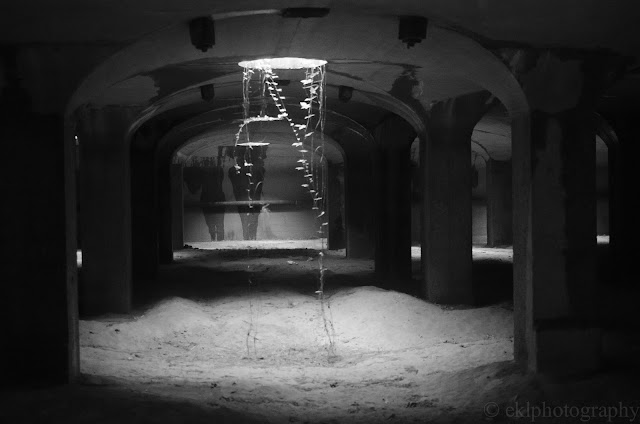
cavern, catacombs, McMillan, sand filtration, Washington, DC, underground, columns

What spun me for the greatest loop was the ending. I guess I shouldn't say here, (oh, heck: SPOILERS!) but it didn't seem in keeping with the rest of the book. In fact, I was so thrown by the ending that I felt certain I missed an important detail and Yossarian was deep into some fever dream, or was heading off for the promised land. The entire last two chapters or so took a sharp left and nearly tossed this passenger out around the curve. I suppose I'm glad it ended the way it did, with a hope for the future, an open ending and striking out for a new world. All is not lost, life goes on, "persevere."

Not sure the photo is relevant, but since I didn't have anything that really is... this underground catacomb is from an exploration of the old McMillan sand filtration site in NE DC I did with DCUrban Explorers in late October.

This review also appears in part on LibraryThing.

Monday, September 12, 2011

Another ode to bicycling

here must be a storm out at sea, on the bay, over bigger water. The field at Gravelly Point is speckled with seagulls, round white spots on the lush green (it's already been raining)(like golf balls). A single gull hovers in the wind over the trail, bored with picking through the grass. Every once in a while one of them cries out, that sound that puts me on the beach, on sand, in salt breeze. The roaring silence of wind in my ears is harshly broken by the roaring noise of jet engines overhead, a larger bird taking off, banking against the wind. Some of the gulls startle and scatter into the air en masse to land a few feet away. False start. A lone jogger jogs by, similarly startled to find this place so differently populated. Il n'y a pas des gens aujourd'hui, seulement les mouettes et le vent.

water, raindrops, Hirshhorn, WashingtonDC, Hurricane Irene, fountain, rain

Sunday, May 2, 2010

To think, to write...


Four years ago, I packed up my life and moved it all 500 miles to one small town on the top of a hill in Southern Vermont, without a damn clue what it would turn into for me. I may wax poetic about it all for years, in hindsight, in retrospect, whatever shades that might tint the memories. Everything wasn't always perfect, but the town of Marlboro felt like *home*. But before Marlboro, there was another me. A me who filled journal after journal with tiny cramped writing, drawings, designs, and lord-knows-what workings of teenage consciousness (the first image in this post is a quick view of some pages from an old journal of mine, and two books I hand-bound on the edges of the frame). Most of the writing probably isn't worth reading, but the way I lay out the text and sketches, sometimes weaving strands of text into images makes the journals visually appealing, a flip-book of nostalgia. Once I got to Marlboro I stopped writing and sketching after one journal of nothing but text. My question is, why did I stop? While I'm not prepared to completely answer that yet, here are some thoughts on the subject:

First, why did the content shift to text-only? Was it because I felt I didn't have the time to commit to more sincere creations on the pages? Because I felt my sketches and layout concepts were piddly, and not worth putting on paper? How could I be more self-conscious in college than in High School? My intent in keeping the journals was always that someday, someone would read them. Whether that would be a progeny or a historian, an alien anthropologist... Or maybe I thought they would fall into someone's hands sooner than that, and prove how awesome I was. With that in mind, I suppose the shift was because I started sharing more with people face to face at college, and didn't feel the need to record everything on paper for future transmission.

And then why did I stop writing entirely? Even at times when I could have used some introspection, I didn't write... at least not in paper journals. I began emailing, using Facebook and Twitter, recording my movements and thoughts in communications and snippets. Microblogging. This, so far as I'm concerned, is a significant step down. Maybe even a slide. Then again, I'm not sure all that introspection helped me develop much at the time, either.

I don't know if trying to restart my journaling is a mistake or not (my own version of NaNoWriMo... whatever month it may be). But if I think "nothing I do is worth recording, not the entire day, certainly" then I'm only discouraging myself. Maybe I became more private, in an odd, long-term way.

... and here I am blogging about it. Hopefully posting this will make me more inclined to journal at least once a week...

Wednesday, July 22, 2009

Just a couple things

I was hoping I'd spend less time around my computer this week while my primary online contact is out of the country, but so far that's failed completely. This might have something to do with all the online applications I'm working on, but hey.

In any case, here's a link to Abby (the) Librarian's blog, which recently posted a giveaway of Catching Fire. It's the second part of the Hunger Games trilogy, the premise of which sounds a little silly, but apparently is completely riveting. I figure it's worth a try.

Then, I read an article that introduced me to the concept of Pierre Teilhard de Chardin’s Nöosphere. I think I had heard the word before, but not known the meaning. It's basically a "sphere of human thought", that represents humanity's development into a highly cognitive species. It's also the next step after the biosphere and geosphere concepts. The Noosphere could also be comparable to the blogosphere, the idea that everyone is connected by these ideas and ways of thinking, by the internet, for example. At Princeton, the Noosphere is being studied as a literal global consciousness that has the power to alter elements (specifically random number generation). The data seem show that if enough people are thinking about the same thing, the numbers change slightly, are less random, and deviate from the prediction.
De Chardin envisioned all this coming to resolution at the "omega point", when human thought will reach its pinnacle... and that's pretty much the end of history. What's up with Omega though? Maybe it's just me and Star Trek Voyager, where the Borg hailed Omega particles as the ultimate symbol of perfection, but I know I've seen it elsewhere and am interested in the root meanings that lead to this stuff.

Well, that should be it for now. Not a terribly coherent post, but ah well. More next time, hopefully on eco-guilt and the economy and whatever else is on my mind/reader.

Friday, July 17, 2009

Sources

If I was a skilled blog writer, I would have a clever title that wraps up the various subjects in my posts and ties them all in a neat bundle. For example, "Sources" should have the bits I'm going to write, but also something about, I don't know, primary sources, research, reference, wells, genealogy... But it doesn't, so here we are anyway:

I take distinct pleasure in knowing where things come from. Not just that, but having a story of some sort attached to things. It gives them meaning beyond "thing," making me feel a little less guilty about all my material possessions. I tend to buy more when I'm on vacations, because it allows me to come back and say, oh, this skirt/pair of shoes/earrings/etc came from London/Avignon/Greece/etc. Far better than *another* shirt from the Gap. Who doesn't have one of those? It occurred to me as I was making toast this evening that this applies not just to material things, but food as well. My dinner tonight:

Toast: Oatmeal molasses bread I made yesterday from organic ingredients. The recipe came from a baking book I first met while house-sitting my first summer in Marlboro. That was my first time with a kitchen all to myself, and I went a little nuts cooking.. at least when there were people to feed. On the toast is soft goat cheese I bought from a friend in Marlboro the other day, and cinnamon pear jam from Sidehill farm in the Cotton Mill complex in Brattleboro. I discovered them while gallery sitting during the Cotton Mill open house three years ago. They also make a very tasty mango-habenero jam.

Salad: Less of a story here. Some goat feta from the same source in Marlboro, and fresh avocado, pepper, romaine, cucumber from Dutton's farm stand in Brattleboro. I had bicycled to Dutton's earlier this week from a friends house in West Bratt as a trial run for biking in town. I'd say it went fairly well. I just like being able to get somewhere on the bike instead of going for the heck of it all the time. Ah, but the reason I started in on salads at home in the first place goes back... five or six years now, to when I had my first goat cheese salad at the Riverview. Which reminds me, I forgot the cranberries.

*runs off to perform salad modifications*