Showing posts with label authors. Show all posts

Friday, September 7, 2012

Orwellian syntax

he title of this post is a little iffy, but I think it works in a couple of ways. First, the content here is by George Orwell, therefore is by definition Orwellian, right? Secondly, his proposed overhaul of the English language (which we'll get to as soon as I'm done justifying and rationalising) is a bit on the totalitarian side, ergo, Orwellian. And uh, Thirdly... thirdly... oh yes, his criticism of the current state of prose essentially compares it to the sort of meaningless catchphrases found in 1984, where words cease to have any relation to their meaning and generally cause the downfall of civilisation as we know it.

That pretty much sums it up, actually, but a little context: I've just read George Orwell's essay on Politics and the English Language. The essay alternates between lambasting several samples of [truly lousy] writing and prescribing a few guidelines to avoid further transgressions. It was written in 1946, so we can only imagine how pained Orwell would be to see the current state of the written word (probably including my own. erk.). I bet he and Hemingway would've gotten along in some ways...

And now, for my own reference and for yours, George Orwell's basic rules for passable writing:

(i) Never use a metaphor, simile or other figure of speech which you are used to seeing in print.
(ii) Never use a long word where a short one will do.
(iii) If it is possible to cut a word out, always cut it out.
(iv) Never use the passive where you can use the active.
(v) Never use a foreign phrase, a scientific word or a jargon word if you can think of an everyday English equivalent.
(vi) Break any of these rules sooner than say anything outright barbarous.

Taken from the essay Politics and the English Language, 1946, page 156 of George Orwell, A Collection of Essays, Harcourt Brace, 1981. 

Monday, December 19, 2011

Quotations: Calvino

n the shop window you have promptly identified the cover with the title you were looking for. Following this visual trail, you have forced your way through the shop past the thick barricade of Books You Haven't Read, which were frowning at you from the tables and shelves, trying to cow you. But you know you must never allow yourself to be awed, that among them there extend for acres and acres the Books You Needn't Read, the Books Made For Purposes Other Than Reading, Books Read Even Before You Open Them Since They Belong To The Category Of Books Read Before Being Written. And thus you pass the outer girdle of ramparts, but then you are attacked by the infantry of the Books That If You Had More Than One Life You Would Certainly Also Read But Unfortunately Your Days Are Numbered, with a rapid maneuver you bypass them and move into the phalanxes of the Books You Mean To Read But There Are Others You Must Read First, the Books Too Expensive Now And You'll Wait Till They're Remaindered, the Books ditto When They Come Out In Paperback, Books You Can Borrow From Somebody, Books That Everybody's Read So It's As If You Had Read Them, Too. Eluding these assaults, you come up beneath the towers of the fortress where other troops are holding out:
     the Books You've Been Planning To Read For Ages,
     the Books You've Been Hunting For Years Without Success,
     the Books Dealing With Something You're Working On At The Moment,
     the Books You Want To Own So They'll Be Handy Just In Case,
     the Books You Could Put Aside Maybe To Read This Summer,
     the Books You Need To Go With Other Books On Your Shelves,
     the Books That Fill You With Sudden, Inexplicable Curiosity, Not Easily Justified.
Now you have been able to reduce the countless embattled troops to an array that is, to be sure, very large, but still calculable in a finite number; but this relative relief is then undermined by the ambush of the Books Read Long Ago Which It's Now Time To Reread and the Books You've Always Pretended To Have Read And Now It's Time To Sit Down And Really Read Them...

 From If on a Winter's Night a Traveller, by Italo Calvino. Wonderful book, you should go read it.

Saturday, December 10, 2011

Books read in Chincoteague (7 of 7): The Cabinet of Curiosities

ast but certainly not least we have a book acquired from one Jeff VanderMeer, signed by said editor and his accomplice, Ann VanderMeer, and kindly shipped to me for review purposes an embarrassingly long time ago. As is appropriate to such an anthology of bits and pieces, I read The Thackery T. Lambshead Cabinet of Curiosities in fits and starts, probably beginning by the pool last summer, the majority read at Chincoteague, and finished post-move in the new house. On the other hand, it's a rich and complex enough world to sink into, if one tends towards more efficient, focused reading.

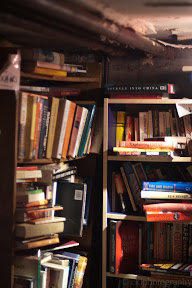
bookstore, books, basement, capitol hill books, dusty, creepyThis level of complexity largely stems from the wide array of contributors to this steampunk confluence, including Garth Nix, Tad Williams, Cherie Priest (of Boneshaker) and Alan Moore. While there were amusing oddities described in brief at various points in the book, the short stories have continued to stand out in my mind. The Relic, a story of a sand-bound church and its odd holy item, has stuck with me most. Some of the content felt mildly forced from the authors' pens, as if they had a story to tell, but had to include that one pesky element (the curiosity). The best written works used the items from Lambshead's cabinet, or snippets about the Doctor himself (because, of course, he was a doctor) to explore into a corner or two of the world set before them. This difference lies between the authors who tried to make the curiosities fit into a world of their own and those who used the curiosity to explore Lambshead's world.

The art is also a wide sweep of varietals, ranging from detailed penwork to signature styles to collaged photographs used to illustrate the [wholly imaginary] cabinet. This is a most impressive anthology, which I will be pleased to keep on my shelf and sometimes flip through to reread a passage or two.

The accidental harmony of the trenches during the war produced, sometimes, odd acquaintances... "Well, that's a proper cup," Russell said softly, as the smell climbed out of the teapot, fragrant and fragile. The brew, when he poured it, was clear amber-gold, and made Edward think of peaches hanging in a garden of shining, fruit-heavy trees, a great sighing breath of wind stirring all the branches to a shake. 
"It'll be all right, you know," Russell said. He rubbed a hand over the teapot. "I don't like to say, because the fellows don't understand, but you see him, too; or at least as much of him as I do... I don't know his name," Russell said thoughtfully. "I've never managed to find out; I don't know that he hears us at all, or thinks of us. I suppose if he ever woke up, he might be right annoyed with us, sitting here drinking up his dreams. But he never has."
Lord Dunsany's Teapot, by Naomi Novik, from The Cabinet of Curiosities. 

Monday, November 28, 2011

Books read in Chincoteague (5 of 7): Rereadings

nother weakness: anything with Anne Fadiman's name attached to it. Rereadings is a collection of book reviews that Fadiman ran whilst at The American Scholar literary quarterly. Each review is a rereading of a book the reviewer (usually a writer themselves) had read long in their past. As Fadiman points out, each is more of a mini-memoir than a review of the book itself. Since I seem to currently be into memoirs and essays, this suited me just fine, plus the entire book is making recommendations for further reading! As if I needed more to read!

The eventual conclusion that each review comes to is: Everything Changes but the Past remains the same. The reviewers largely find themselves rereading with more perspective and experience, but remember their old selves, motivations and weaknesses (their ignorance and their bliss) vividly through association with the text. It makes me incredibly happy to hear others talking about their love of books, and how a life of reading has bolstered a life of writing. These aren't great literary accomplishments, these reviews, but they are familiar, as if hearing a friend tell you a long story after dinner in order to make the point: you might like the book, too.
stack, books, bought, sundial, to-read
"It never occured to me that the need to catalog the stuff of everyday life might be a sign that the authors I loved were loners and misfits. Normal people, after all, don't stand around at garden parties or lie in bed with their loved ones trying to figure out what even the smallest ordinary gesture means."

-David Samuels, Marginal Notes on the Inner Lives of People with Cluttered Apartments in the East Seventies, a rereading of J.D. Salinger's Franny and Zooey.


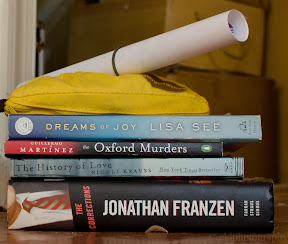
Evidence of the superfluity of books in my life: this wee pile was acquired whilst in Sundial Books, currently the best little bookshop in Chincoteague.

Monday, November 21, 2011

Books read in Chincoteague (2 of 7): Hell to Pay

his was a bit of a disaster for me. I think I encountered George Pelecanos mentioned among a list of the best DC based authors (including Marie Arana). When I heard he wrote crime novels set in DC, I had to read one. Unfortunately, the first chapter I attempted was not to my liking (I believe that was The Big Blowdown), and I dropped that attempt back at the library in favor of a different set of a characters and plot. Come some booksale, I picked up two more, and brought Hell to Pay along to the beach in hopes that it would be a good fluffy crime/thriller to keep me going.

Nooo such luck. If I could've gotten behind the writing the story might have been decent, but it seemed bogged down in vernacular (like the books written in a Scottish "accent"), not just in the characters' voices but in the narrator's as well. The overwhelming number of scenes drenched in sexual innuendo and indiscriminate flirtations were nauseating and unappealing and I didn't care in the least whether the crime was solved or not (although at the point I got to, a quarter of the way in, there had yet to _be_ a crime commited). So perhaps this is simply not the book, nor even the author for me. Oh well.


Washington, DC, New York Avenue, downtown, snow, traffic

Monday, April 18, 2011

Quotations, photos and ponderings, all. at. once.

    "You can live a lifetime and, at the end of it, know more about other people than you know about yourself. You learn to watch other people, but you never watch yourself because you strive against loneliness. If you read a book, or shuffle a deck of cards, or care for a dog, you are avoiding yourself. The abhorrence of loneliness is as natural as wanting to live at all. If it were otherwise, men would never have bothered to make an alphabet, nor to have fashioned words out of what were only animal sounds, nor to have crossed continents — each man to see what the other looked like. 
     Being alone in an aeroplane for even so short a time as a night and a day, irrevocably alone, with nothing to observe but your instruments and you own hands in semi-darkness, nothing to contemplate but the size of your small courage, nothing to wonder about but the beliefs, the faces and the hopes rooted in your mind — such an experience can be as startling as the first awareness of a stranger walking by your side at night. You are the stranger."
  Beryl Markham, West with the Night.


I already posted a passage from West with the Night, but since that was specifically relevant to the airplane post, here's a little more about the book itself: Generally, West with the Night is a ruminative, verbose, sweeping memoir that covers three notably distinct parts of Markham's life. After writing herself into the narrative, she takes the reader through her childhood, hunting lion with African locals, to leaving home and training race-horses, and finally to her career as a freelance pilot. 

So much of the book draws its strength from descriptions of people and places that the silence felt in the above passage is as startling to the reader as it is to Markham. The change from lengthy, illustrative passages about the African landscape and the characters who occupy it to the breathless and fleeting few paragraphs articulating her personal experience of flight parallels her assertion about loneliness. Most everything we do in our day-to-day lives is engineered to keep us from noticing that we are really very alone in the world, thus we keep self-awareness to a minimum in the interest of maintaining sanity. Even when physically alone, humans go to great lengths to avoid confronting themselves, whether by immersion in external stimuli, abuse of a substance, or simply by locking away their thoughts in a mental prison and living in denial of themselves. 

In conclusion, but not really to conclude this ongoing train of thought, West with the Night was an inspiring memoir not just in terms of tangible accomplishments and admirable writing, but in the additions Markham's personal philosophy made to my own modus operandi. Someday, I hope to meet myself.

Photo is of the Potomac River near Theodore Roosevelt Island, April 15, 2011.

Monday, November 15, 2010

Quotations: I have taught myself joy

In my own worst seasons I've come back from the colorless world of despair by forcing myself to look hard, for a long time, at a single glorious thing: a flame of red geranium outside my bedroom window. And then another: my daughter in a yellow dress. And another: the perfect outline of a full, dark sphere behind the crescent moon. Until I learned to be in love with my life again. Like a stroke victim retraining new parts of the brain to grasp lost skills, I have taught myself joy, over and over again.

Barbara Kingsolver, High Tide in Tuscon.

Friday, August 13, 2010

Demons of Simulacra

Just when you think you've perceived a subject clearly - just when the glass, or the light, or the peephole that has allowed you to observe it with certitude - nature fools you. Blame it on perspective, on distortions in the medium, on the demons of simulacra: You can't always believe what you see. In optics it's called an aberration - when light is imperfect, when rays fail to converge to a sharply defined focus. It can be due to a flaw, to the distance, or perhaps even to a failure in the optic nerve. Astronomers know this as the aberration of heavenly bodies: You think you see a star to the left, but in fact it is to the right, because, though every hair on your head is in place, you are reeling through the universe at considerable velocity. This is very like the moment when you gaze out the window of a moving car and the rain looks as if it is falling sideways. It is now. Its trajectory is a plumb line toward the center of the earth, following the brute pull of gravity. But if you are planted serenely in your seat, it is hard to factor that you are rushing along the earth's surface, and so what you think you see happening isn't happening at all.

Cellophane, Marie Arana, p. 255.

Tuesday, July 20, 2010

An Insufficiency of Data

Experience is a poor guide to man, and is seldom followed. A man really learns little by it, for it is narrowly limited in range. What does a faithful husband know of women, or a faithful wife of men? The generalizations of such persons are always inaccurate. What really teaches man is not experiences, but observation. It is observation that enables him to make use of the vastly greater experience of other men, of men taken in the mass. He learns by noting what happens to them. Confined to what happens to himself, he labors eternally under an insufficiency of data.

From Minority Report, H. L. Mencken's Notebooks
, Knopf, 1956, p. 248, nabbed from this page of Mencken quotes.

Saturday, July 17, 2010

The true shape of frontiers

"In the sad August of that year we made a trip to Mentone, ordering bouillabaisse in an aquarium-like pavilion by the sea across from the Hôtel Victoria. The hills were silver-olive, and of the true shape of frontiers.

Leaving the Riviera after a third summer, we called on a writer friend at the Hôtel Continental at Cannes. He was proud of his independence in adopting a black mongrel dog. He had a nice house and a nice wife and we envied his comfortable installations that gave the effect of his having retired from the world when he had really taken such of it as he wanted and confined it."


From Show Mr. and Mrs. F. to Number –, by F. Scott and Zelda Fitzgerald, May-June 1934, as in The Crack-Up, edited by Edmund Wilson.


Wednesday, February 24, 2010

...without man, it sank back into the realm of the unimagined and unconceived and hence into meaninglessness...

"...if, in his house in the mountains, he was being observed less and less, so rarely that, when he pointed his mirror telescope at people who he presumed were observing him from the cliff, they turned out to be observing not him but something else through their field glasses, chamois or mountain climbers or whatnot, this state of not being observed would begin to torment him after a while, much more than the knowledge of being observed had bothered him earlier, so that he would virtually yearn for those rocks to be thrown at his house, because not being watched would make him feel not worth noticing, not being worth noticing would make him feel disrespected, being disrespected would make him feel insignificant, being insignificant would make him feel meaningless, and, he imagined, the end result might be a hopeless depression, in fact he might even give up his unsuccessful academic career as meaningless, and would have to conclude that other people suffered as much from not being observed as he did, that they, too, felt meaningless unless they were being observed, and that this was the reason why they all observed and took snapshots and movies of each other, for fear of experiencing the meaninglessness of their existence in the face of a dispersing universe with billions of Milky Ways like our own, settled with countless of life-bearing but hopelessly remote and therefore isolated planets like out own, a cosmos filled with incessant pulsations of exploding and collapsing suns, leaving no one, except man himself, to pay any attention to man and thereby lend him meaning..."

-from The Assignment, or, On The Observing of the Observer of the Observers, Friedrich Dürrenmatt (Agee translation)


Dürrenmatt surprised me, when I opened the book and the chapter long sentences left me breathlessly trying to keep up with a hyperactive train of thought that continued until it found its destination: the sub-text. (I would try to pull off un-punctuation here, but I just haven't got it in me right now. A few long sentences will have to suffice.) I think that kind of free-form, rolling structure left the book much more open to exploring the ideas behind the text because the characters were not immersed in keeping track of "he said, she said" and all sorts of awkward exposition. The point of the book is definitely not the plot. I've been considering the difference between "literature" and popular novels lately, and it seems like "literature" is more often about the ideas behind the story, while popular works are more plot-centric. These of course follow Freytag's dramatic arc of exposition, rising action, climax, falling action, and resolution (also see Aristotle's Poetics for a good lesson in why your writing isn't up to snuff). The Assignment does follow the same arc, but manages to sound like voices in your head rather than words on a page, thus, at least for me, expressing itself without needing analysis.

And if any of my writing about books seems a bit odd, it's because I've been voraciously reading Jasper Fforde's Thursday Next series. By book four I've grown to accept the fact that popping in and out of chalk pavement pictures books and working alongside fictional characters like Emperor Zhark and Hamlet is just as normal as time travel. Highly recommended, although I haven't finished books four and five just yet.

Monday, October 26, 2009

I have no words


Last fall I was beginning to explore ideas for my Plan of Concentration project in the world of children's books and attended a book making workshop with Linda Lembke of Green River Bindery. At that point it was my intention to create my own wordless picture book using my own photographs to tell a semi-autobiographical story. The original concept was a little too much to execute in the time I had, so the eventual product was simplified considerably (result is the purple book with the leaves at left). Now apart from the fact that the Brattleboro Museum and Art Center (BMAC) is awesome (It's one of the things that enamored me to Brattleboro in the first place, thanks to an Andy Warhol exhibit) there's the fact that I love children's books and bookbinding as an art. So, all of this led to my being at an exhibit of artwork from Kaori Hamura's book Dream Seasons, a wordless narrative illustrated with stylized paintings on wood (if you like paintings on wood, also check out Audrey Kawasaki). The exhibit also included a list of other wordless children's books and related works, and I thought I'd share some of it here. The list was originally produced by BMAC, but I'm adding a few books of my own, as well.

Wordless Children's Books
David Wiesner is pretty good at purely illustrated stories, and wildly popular, too. My favourites are Tuesday, and Sector Seven, but there's also Flotsam and Free fall and a few others. He's very adept at putting the extraordinary into a context that makes it seem quite, well, ordinary, as in the cloud factory in Sector Seven, but while maintaining a sense of wonder, as in Tuesday.

Chris Van Allsburg put together a book of illustrations that are explained only by a single line of text that merely alludes to a greater, unknown story and inspires plenty of speculation among readers. The Mysteries of Harris Burdick goes under wordless books for me because so much of the value of the book comes from what the reader's mind creates to fill in the whole story behind each illustration.

The Arrival
by Shaun Tan is just a plain beautiful book. It's more of a graphic novel, with many, many detailed illustrations in order to get the story across, but still with plenty of room for imagination (which is what I think wordless books are really all about).

A few more, which you may look up on your own (builds character):
Home, by Jeannie Baker
Museum, by Barbara Lehman
Oops, by Arthur Geisert
The Red Book, also by Lehman
The Snowman, by Raymond Briggs
Trainstop, also by Lehman
Un-brella, by Scott Franson
Yellow Umbrella, by Jae-Soo Lui

If you're into this sort of thing, go check out the tag lists for Wordless, Stories Without Words, and Wordless Books on LibraryThing.


Do you prefer book links to LibraryThing or to Amazon? I think LT provides more information on a book, but if you want to go buy it right away you might want Amazon. However, I highly recommend hunting down books at your local bookshop, or at least clicking through a website like FlashlightWorthy, which provides awesome books lists and could use some support. If you're actually reading this, why not comment? Comments are constructive!