Showing posts with label computer. Show all posts

Wednesday, July 6, 2011

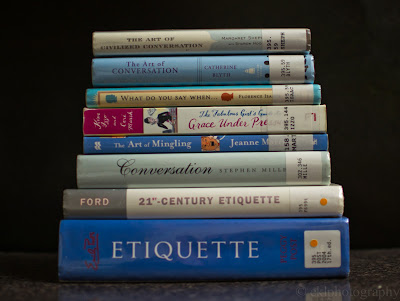
Mini reviews: Etiquette and conversation, or, "An echo is sufficient"

any of the books I looked through in search of advice on how to be a good conversationalist made the same points: remember that you are conversing with someone, not interrogating or soliloquizing.  What I'm looking for is how to ask good questions, what topics to bring up and just what to say in general. Many sources point out the usual topics: weather, travel, news, even the forbidden politics and religion, and strongly recommend against talking about yourself. The easiest way to remember this is to avoid using "I" and "Me" as much as possible. It can be tricky at first and often leads to getting even more tongue tied, but making conversation or writing without the dreaded personal pronouns is an entertaining challenge.

Emily Post's EtiquetteEtiquette focuses on how to be polite and interact appropriately in any situation. The seminal work on traditional etiquette is perhaps my favourite reference out of all that I read through because it takes a more conservative view of manners and proper conduct. Sadly, the young men whom I ran some of Post's points past were more of the opinion that the "liberated woman" doesn't need the door held, her dinner paid for, or any sort of special consideration. She is equal, therefore she is one of of the guys! Mais non, the liberated woman just doesn't want to do all the damn dishes herself. Again.

Grace Under Pressure- This is the book of tactics for those situations you'd never admit to being in. Pulling your reputation back together after a mishap at the company party, getting by at an ex's wedding, and generally how to be gracious and sensitive no matter what. On conversation: a good section on how to start conversations, balancing questions and responses, listening (which makes all the difference when it comes time to reply), getting out of bad small talk, insults, and introducing yourself to strangers. Comes with entertaining anecdotes and scandal (clearly the selling point: this would never be me!).

21st Century Etiquette- Frankly, don't bother with this one. Outdated references to electronic mail and chatrooms, "teens" as children, slightly condescending "quizzes" at the ends of chapters and generally a bit simplistic.  And there wasn't much on conversation.

What do you say when...- More quizzes. I suppose this is a style, as if it were a workbook, but I don't love it. Also a more traditional viewpoint with some good thoughts, and short, so a quick read. There's a good section on romantic meetings that also applies to platonic interactions and meeting new people. Worth it because the book is dedicated to conversation.
books, etiquette, conversation, manners, review, library

The Art of Mingling- Finally, we get past some of the more clichéd approaches (Haven't I seen you somewhere before?) to ideas on how to continue the conversation. Some of the ideas will sound pretty awkward ("This party is a virtual utopia" comes from the a-z list of words to build from when at a loss), but there are plenty such as watching from afar with another wall flower, asking a group a random question to poll responses and start a debate and so on. Kind of dorky to be seen with, but essentially quite useful.

Conversation: A History of a Declining Art- Certainly this is the most expansive and in-depth of all those I checked out... which unfortunately means I did not have time to read it in its entirety. However, I can say that having skimmed a bit, it looks to be perhaps more useful than any of the aforementioned because not only does it include methods from historical conversationalists (hello, Socrates?), but it's actually worth talking about the subject matter when you're done. Will take this one out later to read in full.

Then we come to The Art of Conversation and The Art of Civilized Conversation. Different authors and publishers, but you can just see the expression on the face of the former when she discovered the latter. These are both dense, full of lists, do's and dont's and bullets. The first, however, has the following passage:
"In the 1960s... computer pioneer Joseph Weizenbaum created Doctor, a software program that adapted a psychotherapy technique for bouncing back patients' statements as questions:
User: I have been rather depressed lately.
Computer: Are you depressed often?
User: Yes, almost all the time.
Computer: Why do you say yes almost all the time?
User: Right now I feel like I could cry.
Computer: Is it because right now you feel like you could cry that you came to me?
One morning he was appalled to discover his transfixed secretary at a computer, unspooling her sorrows into Doctor's clunky, copycat code. ...So the thought that an echo is sufficient to convince us we're being listened to, that the bogus Doctor could seduce the secretary, carries the degrading suggestion that much of human complexity—those worries and wonders we store up and long to share—may also be illusory, empty, and that we are mere bundles of reactions, mysterious and meaningful only to us."

Thanks to the Arlington VA public library for having all these books and putting them on hold for me.

Friday, May 13, 2011

Junk information

books, bookstore, shelves

There's a lot that's been written lately about how much information is available to us through the internet and out in the world. It seems as though people are overstimulated and yet somehow uninspired, almost stifled by the options available. Calvin's dad once had a fit about the wide variety of peanut butters available in the grocery store. It's kind of like that. 

So there are tweets and Facebook posts at the bottom of it, meaningless snippets, but capable of sucking away half a person's day. One level up are blogs, newspaper articles (online or not) and magazines. While these are slightly more in depth discussions or examinations of a topic, a couple of pages are most often not sufficient for true thoroughness. A really well written article can, however, inspire further investigation on the part of a reader by prodding their curiosity and providing a vivid window into the subject.

Here are some bits and pieces of associated information that I've pulled together here. My favourite is a quotation from a professor Aitken, who I referenced in my thesis on childhood memory a few years ago. Aitken suggests that the best way to understand or memorize something is to love and care about it first and seek meaning in it, giving yourself context and motivation for information retention, as well as a more complex understanding of the subject through muti-layered assimilation. 

"The thing to do is to learn by heart, not because one has to, but because one loves the thing and is interested in it." -Professor Alexander Craig Aitken (Ian M.L. Hunter, “An Exceptional Memory,” In Memory Observed: Remembering in Natural Contexts, ed. Ulric Neisser (New York: Worth Publishers, 2000), 515.) 
And on the subject of tidbits versus comprehensive:
Many of us worry about a decline in deep, reflective, cover-to-cover reading. We deplore the shift to blogs, snippets, and tweets. In the case of research, we might concede that word searches have advantages, but we refuse to believe that they can lead to the kind of understanding that comes with the continuous study of an entire book. Is it true, however, that deep reading has declined, or even that it always prevailed? Studies by Kevin Sharpe, Lisa Jardine, and Anthony Grafton have proven that humanists in the 16th and 17th centuries often read discontinuously, searching for passages that could be used in the cut and thrust of rhetorical battles at court, or for nuggets of wisdom that could be copied into commonplace books and consulted out of context. - Robert Darnton, "Five myths about the 'Information Age" The Chronicle of Higher Education, April 17, 2011.
Lastly, some associated bits on multitasking, technology and focus from NYTimes and elsewhere can be found starting with this here blog post.


Photo from Capitol Hill Books, winter 2011. Not junk information?

Sunday, May 2, 2010

To think, to write...


Four years ago, I packed up my life and moved it all 500 miles to one small town on the top of a hill in Southern Vermont, without a damn clue what it would turn into for me. I may wax poetic about it all for years, in hindsight, in retrospect, whatever shades that might tint the memories. Everything wasn't always perfect, but the town of Marlboro felt like *home*. But before Marlboro, there was another me. A me who filled journal after journal with tiny cramped writing, drawings, designs, and lord-knows-what workings of teenage consciousness (the first image in this post is a quick view of some pages from an old journal of mine, and two books I hand-bound on the edges of the frame). Most of the writing probably isn't worth reading, but the way I lay out the text and sketches, sometimes weaving strands of text into images makes the journals visually appealing, a flip-book of nostalgia. Once I got to Marlboro I stopped writing and sketching after one journal of nothing but text. My question is, why did I stop? While I'm not prepared to completely answer that yet, here are some thoughts on the subject:

First, why did the content shift to text-only? Was it because I felt I didn't have the time to commit to more sincere creations on the pages? Because I felt my sketches and layout concepts were piddly, and not worth putting on paper? How could I be more self-conscious in college than in High School? My intent in keeping the journals was always that someday, someone would read them. Whether that would be a progeny or a historian, an alien anthropologist... Or maybe I thought they would fall into someone's hands sooner than that, and prove how awesome I was. With that in mind, I suppose the shift was because I started sharing more with people face to face at college, and didn't feel the need to record everything on paper for future transmission.

And then why did I stop writing entirely? Even at times when I could have used some introspection, I didn't write... at least not in paper journals. I began emailing, using Facebook and Twitter, recording my movements and thoughts in communications and snippets. Microblogging. This, so far as I'm concerned, is a significant step down. Maybe even a slide. Then again, I'm not sure all that introspection helped me develop much at the time, either.

I don't know if trying to restart my journaling is a mistake or not (my own version of NaNoWriMo... whatever month it may be). But if I think "nothing I do is worth recording, not the entire day, certainly" then I'm only discouraging myself. Maybe I became more private, in an odd, long-term way.

... and here I am blogging about it. Hopefully posting this will make me more inclined to journal at least once a week...

Friday, October 2, 2009

Wishful listing

Dear Santa,

This year for Christmas I would like to receive the following...

My computer has been acting up lately, fighting back against my overuse by occasionally turning itself off and complaining constantly, or just refusing to comply with my commands. Don't get me wrong, I love my little iBookG4, especially because it still runs OS9 applications (read: games, aka Power Pete, which technically came with OS7), but if I could relieve it of some of its burden we'd both be happier. I'm torn though. Since I also need my computer to be able to handle advanced graphics work, a desktop with a tower and wide-screen might be best, but I'd also like a more competent laptop... For now, the 15 inch solid state MacBook Pro (previous link) would fill in fine; I can always add the larger display later. And the Mac Pro Nehalem can just wait until I pick up the Epson 9900(with orange and green inks. whoa).

Meanwhile, my communications capabilities are suffering from another case of outdated technology. Three years of being in my left pocket have been hard on my Nokia. At the same time, my ipod classic did the thing ipods do and broke its headphone jack, and quite likely has a hard drive failure as well. My immediate thought was to get another ipod, but as it turns out I might as well get an iphone 3GS 32 GB and solve both problems at once. And again, the solid state drive will help a lot when it's bouncing around in pockets and bags. Next issue: bluetooth earbuds/headset and laser keyboard (although I'd prefer if it were a smaller device. If only someone would develop it further!).

If I'm going to be getting that Epson 9900, I should really also have a digital camera. I'm conceding the point of digitization in photography only because buying a few medium-large format film cameras (with lenses and different backs), learning colour processing and setting up a colour darkroom (or at least getting a film scanner and settling with the printer) all poses slightly more difficulty than spending a few grand on two pieces of equipment. A quick browse through some old Photocritic posts pointed me at the Nikon D90, but further research and recommendations are welcome.

On a less selfish note, a good way to connect with other artists/photographers in the area is to hunt down your local darkroom. The Washington School of Photography, for instance, has a camera club and workshops for community members.

...Anyway, Santa, I don't know how to prioritize my phone, computer and camera needs, but there you have it. My best to Mrs. Claus and all the elves. See you in two months!

Yours,
Elli