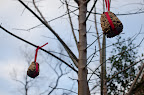
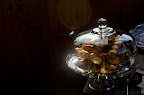
Here's a selection of photos from things done in the days betwixt holidays this last month. Some crafty stuff, some baking stuff, some decorations... A decently festive month, indeed.
Saturday, December 24, 2011






Monday, December 19, 2011
Quotations: Calvino
n the shop window you have promptly identified the cover with the title you were looking for. Following this visual trail, you have forced your way through the shop past the thick barricade of Books You Haven't Read, which were frowning at you from the tables and shelves, trying to cow you. But you know you must never allow yourself to be awed, that among them there extend for acres and acres the Books You Needn't Read, the Books Made For Purposes Other Than Reading, Books Read Even Before You Open Them Since They Belong To The Category Of Books Read Before Being Written. And thus you pass the outer girdle of ramparts, but then you are attacked by the infantry of the Books That If You Had More Than One Life You Would Certainly Also Read But Unfortunately Your Days Are Numbered, with a rapid maneuver you bypass them and move into the phalanxes of the Books You Mean To Read But There Are Others You Must Read First, the Books Too Expensive Now And You'll Wait Till They're Remaindered, the Books ditto When They Come Out In Paperback, Books You Can Borrow From Somebody, Books That Everybody's Read So It's As If You Had Read Them, Too. Eluding these assaults, you come up beneath the towers of the fortress where other troops are holding out:
the Books You've Been Planning To Read For Ages,the Books You've Been Hunting For Years Without Success,the Books Dealing With Something You're Working On At The Moment,the Books You Want To Own So They'll Be Handy Just In Case,the Books You Could Put Aside Maybe To Read This Summer,the Books You Need To Go With Other Books On Your Shelves,the Books That Fill You With Sudden, Inexplicable Curiosity, Not Easily Justified.Now you have been able to reduce the countless embattled troops to an array that is, to be sure, very large, but still calculable in a finite number; but this relative relief is then undermined by the ambush of the Books Read Long Ago Which It's Now Time To Reread and the Books You've Always Pretended To Have Read And Now It's Time To Sit Down And Really Read Them...
From If on a Winter's Night a Traveller, by Italo Calvino. Wonderful book, you should go read it.
Saturday, December 10, 2011
Books read in Chincoteague (7 of 7): The Cabinet of Curiosities

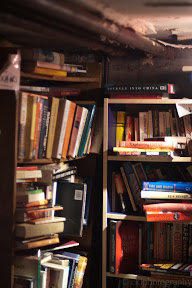 This level of complexity largely stems from the wide array of contributors to this steampunk confluence, including Garth Nix, Tad Williams, Cherie Priest (of Boneshaker) and Alan Moore. While there were amusing oddities described in brief at various points in the book, the short stories have continued to stand out in my mind. The Relic, a story of a sand-bound church and its odd holy item, has stuck with me most. Some of the content felt mildly forced from the authors' pens, as if they had a story to tell, but had to include that one pesky element (the curiosity). The best written works used the items from Lambshead's cabinet, or snippets about the Doctor himself (because, of course, he was a doctor) to explore into a corner or two of the world set before them. This difference lies between the authors who tried to make the curiosities fit into a world of their own and those who used the curiosity to explore Lambshead's world.
The art is also a wide sweep of varietals, ranging from detailed penwork to signature styles to collaged photographs used to illustrate the [wholly imaginary] cabinet. This is a most impressive anthology, which I will be pleased to keep on my shelf and sometimes flip through to reread a passage or two.
The accidental harmony of the trenches during the war produced, sometimes, odd acquaintances... "Well, that's a proper cup," Russell said softly, as the smell climbed out of the teapot, fragrant and fragile. The brew, when he poured it, was clear amber-gold, and made Edward think of peaches hanging in a garden of shining, fruit-heavy trees, a great sighing breath of wind stirring all the branches to a shake.
"It'll be all right, you know," Russell said. He rubbed a hand over the teapot. "I don't like to say, because the fellows don't understand, but you see him, too; or at least as much of him as I do... I don't know his name," Russell said thoughtfully. "I've never managed to find out; I don't know that he hears us at all, or thinks of us. I suppose if he ever woke up, he might be right annoyed with us, sitting here drinking up his dreams. But he never has."
Lord Dunsany's Teapot, by Naomi Novik, from The Cabinet of Curiosities.
Wednesday, November 30, 2011
Books read in Chincoteague (6 of 7): The Shipping News
 arlier in this week of reading I very quickly judged a book to be not-my-type. The same could have happened with The Shipping News, but for the fact that Annie Proulx's writing style (unique, fragmented thought-blows of sentences) drew me in, the hope that things would improve for Quoyle, our protagonist, and the knowledge that the book did pick up in mood after the first few chapters. It was well worth it, and that very same point winds up being the heart of the book.
The early descriptions of Quoyle make him out to be a lumbering clod, barely capable of speech, unattractive in every way, making the reader feel the self-loathing of a young man lost in a highly critical world. As he begins to let his voice be heard, more of his own character comes out, slowly and painfully, and the story moves forward as we get to know him and he gets to know himself. While the beginning of the book is one calamity after another, Quoyle sticks with it and keeps plodding along, going where the winds take him until his fortunes right themselves.



Once I was inside this world, I stopped wanting to leave. One of my favourite quirks in the book is Quoyle's habit of creating impromptu newspaper headlines about the world around him ("Man with Hangover Listens to Boat Builder Project Variables"). There was also the warmth of the closeknit community in the Northern reaches, the intriguing history and mystery of each character and the town, even an abandoned village on a desolate island. I made a point of never checking the publication date on Shipping News, because it sits fairly happily in the near-present, comfortably familiar and nonspecific. Come to think of it, this was probably my favourite book of the week.
"There are four women in every man's heart. The Maid in the Meadow, the Demon Lover, the Stouthearted Woman, the Tall and Quiet Woman."
Monday, November 28, 2011
Books read in Chincoteague (5 of 7): Rereadings
 nother weakness: anything with Anne Fadiman's name attached to it. Rereadings is a collection of book reviews that Fadiman ran whilst at The American Scholar literary quarterly. Each review is a rereading of a book the reviewer (usually a writer themselves) had read long in their past. As Fadiman points out, each is more of a mini-memoir than a review of the book itself. Since I seem to currently be into memoirs and essays, this suited me just fine, plus the entire book is making recommendations for further reading! As if I needed more to read!
The eventual conclusion that each review comes to is: Everything Changes but the Past remains the same. The reviewers largely find themselves rereading with more perspective and experience, but remember their old selves, motivations and weaknesses (their ignorance and their bliss) vividly through association with the text. It makes me incredibly happy to hear others talking about their love of books, and how a life of reading has bolstered a life of writing. These aren't great literary accomplishments, these reviews, but they are familiar, as if hearing a friend tell you a long story after dinner in order to make the point: you might like the book, too.
"It never occured to me that the need to catalog the stuff of everyday life might be a sign that the authors I loved were loners and misfits. Normal people, after all, don't stand around at garden parties or lie in bed with their loved ones trying to figure out what even the smallest ordinary gesture means."
-David Samuels, Marginal Notes on the Inner Lives of People with Cluttered Apartments in the East Seventies, a rereading of J.D. Salinger's Franny and Zooey.
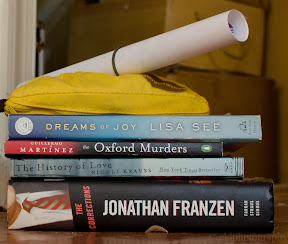
Evidence of the superfluity of books in my life: this wee pile was acquired whilst in Sundial Books, currently the best little bookshop in Chincoteague.
Friday, November 25, 2011
Books read in Chincoteague (4 of 7): Boneshaker
 or once, the cover blurb is entirely accurate: "A steampunk-zombie-airship adventure[!]" Really, what more do you need to know? And yet, the characters in Cherie Priest's Boneshaker do go a bit deeper than that. They have emotional needs, frailities, a search for a father and role model, a last hope for lost love, an avoidance of kinship at the same time as a frantic search for the same. Not to mention attempts to understand another culture, come to terms with a violent history and guilt (over the same), and yes, the book contains a map.
 In the desolate wastes of an alternate Seattle it's every man for himself, except when he feels the need to assuage his guilty soul by coming to a comrade's aid, but it's also all men against the undead, the darkness, without and within. Things can be simple and full of comaraderie in a society with a common enemy. And yet, men and women turn against each other in order to save themselves, to avoid or fight their inner demons, always always putting the self first, for there is very little true altruism in the world.
The book was pretty good, a fascinating and light frolic through a fledgling universe with some mystery thrown in along the way. The steampunk aspects are not obnoxiously overwhelming, but the "blight" victims (the zombie hordes) seem a little gratuitous (I think this is pretty much always the case with the undead). At four hundred fourteen reasonably dense pages, I could have gone for a lot more detail of the world and development of some of the characters' relationships. I'm told there are further developments to be had in subsequent novels.
Wednesday, November 23, 2011
Books read in Chincoteague (3 of 7): Not Becoming My Mother
 eople of first world countries in the twenty-first century have a tendency to take an awful lot for granted. While many in democratic society worry that their freedoms are shrinking, it also seems as though they are expanding. Even a few decades ago a more conservative U.S. might not have put up with the diatribes of certain "grassroots" movements, more likely dismissing them outright as being incoherent and extremist. Today we still have the great benefit of an equal voice for all, even though some may be less deserving of serious consideration.
 All of which is, for some reason, leading up to my notes on Not Becoming My Mother, this short memoir by Ruth Reichl about her mother's search (somewhat in vain) for a life as a non-homemaker in the middle of the 20th century. I have a certain weakness for reading about the lives of others, who, while not consequential or influential on any grand scale, have at least merited some well-written words and a bit of immortality on the bookshelf. No one is really inconsequential, in the big chaotic world of butterfly wingbeats, but some are significant only to a small circle of fortunate insiders.
 Reichl's search for her mother's story focuses on the the fortunes of mid-century homemakers, facing proud and territorial husbands in a difficult job market after the Depression and World War II. Reichl had originally made the mistake of assuming that everything changed to roses for women after the 19th Amendment was passed. In truth, society took much longer to adjust to the change, and families behind closed doors longer still. Traditional patriarchal values (often maintained by the physically larger and stronger sex, and accepted by women who aren't sure how to do otherwise) still linger today. Reichl's mother did her best to instill deep seated independence and self-reliance in her daughter, such that she might never feel the need to ally herself with a husband in order to get by. Anyway, the thing was inspiring, comforting and entertaining, a quick read. Recommended.
Monday, November 21, 2011
Books read in Chincoteague (2 of 7): Hell to Pay
 his was a bit of a disaster for me. I think I encountered George Pelecanos mentioned among a list of the best DC based authors (including Marie Arana). When I heard he wrote crime novels set in DC, I had to read one. Unfortunately, the first chapter I attempted was not to my liking (I believe that was The Big Blowdown), and I dropped that attempt back at the library in favor of a different set of a characters and plot. Come some booksale, I picked up two more, and brought Hell to Pay along to the beach in hopes that it would be a good fluffy crime/thriller to keep me going.
Nooo such luck. If I could've gotten behind the writing the story might have been decent, but it seemed bogged down in vernacular (like the books written in a Scottish "accent"), not just in the characters' voices but in the narrator's as well. The overwhelming number of scenes drenched in sexual innuendo and indiscriminate flirtations were nauseating and unappealing and I didn't care in the least whether the crime was solved or not (although at the point I got to, a quarter of the way in, there had yet to _be_ a crime commited). So perhaps this is simply not the book, nor even the author for me. Oh well.
Friday, November 18, 2011
Books read in Chincoteague (1 of 7): Catch-22
 s I finally wrapped up the last chapters of Catch-22 and went to enter this triumph in my book log, I discovered that I had begun this one not just months ago, but last November. Horrors, that I had left a book neglected for so very long, thinking that I wasn't in the mood for it, not giving it a chance. Well, to be fair, I probably wasn't in the mood for it, nor would I ever have been, but finally, on the porch swing overlooking the marsh, I at least felt comfortable enough to forge my way through the latter third of Catch-22 without going crazy myself.
Having been told by two reliable sources that this was a hilarious read, full of wit and whimsy, albeit dark whimsy, I figured I ought to at least give it a chance, read the whole damn thing and be able to reflect on it. Having done so, I'm glad I did, but the journey was one of the most depressing I've been on, stretching thin my last shreds of faith in a decent world.
Anyway, horrifyingly obtuse and, yes, hilariously conniving as Colonel Cathcart and Milo are, clearly this is a pretty good book because it did _get to me_. And I did understand Yossarian's plight, the desperation and the confusion, the fear that the world really is nuts, that this must be some deep level of punishing inferno, and the emotional grasping at what few friends could be found in the midst of war.
What spun me for the greatest loop was the ending. I guess I shouldn't say here, (oh, heck: SPOILERS!) but it didn't seem in keeping with the rest of the book. In fact, I was so thrown by the ending that I felt certain I missed an important detail and Yossarian was deep into some fever dream, or was heading off for the promised land. The entire last two chapters or so took a sharp left and nearly tossed this passenger out around the curve. I suppose I'm glad it ended the way it did, with a hope for the future, an open ending and striking out for a new world. All is not lost, life goes on, "persevere."
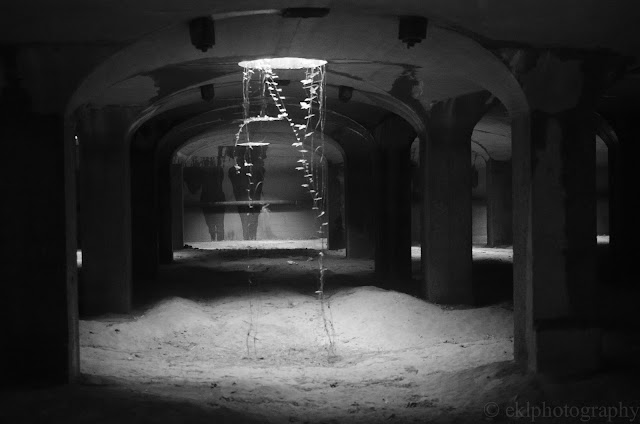
Not sure the photo is relevant, but since I didn't have anything that really is... this underground catacomb is from an exploration of the old McMillan sand filtration site in NE DC I did with DCUrban Explorers in late October.
This review also appears in part on LibraryThing.
Thursday, November 17, 2011
Books Read in Chincoteague (0 of 7): Introduction
 am a reader. If I could be The Reader I would be, but in this day and age it seems that all of the archetypes have all been claimed, and all one can do is occupy an indefinite article.
In order to avoid a[nother] rant about [the sad state of] contemporary society, I will simply describe the situation, the setting for the seven posts I will make in the forthcoming fortnight. Once a year, every year for the last [20+] my family has vacationed in a small cottage on Chincoteague Island for a week. When I was smaller and/or younger, the purpose included daily trips to the ocean for sandcastle making and mole-crab catching, mom-made sandwiches and hours spent sitting in the porch swing listening to books on tape.
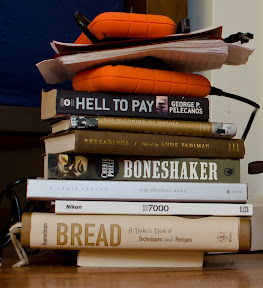 Now the entire purpose seems to be to bike around the [nice, flat] island a bit, go for a long walk or two on [what's left of] Assateague Island and spend as much time as possible reading book after [quality] book. In my teens, I blazed through every book Anne McCaffrey had written in the space of approximately 48 hours (Slight exaggeration. May have been 72.). While I'm still not reading Joyce and James and Dostoevsky in the space of hours, I did manage a few decently mature books in the space of a week; a book a day for soothing a soul.
And, somehow, the books I brought along matched my mental state and future-goals with aplomb. Each stood up and made its point across time and space, reaching me through excellent authors, stories and words.
The overarching themes in a nutshell: From The Shipping News to Catch-22, a frabjous sense of optimism or hopeless-hope in the face of disaster, despair and delirium (Endless tie-in!), lessons on the paths we take through life to the place Ruth Reichl's mom teaches us to be: unshakably within our selves.
Then, from Boneshaker back to Shipping News, a sense of community and grand purpose pervading humanity in times of challenge and need. Reichl's mother proselytizes steadfast self-confidence, but the citizens of Proulx's Newfoundland will tell you: in the end, only the wind and the sea will have their way.
Stay tuned for seven (7!) upcoming (short) book reviews...
Then, from Boneshaker back to Shipping News, a sense of community and grand purpose pervading humanity in times of challenge and need. Reichl's mother proselytizes steadfast self-confidence, but the citizens of Proulx's Newfoundland will tell you: in the end, only the wind and the sea will have their way.
Stay tuned for seven (7!) upcoming (short) book reviews...
Subscribe to:
Posts (Atom)